Gerald McCormack, CINHT,
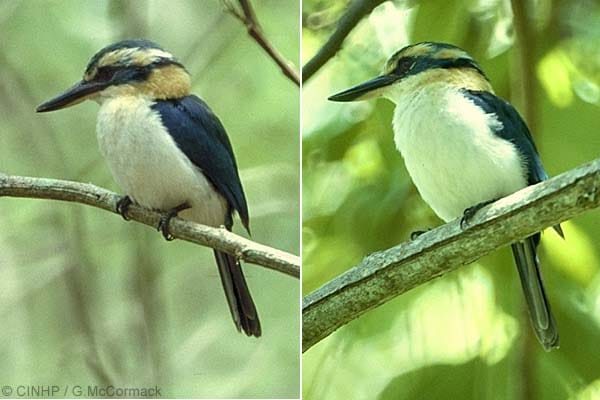
The landbirds which breed on Mangaia, the resident landbirds, can be divided into those introduced by people (the introduced landbirds) and those which arrived naturally (the native landbirds). Continue reading →
Gerald McCormack, CINHT,
The landbirds which breed on Mangaia, the resident landbirds, can be divided into those introduced by people (the introduced landbirds) and those which arrived naturally (the native landbirds). Continue reading →
Gerald McCormack, CINHT
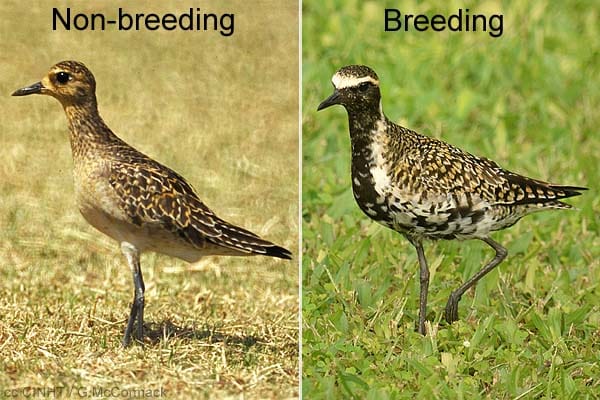
On the airport, golf courses, sports fields and larger lawns of the Cook Islands the Common Mynah (Manu Kavamani, Acridotheres tristis) is busy feeding throughout the year. During the summer months they are joined by the Pacific Golden-Plover (Pluvialis fulva), which is dark brown with pale spots, has long dark grey legs, and a short straight beak (24mm). The plover has an erect alert posture, giving it a height of about 25cm. For convenience we can combine its name and where it is found, to call it the “plover-of-the-grass”, although it is also seen along the shoreline. When alarmed the plover-of-the-grass gives two or three short “TUUU-REE” calls as it takes to the air. Continue reading →
Gerald McCormack, CINHT
The Red-tailed Tropicbird (Tavake Phaethon rubricauda) is a snow-white seabird with a red bill and slender red tail. It nests during the winter months in moderate numbers on the cliffs behind Avarua and is often seen flying over the island. It has a raucous call and performs dramatic loop-the-loop courtship displays. The largest Cook Islands colonies are on Takutea (near Atiu), Suwarrow, and Palmerston and a small population on Mā’ina-iti, Aitutaki.
It is a rare nester on most peopled-atolls because it is a favourite traditional food and domestic dogs often disturb the nests. Palmerston is an interesting exception because the tropicbird remains common despite more than a hundred years of harvesting. The secret of its survival has been that Palmerston islanders harvest the “mature” nestlings only every 28th day, and enough fledge between harvests to maintain the colony.
Gerald McCormack, CINHT
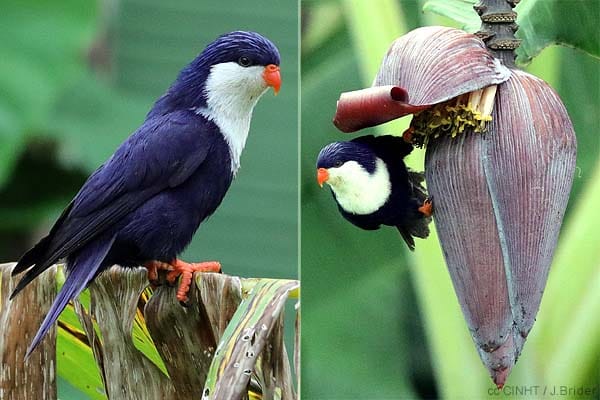
The Blue Lorikeet (Vini peruviana ) is a native bird of French Polynesia, formerly existing on about twenty islands in the Society Islands (including Tahiti) and the northern Tuamotu atolls. In recent years it has been lost from Tahiti and all the main Society Islands, surviving only on three remote atolls to the northwest (especially Bellinghausen/Motu One) and on three or four atolls of the Tuamotus. Continue reading →
Gerald McCormack, Director, CINHT
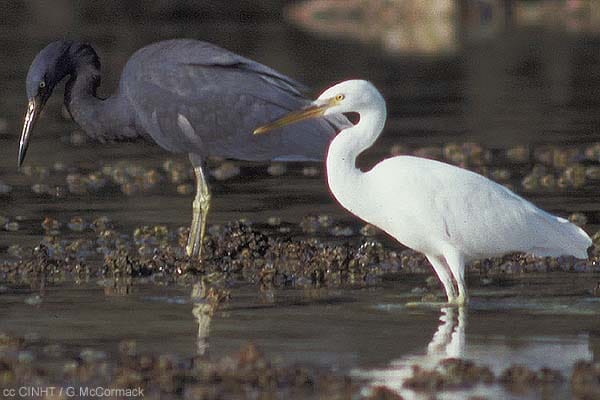
The Pacific Reef Heron (Kōtuku, Egretta sacra) is the fowl-sized, hunch-backed bird stalking in the shallow waters of the lagoon and in inland swamplands and streams. It grabs or stabs small fish and invertebrates with its large sharp beak by suddenly extending its long neck, at times assisted by a forward dash. Sometimes they extend their wings and run back and forth to herd small fish before lunging in for the kill. Continue reading →