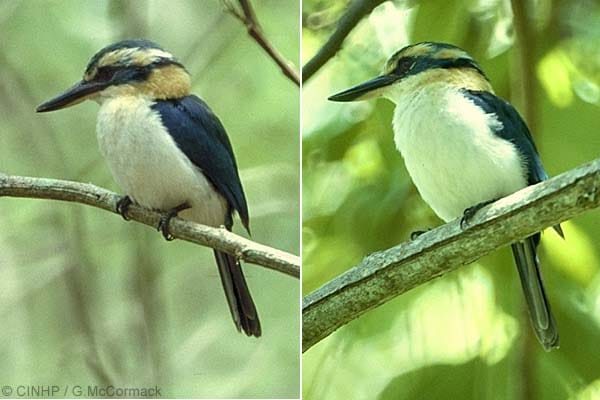
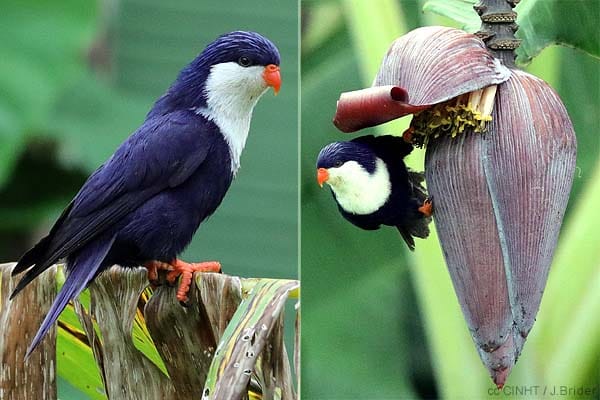
Mangaia

The Status of Cook Islands Birds -1996

The Status of Cook Islands Birds -1996

Gerald McCormack, CINHT

The Cook Islands is fifteen small islands (total land area 240km²), scattered over an area approaching the size of Western Europe, in the tropical South Pacific. Although the 18,000 residents, almost all Polynesian, carry New Zealand passports, the country has been internally self-governing since 1965, and is independently responsible for all environment matters.

Two divisions of Government are specifically concerned with the environment: (1) the Environmental Service (formerly the Conservation Service) implements the environment act, with a special emphasis on Environmental Impact Assessment; and (2) the Natural Heritage Project undertakes research, and prepares publications, to integrate traditional and scientific knowledge on all aspects of the environment. The latter project, formalised in 1990 by the Prime Minister, Sir Geoffery Henry KBE, is unique in the South Pacific.

The limited availability of specialist staff, and of financial resources, has meant that overseas volunteers and funding have been of fundamental importance in monitoring and maintaining the inherently fragile terrestrial and coral-reef ecosystems. Land is under family-inherited ownership and, although it cannot be sold, a small amount is leased to the Government and to non-family people.

The fifteen islands divide socially and physically into a Northern Group of six islands and a Southern Group of nine islands. The five atolls and one sand-cay of the Northern Group, support extensive Coconut Palm plantations for a fickle copra industry. The only resident landbird is the Pacific Pigeon (Rupe, Ducula pacifica), which lives on three atolls, feeding mainly on the fruits of the indigenous Beach Gardenia(Ano, Guettarda speciosa).

Continue reading →

Posted by Gerald in Animals, Birds, 0 comments
Mato – Cyclones Make it Flower

Mato – Cyclones Make it Flower

Gerald McCormack, CINHT

Flowering Mato tree – Rarotonga, Cook Islands – Gerald McCormack

Rarotonga has one of the last pristine native-forests in Polynesia. The ancient Polynesian settlers removed the forest on the lower hills and as these became infertile they developed into the Fernlands. After European Contact, especially after 1823, many new plants were introduced and some of these were planted in the mountains, especially cotton, coffee, and bananas. A Disturbed Forest of Tree Hibiscus (‘Au, Hibiscus tiliaceus) and invasive shrubs now cover these areas. Inland of the Fernland and the Disturbed Forest there remains a near-pristine native forest, protected from people by being too steep for horticulture and by the absence of trees suitable for timber. Continue reading →

Posted by Gerald in Plants, 0 comments
New Bird on Mangaia Identified

New Bird on Mangaia Identified

Gerald McCormack, CINHT

Adult and Juvenile Chestnut-breasted Mannikin – Mangaia, Cook Islands – Gerald McCormack

In the CI News (13 May 2006) Sue Ngatokorua described a new bird on Mangaia, and the author suggested it might be a Chestnut-breasted Mannikin (Lonchura castaneothorax). In late May Peter Ngatokorua, who provided the original information for the news article, took Ian Karika and the author to see the birds in Veitatei swamp, and they were confirmed as Chestnut-breasted Mannikins. Groups of up to 30 were seen, and the population might be near 100.

Peter and others had concluded that the bird arrived naturally, because arrival of any cage bird would have sent the inevitable buzz-of-curiosity throughout the Mangaian community. To honour the birds’ great flight to Mangaia, Peter had suggested it be called Toa Kere-ā-Rangi, literally “mighty warrior of Rangi”. While other Veitatei planters suggest it should be named Pātiki-‘Enua-ō-Rangi, an alternate name for Veitatei district, where it was first seen in 1999. Continue reading →

Posted by Gerald in Animals, Biodiversity, Birds, Introduced Species, 0 comments