Aitutaki

The Three Rats

The Three Rats

Gerald McCormack, CINHT,

Pacific rat, Adult – Cook Islands, Rarotonga – Gerald McCormack

When the Polynesians first sailed through the Cook Islands, probably more than 2000 years ago, they carried the Pacific Rat, also called the Polynesian Rat (Kiore, Rattus exulans). Whether they carried it accidently, or purposefully, is unknown. Either way, the Kiore established itself throughout Polynesia, and was often used as a source of food. Continue reading →

Posted by Gerald in Animals, 0 comments
Red-tailed Tropicbird, Tavake

Red-tailed Tropicbird, Tavake

Adult in flight – Cook Islands, Takūtea – Gerald McCormack

Gerald McCormack, CINHT

The Red-tailed Tropicbird (Tavake Phaethon rubricauda) is a snow-white seabird with a red bill and slender red tail. It nests during the winter months in moderate numbers on the cliffs behind Avarua and is often seen flying over the island. It has a raucous call and performs dramatic loop-the-loop courtship displays. The largest Cook Islands colonies are on Takutea (near Atiu), Suwarrow, and Palmerston and a small population on Mā’ina-iti, Aitutaki.

It is a rare nester on most peopled-atolls because it is a favourite traditional food and domestic dogs often disturb the nests. Palmerston is an interesting exception because the tropicbird remains common despite more than a hundred years of harvesting. The secret of its survival has been that Palmerston islanders harvest the “mature” nestlings only every 28th day, and enough fledge between harvests to maintain the colony.

Continue reading →

Posted by Gerald in Birds, 0 comments
The Blue Lorikeet (Kurāmo‘o) of Aitutaki

The Blue Lorikeet (Kurāmo‘o) of Aitutaki

Gerald McCormack, CINHT

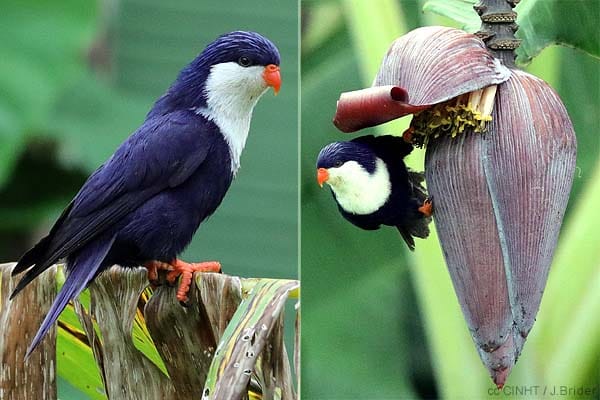
Adult on Banana leaf and flower – Cook Islands, Aitutaki – Joseph Brider 2021-10

The Blue Lorikeet (Vini peruviana ) is a native bird of French Polynesia, formerly existing on about twenty islands in the Society Islands (including Tahiti) and the northern Tuamotu atolls. In recent years it has been lost from Tahiti and all the main Society Islands, surviving only on three remote atolls to the northwest (especially Bellinghausen/Motu One) and on three or four atolls of the Tuamotus. Continue reading →

Posted by Gerald in Birds, 0 comments
The Status of Cook Islands Birds -1996

The Status of Cook Islands Birds -1996

Gerald McCormack, CINHT

The Cook Islands is fifteen small islands (total land area 240km²), scattered over an area approaching the size of Western Europe, in the tropical South Pacific. Although the 18,000 residents, almost all Polynesian, carry New Zealand passports, the country has been internally self-governing since 1965, and is independently responsible for all environment matters.

Two divisions of Government are specifically concerned with the environment: (1) the Environmental Service (formerly the Conservation Service) implements the environment act, with a special emphasis on Environmental Impact Assessment; and (2) the Natural Heritage Project undertakes research, and prepares publications, to integrate traditional and scientific knowledge on all aspects of the environment. The latter project, formalised in 1990 by the Prime Minister, Sir Geoffery Henry KBE, is unique in the South Pacific.

The limited availability of specialist staff, and of financial resources, has meant that overseas volunteers and funding have been of fundamental importance in monitoring and maintaining the inherently fragile terrestrial and coral-reef ecosystems. Land is under family-inherited ownership and, although it cannot be sold, a small amount is leased to the Government and to non-family people.

The fifteen islands divide socially and physically into a Northern Group of six islands and a Southern Group of nine islands. The five atolls and one sand-cay of the Northern Group, support extensive Coconut Palm plantations for a fickle copra industry. The only resident landbird is the Pacific Pigeon (Rupe, Ducula pacifica), which lives on three atolls, feeding mainly on the fruits of the indigenous Beach Gardenia(Ano, Guettarda speciosa).

Continue reading →

Posted by Gerald in Animals, Birds, 0 comments
Rare Seabirds on Aitutaki and Rarotonga

Rare Seabirds on Aitutaki and Rarotonga

Gerald McCormack, CINHT

Laughing Gulls

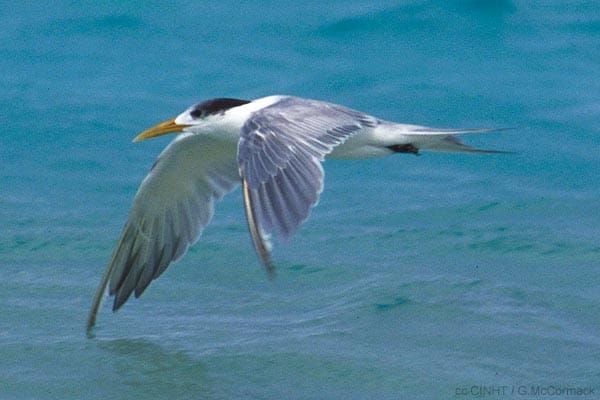
Adults (right & top), Juvenile (bottom) – Cook Islands, Aitutaki – Gerald McCormack

Seagulls are such common seabirds in New Zealand, Australia and America, that it always comes as a surprise for visitors to find no seagulls in the Cook Islands, assuming they ignore the two plastic ones at the Deli in Foodland. Although seagulls seem like the most adaptable scavengers we can imagine, they have not managed to establish themselves on the islands of tropical Polynesia. The nearest island to have resident seagulls is New Caledonia.

It was therefore surprising when people reported a dull brown seagull at Avatiu and at Muri in April 1992. It stayed a few weeks and then disappeared. Since then a similar type of seagull has been reported during the early months of 1995, 1997 and 1998. These birds were all first-year Laughing Gulls (Leucophaeus atricilla). This means that on each occasion it was a different bird that was seen, and only on one occasion did two birds visit together.

Continue reading →

Posted by Gerald in Animals, Birds, 0 comments