Endemic

Cook Islands Fruit-Dove (Kūkupa)

Adult and chick – Joseph Brider, 2021

Gerald McCormack, CINHT

The Cook Islands Fruit-Dove(Kūkupa, Ptilinopus rarotongensis) lives only on the islands of Rarotonga and Ātiu, making it a 2-island endemic of the Cook Islands. It was recorded on Ma‘uke in the 1820s but was lost sometime before 1970 – cause unknown. It was also in the fossil record of Mangaia but was lost before the arrival of the Missionaries.

It is the Cook Islands most colourful native bird. Its typical call on Rarotonga is a mournful “OOOOO-OOOO-OOO-OOO-ooo-oo” with each coo being softer and shorter than the one before, while on Ātiu it is typically “OOOOO-OOOOO-ooooooo” with the final note distinctly lower. It is common in the mountain forest of Rarotonga, and in makatea forest of Ātiu. They often venture onto the horticultural areas of both islands, but usually fail to nest successfully because of predation by cats (introduced in the 1820s), and harassment by the Common Myna (introduced to Rarotonga in 1906, and to Ātiu in 1915).

Although few nests have been reported the main nesting season is probably August to October, with one reported in July. In August 1997 Jeanne and Rosaline Tianoa and Georgina Maui reported that they had a Kūkupa nesting in a Lychee tree in their yard in Avarua. The nest was only two metres off the ground and relatively easy to observe. After being told that the details of Kūkupa nesting had never been recorded the women decided to record the behaviour of the birds. Thus began six weeks of detailed observations.

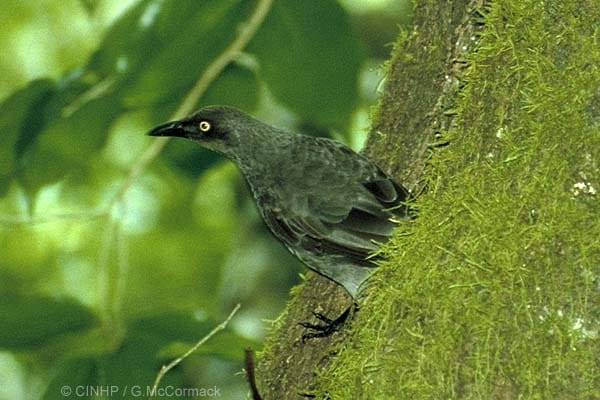
The nest was found on 1st August containing one white egg. The lay-date was unknown but after 12 days the egg hatched on 12 August around dawn. The birds were distinguished by colour and behaviour. Light Pink incubated at night, was smaller, was more greyish in colour, had a white tail-bar, and its beak was shorter, grey and light pink, and it looked away from the observer – the researchers thought this was the female bird, and the bird in the photo has similar features. In contrast, Dark Pink incubated during the day, was larger, was more colourful, had a yellow tail-bar, and its beak was longer, yellow and dark pink, and it stared at the observer. Light Pink’s night-shift usually started around 5pm and continued until around 9am next morning, and during daylight incubation the nest was periodically left unattended for 5-7 minutes at a time.

Mynas regularly approached the nest tree and sometimes harassed the fruit-doves. For example, on chick-day 4 around 4pm a myna landed on the branch near the nest and actually attacked the dove that was standing near the nest. The dove chased the myna away from the nest tree and then returned to sit on the nest.

The chick opened its eyes on chick-day 5 and had a few feathers. By chick-day 9 it was almost covered with small feathers. During these first days an adult was almost always covering the chick, and periodically the chick was fed on a green fluid by pecking inside the adult’s open mouth. After chick-day 9 the chick was able to stand and the adults left it unattended for up to an hour at a time. By chick-day 14 the nestling had small green wing-feathers with yellow and white edges, green tail-feathers with yellow tips, and white down under the tail – the young bird in the photo has similar features and might be about 14 days old. The chick also started to periodically climb onto the branch beside the nest, and the adults started feeding it on berries. On chick-day 16 the chick was hopping from branch to branch after the adult and around 3pm it flew a few times about 30cm from one branch to another towards the adult. At 4.30pm it fell out of the tree and was put back by Mr Tianoa. Chick-day 17 the adult hopped and flew from branch to branch and although the chick hopped along some branches it did not fly.

Chick-day 19 was a day of drama. It dawned to find that Light Pink had been killed in the nest-tree during the night by the cat, which was banished in disgrace to a relative’s place. The chick was attacked by a myna at 8am, and at 9am it flew to a nearby tree. The lone parent attended it most of the time and fed it purple fruit from inside its mouth, and it also put berries on the branch next to the chick. During the next 10 days the young flew from tree to tree calling and was fed by the lone adult, which also chased away harassing mynas several times. From chick-day 22 another Light Pink dove started approaching the nest tree, Dark Pink and the chick. Dark Pink usually chased it away, and a couple of times it attacked the chick. Several times mynas attacked the chick and they were chased away by Dark Pink. On chick-day 30 the adult was still feeding the young; Dark Pink fought off some mynas; and when last seen Dark Pink and its young were flying southwards towards the mountains.

The idea that Light Pink was the female bird could not be verified, but it is consistent with information from other fruit-doves indicating that females are typically smaller and paler in colour than males. Here we also have the interesting further information that the smaller, paler bird incubated throughout the night. The birds were seen to eat the fruits of Cordyline(Rautī, Cordyline fruticosa) and flowers of the Carambola(Raparapa, Averrhoa carambola).


Author’s notes

First published Cook Islands Bishop Museum ( 02 March 2005)

This was a very important piece of research. If anybody else has a similar opportunity to observe the details of the nesting behaviour of a Cook Islands bird it would be a pleasure to make it available on this website. Please see the Contact page for more information.

Posted by Gerald in Animals, Birds, 0 comments
Life in the Karekare Bee Hotel

Life in the Karekare Bee Hotel

Gerald McCormack, CINHT

We built a small hotel to study the behaviour of the local Leaf-cutter Bee, which

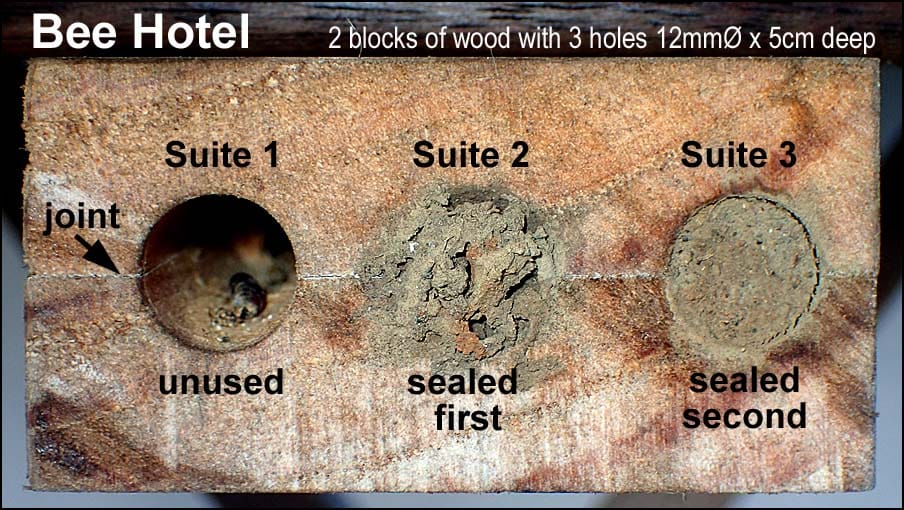
Karekare Bee Hotel at 6pm on 28th December 2021 with suites numbered left to right

usually nests around March or April. The hotel had three 12mm holes about 50mm long drilled to overlap two blocks of wood so that separating them would open the holes for inspection. As a hotel, each hole is a suite and any occupying bee or wasp makes its own rooms by building partitions or doors. Within a suite, Room 1 is the first to be partitioned and will contain the oldest offspring.

Early morning on the 28th December 2021 it was unexpectedly noticed that a large Tahitian Mason Wasp had already sealed Suite 2 with mud and was starting work on Suite 3, which she sealed in the early evening.  Suite 1 remained vacant. Twelve days later, on the 9th January the hotel was opened for inspection.

The first surprise was that Suite 3 which she worked on during the 28th December contained two empty rooms. The purpose of creating a suite of empty rooms is unknown. Was she expecting the fresh doors to attract door-boring parasites away from her young in Suite 2? Had she run out of eggs to lay?

In Suite 2 she had created three rooms. In Room 1, the oldest room, there was a live pupa, while Room 2 contained a dead larva killed by parasites, and Room 3 was empty. We will discuss the occupants of the hotel, including an accidentally imprisoned guest.


Tahitian Potter Wasp

Tahitian Potter Wasp (Rhynchium quinquecinctum tahitense) Adult Female with facial insert [19mmBL] – Cook Islands, Rarotonga – Joseph Brider 2020-02

The dark brown and yellowish-banded Tahitian Potter Wasp (Rhynchium quinquecinctum tahitense) was first recorded on Rarotonga in 2014 by the Trust and on Ātiu in 2020 by Roger Malcolm. It is surprising it had not arrived much earlier considering it was recorded in the Society Islands 150 years ago and it often builds its nests in transportable objects.

It is now widespread on Rarotonga and very conspicuous because of the queen’s large size (21mmBL) and her persistent nesting activity. She is a solitary wasp which means she nests alone and is both the egg-laying queen and the worker. She is also a tube-renter because she nests in an existing tube instead of building an entire nest of mud.

After selecting a suitable tube, she can build a wall to make it shorter, or, as in the case of our hotel suites, she smoothed the end with some mud. She then hunted caterpillars which she paralysed with her stinger and stacked into the end her nest. When she had provided enough paralysed food for her offspring to fully develop she laid an egg and sealed the room with a mud door, a millimetre or two thick.

Within Suite 2 of our bee hotel she provisioned the two inner rooms, but left the outer room empty. The outermost door was more substantial at about 3mm thick to better exclude her enemies. Alas, sometime before the 28th she noticed drying cracks in the outer door so she added some thick strands of mud to conceal or reseal it. (See Bee Hotel photo.)

On opening the hotel on the 9th January, Room 1 of Suite 2 contained a live pupa which a week later on the 16th January

The occupants of Suite 2 on 9th January 2022. Top: opened suite with the potter wasp live pupa and dead late-stage larva. Lower left: Staghorn Wasp adult children and egg-stage grandchildren. Lower right: Female Basket-cocoon Wasp accidentally trapped in the nest

transformed into an adult male potter wasp. This new male was unexpected, because the literature shows that related mud-wasps have the larger, slower-developing female offspring in the innermost rooms and the smaller, faster developing males nearer the suite entrance. In this way the males emerge a little ahead of their sisters and are ready to mate. The sisters are all future queens and they store sperm in a special sac to use selectively to fertilize some eggs to grow into females, and not fertilize others to make males.  Why our queen made her first born a male is unknown – a mistake or a preference for sons?


Staghorn Wasp

Unfortunately for our potter wasp queen, her younger child was killed by parasites in the final stages of being a larva. The killers were a family of tiny wasp larvae of a species first found on Rarotonga by 5-year old Keanui Selam in 2020 in a Leaf-cutter Bee nest in this same hotel.

Keanui’s tiny parasitic wasp was an unidentified species in the genus Melittobia, the first species recorded in tropical Southern Polynesia. The males of the genus have very conspicuous antler-like antennae so we will call them Staghorn Wasps.

The Staghorn Wasp is a parasite which is more correctly known as a parasitoid because it always kills its host, while typical parasites, such as fleas and gut worms, do not kill their hosts. Furthermore, its larvae consume the host from the outside as an ectoparasitoid, rather than internally as an endoparasitoid. Staghorn wasps are widely recognised as invasive pests because they kill leaf-cutter bees which are important pollinators of flowers.

Each Staghorn Wasp colony is founded by a long-winged flying queen which chews her way into the host’s nest and injects a late-stage larva to prevent it pupating. She then lays her eggs on its skin and the emerging parasitoid larvae feed on the host larva to grow into flightless males and females, about 1.5mm long. The males, which are also blind use their large antler-like antennae to fight their brothers, while they exude a scent that has their sisters lining up to mate.

The flightless females are imprisoned queens to expand the colony. As the colony matures almost all eggs will develop into long-winged females, which after mating chew their way out of the nest and fly away to establish new colonies on the larvae of other unlucky large wasps.

The situation in our bee hotel was rather different to the textbook. When the hotel was opened on the 9th January I did not see the founding Staghorn queen, which might have escaped unnoticed. I was surprised to find two generations of her offspring. The older generation of her children consisted of nine adult short-winged females and five antlered males, while the second generation of her grandchildren consisted of about a hundred eggs and a few young larvae on the skin of the potter wasp larva.

A possible explanation for this situation is that the founding Staghorn queen entered the room before the door was closed and, because there was no host larva available, she laid her eggs on a paralysed caterpillar where they grew into the few female and male adults. In the meantime, the mason wasp larva ate enough paralysed caterpillars to grow to its final or pre-pupal stage. At this point, the Staghorn founding queen stung the large host larva to arrest its development and her now mated, adult daughters laid dozens of eggs on the arrested pre-pupal larva.

In this proposed explanation the potter wasp would have had to close the nest around the 20th December to enable enough time for its young to be a large pre-pupal larva by the 9th January. And 20 days would also have been enough time for the tiny children of the Staghorn queen to grow into adults and lay dozens of eggs on the potter wasp larva.


The Accidental Guest

Adult Basket-cocoon wasp from Potter Wasp nest [4mmBL] – Cook Islands, Rarotonga – Gerald McCormack 2022-09

The accidental guest was a Basket-cocoon Wasp (Meteorus pulchricornis), which was first recorded in the Cook Islands by Maja Poeschko in 2005. It was originally described in Europe where it is a biparental species with males and females. It is biparental in much of Asia, but in some areas the population is uniparental with females breeding by virgin birth.

They arrived in New Zealand in the early 1990s and are now widespread, and they are a uniparental all-female population. The few recorded in the Cook Islands have also been females, so it is very likely that our population is also uniparental.

Basket-cocoon Wasps are internal lethal-parasites or endoparasitoids on caterpillars. They use their hollow spear-like ovipositor to deposit an egg (ova) into a live caterpillar. The egg develops into a larva which consumes the caterpillar from the inside before emerging to hang by a thread from a leaf while it weaves an oval cocoon around itself. In this hanging basket-like cocoon it transforms into an adult wasp – a female wasp, a clone of its virgin mother.

In the case of our bee hotel, the potter wasp queen paralysed a caterpillar that happened to contain an egg or larva of a Basket-cocoon Wasp. It placed the caterpillar into its nest as food for its own larva. Fortunately, the caterpillar containing the Basket-cocoon Wasp larva was not chewed up by the potter wasp larva.

The literature indicates that Basket-cocoon Wasps take about two weeks from egg to adult which means that, if our potter wasp sealed the room around the 20th December, it probably emerged from its cocoon around the 3rd of January. With no way to escape, this accidentally entrapped guest had to wander around in the dark without food or water for several days before I released it on 9th January. If that had not happened, it would have had to wait at least another week for the male potter wasp to emerge from its pupa and eat its way out of the suite.

Such are the complexities of life in a bee hotel in Karekare.


Author’s notes
First published CINEWS (February 12 2022) 
Posted by Gerald in Animals, Biodiversity, Terrestrial, 0 comments