


Cindy Milanovic, CINHT,
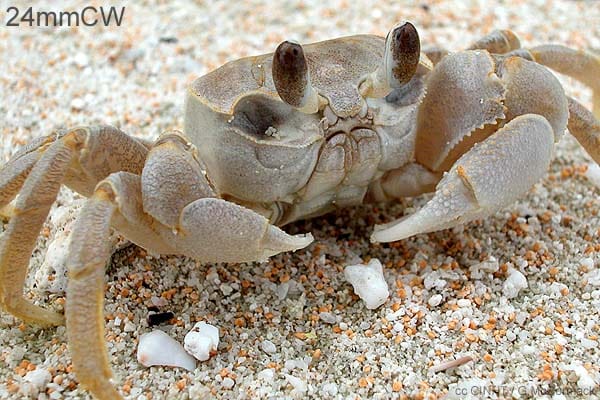
Pale Ghost Crab, Pukapuka – Gerald McCormack
Have you spotted a pale, fast-moving blur darting across the beach at dusk? Chances are you’ve met one of our Ghost Crabs! They are responsible for those small, deep holes you see in the sand.
Two species call the beaches of the Cook Islands home:
Pale Ghost Crab Ko’iti (RR) –Ocypode pallidula — About 2.5 cm wide, their name literally means pale. They dig burrows by flipping sand in a distinctive fan shape, sealing the entrance tight when the tide rolls in.
Horn-eyed Ghost Crab Kohite (RK) –Ocypode ceratophthalmus — Named for its remarkable horned eye-stalks. A fierce predator and one of the fastest crabs in the world! Both belong to the Long-eyed Crab family and are clever engineers of our beaches — emerging at dusk to hunt, then retreating to sealed burrows as the tide returns. With their diets consisting of tiny animals and rotting material along the shoreline and amongst the plants that habitat coastal areas, they play an important role in maintaining a healthy beach ecosystem.
How you can help: → Admire from a distance → Never dig up their burrows → Walk softly at dusk when they’re most active→ Protect habitat by allowing foreshore vegetation to grow.
Ghost Crabs as Eco Soldiers.
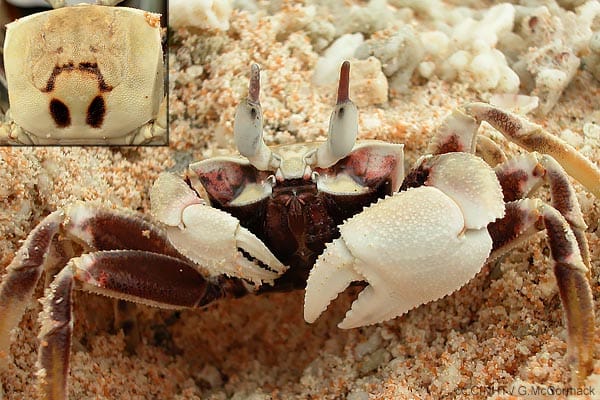
Horn-eyed ghost Crab, Pukapuka – Gerald McCormack
Ghost crabs are far more than the pale, darting shadows we glimpse at dusk — they are key engineers and custodians of the beach ecosystem. As predators, they control populations of insects, small invertebrates, and beach fauna, helping to keep the foreshore community in balance. As scavengers, they act as nature’s cleanup crew, rapidly breaking down dead fish, organic debris, and carrion that washes up along the strandline, recycling nutrients back into the beach system. Their burrows are equally important — by constantly excavating and turning over sand, they aerate the beach substrate much like earthworms do in soil, improving drainage and sediment health. These same burrows also provide shelter for other small organisms. As prey themselves, ghost crabs are a vital food source for shorebirds such as the reef heron, and larger predators, connecting the beach to broader food webs. In short, a beach with a healthy ghost crab population is a beach that is functioning well — and their absence or decline is one of the earliest warning signs that a foreshore ecosystem is under stress from human disturbance, pollution, or habitat loss.
The Foreshore Ecosystem and Ghost Crabs.
As a food source itself
Both species of crabs are omnivores and opportunistic scavengers. Rotting coconut fronds and decaying vegetation create organic matter that ghost crabs will directly consume. The O. pallidula in particular, being described as a nocturnal scavenger, will feed on decomposing plant material as part of its varied diet.
As an insect and invertebrate factory
This is probably the most significant link. Decaying fronds and rotting coconuts attract and harbour large numbers of insects, beetles, flies, amphipods, isopods (sea slaters), and worms — all of which are prime ghost crab prey. The crabs essentially have a buffet laid out for them along the foreshore at night.
As habitat for other prey
Vine tangles and debris along the foreshore provide shelter for small crustaceans, molluscs, and other invertebrates that ghost crabs hunt. The denser and more complex the foreshore habitat, the richer the community of crabs living within it.
As a moisture and microclimate regulator
Foreshore vegetation slows drying out of the upper beach and maintains cooler, moister conditions — important because ghost crabs need to periodically wet their gills to breathe air. A vegetated foreshore extends the zone where crabs can comfortably forage without having to return to the waterline to wet their gills.
As a structural refuge
Vine and debris tangles at the back of the beach give ghost crabs cover from predators like herons and reef herons (Egretta sacra — Kōtuku (RR)) while they forage. This allows them to range further up the beach and spend more time feeding.
The broader picture
A stripped, heavily raked, or “cleaned” beach foreshore — as is common near resorts and public beaches — actually reduces ghost crab food availability significantly. It removes the insect habitat, the decomposing organic matter, and the structural cover they depend on. Many people assume a tidy beach is a healthy beach, when ecologically the opposite is often true.
First published Cinature.org (4 May 2026)


