



Gerald McCormack, CINHT
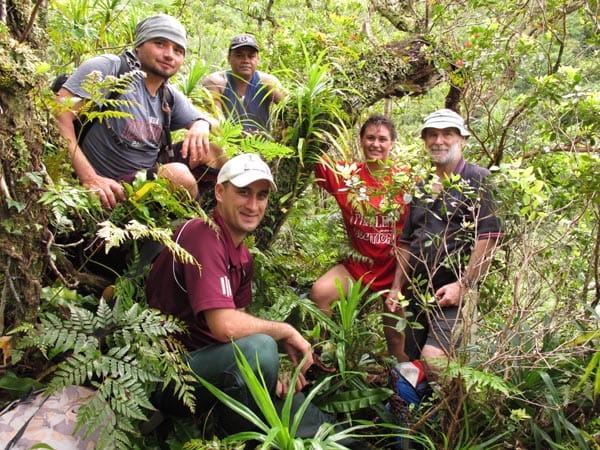
The expedition team from left to right: Jason Tuara, Joe Brider, Edwin Apera (back), Jacqui Evans, Gerald McCormack and photo by Judith Kunzlé.
It has long been hoped that pristine forests at the base of remote and almost inaccessible cliffs might have thriving populations of some of Rarotonga’s rarest plants – maybe even the Pilea, which has not been seen for 80 years.
In July (2010) the Natural Heritage Trust launched a project to assess the status of Rarotonga’s rarest plants. With the assistance of two New Zealand botanists, they explored the island’s native forest, but unfortunately, with one exception, only saw previously known plants. The top ridges of the main mountains were visited, but there is one area the survey failed to get to: the cliffs below the highest ridge, between Te Manga and Te Atukura, in the upper Avana.
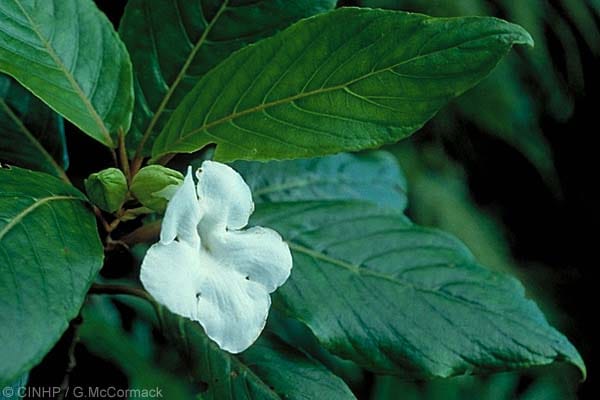
Te Manga Cyrtandra Flower and leaves – Cook Islands, Rarotonga – Gerald McCormack
Last Saturday a team of local conservationists set off at 6 am to allow for a long day hiking, in search for the last refuge of Rarotonga’s rarest unique plants. The team members were Jacqui Evans (Te Ipukarea Society), Joe Brider (Environment Service) and Gerald McCormack(Natural Heritage Trust) and experienced mountain climbers and enthusiasts Jason Tuara, Edwin Apera and Judith Kunzlé. It was a long morning walk along the banks of the Avana, crossing the stream many times and scrambling up the steep side slopes to skirt waterfalls. In the upper Avana valley the hike continued onto a ridge covered in ferns, mosses and typical ridge trees. Midday lunch break was at just over 400m, with a view to Ava‘avaroa passage and the lagoon. With renewed energy the team started to climb the now very steep and narrow ridge up to the base of the cliff at about 500m, and got there an hour later. Gerald had been to within a hundred meters of this cliff several times before, but never made it all the way up, so this was beginning to get exciting.
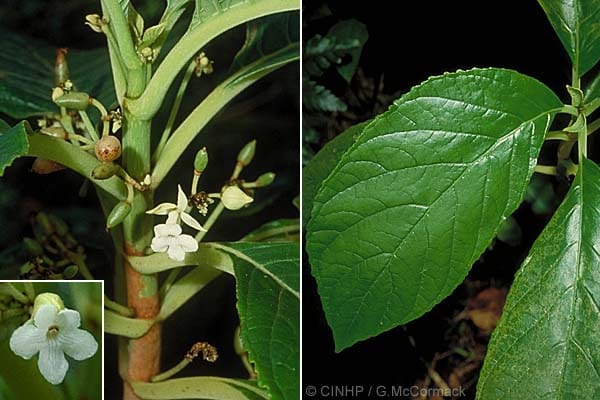
Rarotonga Cyrtandra Flowers and leaves – Cook Islands, Rarotonga – Gerald McCormack
The Rare Plants Project and this expedition focused on searching for the following plants: Te Manga Cyrtandra (Cyrtandra lillianae), Rarotonga Cyrtandra (Cyrtandra rarotongensis), Rarotonga Sclerotheca (Sclerotheca viridiflora) and the Pilea (), which Rarotonga shares with Ra‘ivavae in the Australs, where it is seriously endangered. Mist hung around the vertical cliff and plants grew out from every ledge, nook and cranny. All eyes were out to detect the top rare plants, but none were seen. After clambering along the narrow ledge at the base of the cliff for 1½ hours, the team found a way to get down on another ridge. It was a steep descend to the upper Avana stream. The water was barely trickling from one pool to another with the rocky riverbed dry between, but in one of the small pools above a 4m waterfall, Gerald spotted a Pacific Short-fin Eel, Tuna Māori (Anguilla obscura). This was a most unexpected find, because this is the species of the swamps rather than the mountain streams.
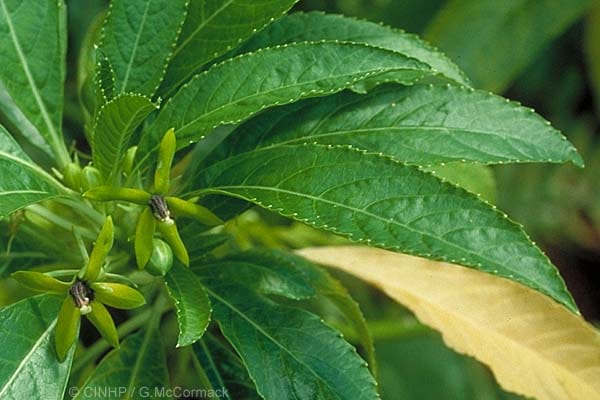
Rarotonga Sclerotheca Leaves & flower (Te Manga East Slope) – Cook Islands, Rarotonga – Gerald McCormack 2010-07
The other animal seen in the pool was an adult Thickarm Prawn (Macrobrachium latimanus)Kourā-vai Rapanui. It was concluded that the eel preferred to have company rather than a meal. This eel and the other two species of freshwater eels on Rarotonga migrate hundreds of kilometres at sea to their breeding grounds, where they spawn and die. The juvenile eels eventually find their way to streams where they continue their life cycle.
Freshwater prawns breed in the streams and the juveniles are carried into the ocean where they develop for a while before walking up the streams. Enjoying perfect weather, the expedition team returned to the Avana water intake at 5pm. Despite not finding a secret cache of rare plants, it was a great day exploring a very remote place of Rarotonga. After this survey it is estimated that the local Crytandras and the Sclerotheca probably have total populations of less than a hundred plants, and that the Pilea is most probably lost.
First published in the CINEWS ( 25 September 2010)


