Introduced Species

New Bird on Mangaia Identified

New Bird on Mangaia Identified

Gerald McCormack, CINHT

Adult and Juvenile Chestnut-breasted Mannikin – Mangaia, Cook Islands – Gerald McCormack

In the CI News (13 May 2006) Sue Ngatokorua described a new bird on Mangaia, and the author suggested it might be a Chestnut-breasted Mannikin (Lonchura castaneothorax). In late May Peter Ngatokorua, who provided the original information for the news article, took Ian Karika and the author to see the birds in Veitatei swamp, and they were confirmed as Chestnut-breasted Mannikins. Groups of up to 30 were seen, and the population might be near 100.

Peter and others had concluded that the bird arrived naturally, because arrival of any cage bird would have sent the inevitable buzz-of-curiosity throughout the Mangaian community. To honour the birds’ great flight to Mangaia, Peter had suggested it be called Toa Kere-ā-Rangi, literally “mighty warrior of Rangi”. While other Veitatei planters suggest it should be named Pātiki-‘Enua-ō-Rangi, an alternate name for Veitatei district, where it was first seen in 1999. Continue reading →
Posted by Gerald in Animals, Biodiversity, Birds, Introduced Species, 0 comments
The spread of the “farmers friend” – the myna

The spread of the “farmers friend” – the myna

Gerald McCormack, CINHT

The myna is locally much loathed as a pest, yet it arrived in the early 1900s with such high hopes as the “farmer’s friend”. We follow its triumphant march from India to many countries, including the Cook Islands.

The “farmer’s friend”

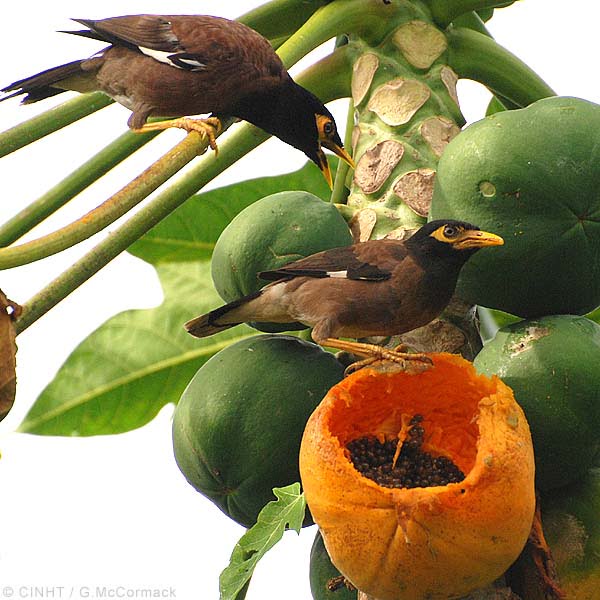
A couple of common myna birds competing for the right to feed on the fruit of the pawpaw.

The Common Myna is indigenous to southern Asia, primarily India. It lives in open woodlands but is strongly associated with people in agricultural and urban areas. It is known as the “farmer’s friend” because it helps control insects.

It was probably the first animal introduced to another country as a biocontrol, when the French took some from southeast India to Mauritius and Réunion islands in 1763 to control locusts/grasshoppers in the sugarcane fields. The French colonists called them “Martin” after Captain Martin of the ship “Gracieuse” that had brought them. The locusts were soon much reduced and the Martin was given the credit.

A little later, in 1766 Linnaeus considered this bird to be a bird of paradise and named it Paradisea tristis, meaning the dull  bird of paradise. In 1816 Vieillot made the genus Acridotheres meaning grasshopper-hunter,and our myna became Acridotheres tristis; literally meaning the dull grasshopper-hunter. An obvious misnomer for a bird that is not dull in behaviour or appearance.

These birds and their relatives are Asian starlings and they are known in Hindi as Mainā, meaning “delightful”, referring to their varied calls and speech mimicry. Mainā is rendered into English as mynah or myna, while the French name is martin. Our particular myna is the Common Myna or Indian Myna, and it is identified in French as Martin triste.

Continue reading →

Posted by Gerald in Agriculture, Animals, Biocontrol Species, Invasive Species, 0 comments
Keanui’s Biodiversity Bonanza

Keanui’s Biodiversity Bonanza

Gerald McCormack, CINHT

Entomologist at work!

Residents often talk about Cook Islands biodiversity, but few have discovered as many unrecorded species as 6-year-old Keanui Selam.  His recent insect-catching expeditions led to the discovery of eight unrecorded species of Heteroptera, a group of insects known as true bugs, or typical bugs.

True bugs all have a proboscis of long tubular mouthparts, which some use to suck the sap of plants; while others use it to spear and suck the juices out of caterpillars and other insects. The first group are farmers’ foes, while the latter are farmers’ friends. Continue reading →

Posted by Gerald in Animals, 0 comments
Cycads and their Golden Age

Cycads and their Golden Age

Joseph Brider, Natural Heritage Trust.
First published online (19 Feb 2021).

Japanese Sage-palm Cycad (Cycas revoluta) showing a mature plant with male (top) and female (bottom) reproductive organs in the right-hand inserts. The composite image was prepared by Gerald McCormack

Japanese Sago-palm with male reproductive structure in top insert and female structures in bottom insert. Photo: CINHT

What do Japanese Sago-palms, Queen Sago-palms and Cardboard Palms all have in common? Well… they are NOT palms, they are all Cycads! The ‘palm’ reference comes from the shape of their leaves and cylindrical trunks but these plants are not even closely related to palms!

These recently introduced plants to the Cook Islands represent a very, very old lineage of plants that predate the dinosaurs.  These are very slow-growing, long lived plants with some specimens in the wild being over 1000 years old1. A particular specimen of Cycad in Kew Gardens in the UK arrived at their botanical garden in 1775, making it 246 years old in 2021. Consequently, it also holds the record for being the oldest potted plant in the world2.

Let’s dive in and learn about the charismatic, but often misunderstood plants.

Continue reading →

  1. Hill, K., & Stevenson, D. (1998). The Cycad Pages. The Cycad Pages. Retrieved from https://plantnet.rbgsyd.nsw.gov.au/PlantNet/cycad/cycsour.html []
  2. Avis-Riordan, K. (2019, 07/23/2019). Meet the oldest pot plant in the world. Royal Botanic Gardens Kew. Retrieved from https://www.kew.org/read-and-watch/oldest-pot-plant-in-world-eastern-cape-giant-cycad#. []
Posted by Joseph in Ecology, Plants, Terrestrial, 0 comments