Biodiversity

Unusual deepwater fish identified in 1998-99

Unusual deepwater fish identified in 1998-99

Gerald McCormack, Director, CINHT

Long before the first Papa‘ā (Caucasians) visited the Cook Islands Polynesian fisherman were using drop-stone hand-lining at 100-150 fathoms (200-300 metres) to catch Vena, Mangā, ‘Ā’ā Mangā and Mangā Ru‘i. The fishing technique was a unique tradition of the Northern and Southern Cook Islands, Rimatara and Rurutu, and it was not introduced to the Society Islands, Tuamotu and Tubuai until after European contact[1]. While the scientific identification of Vena and Mangā had been known for a long time, this article discusses the discovery of ‘Ā’ā Mangā in 1998, and Mangā Ru‘i in April 1999.

The four fishes belong to the Snake-Mackerel Family, which are deepwater predators, with strong conical teeth along the jaws and a few razor-sharp fangs on the roof of the mouth. These fishes generally live at depths of 200-500 metres, sometimes migrating upwards at night. While we usually call them snake-mackerels, they are also known as gemfishes and escolars. Continue reading →

Posted by Gerald in Fish, Marine, 0 comments
The Blue Lorikeet (Kurāmo‘o) of Aitutaki

The Blue Lorikeet (Kurāmo‘o) of Aitutaki

Blue Lorikeet on a banana flower – J brider

Gerald McCormack, Director, CINHT


The Blue Lorikeet (Vini peruviana) is a native bird of French Polynesia, formerly existing on about twenty islands in the Society Islands (including Tahiti) and the northern Tuamotu atolls. In recent years it has been lost from Tahiti and all the main Society Islands, surviving only on three remote atolls to the northwest (especially Bellinghausen/Motu One) and on three or four atolls of the Tuamotus.

Scientists have concluded that the Blue Lorikeet has been lost after the islands had been colonised by the Ship Rat (Rattus rattus). The lorikeet nests in holes in trees, and the Ship Rat destroys its eggs and young. In contrast, the Blue Lorikeet, and its relative the Rimatara Lorikeet (Vini kuhlii), can flourish on islands known to have only the smaller Pacific Rat (Rattus exulans).

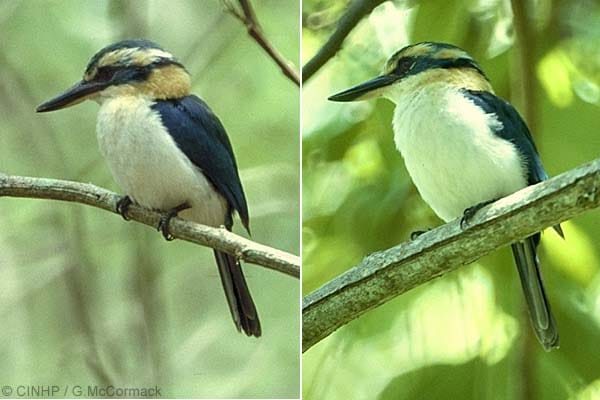
In ancient times the larger Southern Group islands all had a variety of landbirds, probably including the Grey Duck (Mokorā, Anas superciliosa), Pacific Reef-Heron (Kōtuku, Egretta sacra), Pacific Pigeon (Rupe, Ducula pacifica), Cook Islands Fruit-Dove (Kūkupa, Ptilinopus rarotongensis), a kingfisher (Ngōtare/Tanga‘eo), Spotless Crake (Mo‘o, Zapornia tabuensis), and the Rimatara Lorikeet (Kura). Some time before the Missionaries arrived in the 1820s all islands had lost the Rimatara Lorikeet, and 1899 Aitutaki had lost all its native landbirds, except the Grey Duck and the Reef-Heron.

It was therefore very surprising that in 1899 visiting scientists noted the Blue Lorikeet on Aitutaki. They described it as the pet of the natives. Today the Blue Lorikeet is more numerous on Aitutaki than on any island in French Polynesia, thanks to the abundance of flowers with nectar and the absence of Ship Rat. There are in excess of 1000 birds, possibly more than 2000. They are obviously not seriously interfered with by the abundant Pacific Rat.

When the Blue Lorikeet was introduced to Aitutaki is not known. A likely scenario is that it was brought as a cage-bird from French Polynesia on the Mission ship, which was regularly sailing between the Cook Islands and the Society Islands after 1820.

In September 2001 a number of people have been reporting a small blue and white bird with a short beak on Rarotonga. The adult Blue Lorikeet (Kurāmo‘o) of Aitutaki fitted the description but its presence here was unlikely. However, on Saturday and Sunday mornings the bird spent some time feeding on our banana flowers in Upper Tūpapa. It certainly was a Blue Lorikeet.

Should we introduce more Blue Lorikeets to Rarotonga?  While there is plenty of suitable food, the widespread presence of the Ship Rat counts against the lorikeet flourishing on Rarotonga. The most humane conclusion is to leave the Blue Lorikeet to Aitutaki where they can breed successfully because there are no Ship Rats.

There is also a lone Eastern Rosella(Platycercus eximius) of Australia in the ‘Ārorangi and Nikao areas. This bird was one of four aviary-birds brought to Tītīkāveka around 1988. They escaped around 1990 and three were killed or died within a year or two. The lone survivor moved to the other side of the island where it was last reported in May 2002. I would be interested in any report that it is still alive. It is about 30cm in total length. It has a red head and breast, white cheeks, with yellow on the belly and blue on the wings.

Author’s notes

First published CINEWS (March 2023)

Posted by Gerald in Birds, 0 comments
Hummingbirds in the Cook Islands?

Hummingbirds in the Cook Islands?

Gerald McCormack, CINHT

Gnathothlibus erotus Hover-feeding on Tahitian Gardenia – Cook Islands, Rarotonga – Gerald McCormack

Sometimes in the evening bird-like creatures hover over flowers while probing them with a long slender beak. Are they hummingbirds?

Although they look like the hummingbirds of books and films these creatures are actually large moths, known as hawk-moths or sphinx-moths. They have strong slender wings enabling them to fly very fast and to hover. They are nocturnal feeders, usually starting around dusk. Their caterpillars are called hornworms, because they have a long horn on the rear end.

In the Cook Islands there are five species of hawkmoth. Our most commonly seen hawkmoth is the large brown Gnathothlibus erotus – wow, what a name. Unfortunately this large moth (to 5cm long) does not have an English name. It is our only hawkmoth with a white stripe from the eyebrow along the sides of the thorax, so we might call it the White-brow Hawkmoth.

Continue reading →

Posted by Gerald in Insects, 0 comments
Our Family of Stinging Fishes

Our Family of Stinging Fishes


The most venomous fishes in the Cook Islands are several Lionfishes and Scorpionfishes, and a Stonefish, which all belong to the Scorpionfishes family. All members of this family have poison glands associated with hollow fin-spines, especially the dorsal spines, to inject poisonous proteins into animals that attack them. Although the puncture wounds from the spines are small and inconspicuous, a sharp throbbing pain develops almost immediately, and within minutes it spreads up the limb and intensifies.

Lionfishes have a weak system of injecting their venom. Scorpionfishes have a more efficient system of injecting the poison. The most serious of all stinging fishes, the Stonefish, has very large poison glands and an extremely efficient system of injecting the venom. The degree of pain is a measure of the seriousness of the sting – Lionfishes and small Scorpionfishes cause the victim to cringe with pain, large Scorpionfishes cause the victim to almost lose control with pain, while the Stonefish causes the victim to thrash about uncontrollably and scream in agony. Only in the most unusual circumstances are stings from Lionfishes and Scorpionfishes life threatening, but a serious sting from a Stonefish, without suitable treatment, can progress over a period of a few hours to extreme breathing difficulty, convulsions, and even death. Continue reading →

Posted by Gerald in Fish, Marine, 0 comments
The long-tailed Cuckoo – Part 2

The long-tailed Cuckoo – Part 2

Gerald McCormack, CINHT

This post is the second in a 2-part blog about The Long-tailed Cuckoo (Karavia, Urodynamis taitensis) which winters in tropical Polynesia and migrates to New Zealand in October and November to breed by duping other birds to incubate its eggs and raise its young. Part 2 explores the birds polynesian names and the possibility it was linked to early navigation. Continue reading →

Posted by Gerald in Animals, Birds, 0 comments