Rare sea birds

Frigatebirds – Our Vulnerable Pirates

Frigatebirds – Our Vulnerable Pirates

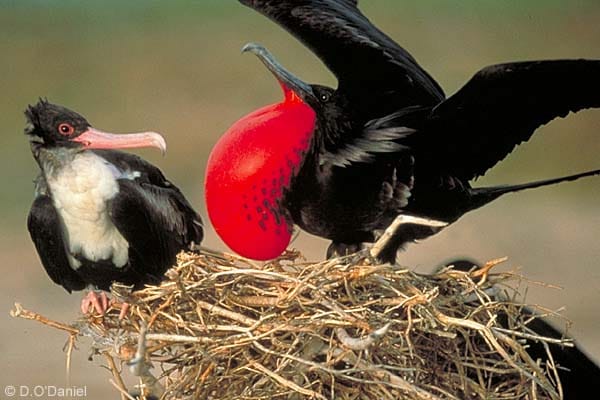
Great Frigatebird Courtship – Donna O’Daniel

Gerald McCormack, CINHT

Frigatebirds are the largest seabirds residing in the Cook Islands, with wingspans of 180-220cm. They are uniformly black above, and black or black with a white breast below; their wings are long, angled, and sharp tipped; their tails are long, and deeply split into two sections. They do not nest on Rarotonga, or on any inhabited Southern Group island, although they often soar over the coast of inhabited islands when there is a storm at sea. As a result they are sometimes called Storm Birds or Hurricane Birds. It is not clear why frigatebirds congregate at islands during storms, but it is probably because they find flying at sea more difficult and if they land on the water they usually die.
Continue reading →

Posted by Gerald in Animals, Birds, 0 comments
Rare Seabirds on Aitutaki and Rarotonga

Rare Seabirds on Aitutaki and Rarotonga

Gerald McCormack, CINHT

Laughing Gulls

Adults (right & top), Juvenile (bottom) – Cook Islands, Aitutaki – Gerald McCormack

Seagulls are such common seabirds in New Zealand, Australia and America, that it always comes as a surprise for visitors to find no seagulls in the Cook Islands, assuming they ignore the two plastic ones at the Deli in Foodland. Although seagulls seem like the most adaptable scavengers we can imagine, they have not managed to establish themselves on the islands of tropical Polynesia. The nearest island to have resident seagulls is New Caledonia.

It was therefore surprising when people reported a dull brown seagull at Avatiu and at Muri in April 1992. It stayed a few weeks and then disappeared. Since then a similar type of seagull has been reported during the early months of 1995, 1997 and 1998. These birds were all first-year Laughing Gulls (Leucophaeus atricilla). This means that on each occasion it was a different bird that was seen, and only on one occasion did two birds visit together.

Continue reading →

Posted by Gerald in Animals, Birds, 0 comments