



Gerald McCormack, CINHT
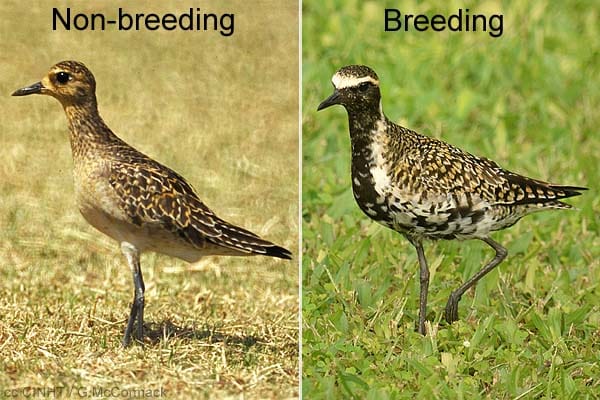
Non-breeding vs Breeding Plumage – Cook Islands, Rarotonga – Gerald McCormack
On the airport, golf courses, sports fields and larger lawns of the Cook Islands the Common Mynah (Manu Kavamani, Acridotheres tristis) is busy feeding throughout the year. During the summer months they are joined by the Pacific Golden-Plover (Pluvialis fulva), which is dark brown with pale spots, has long dark grey legs, and a short straight beak (24mm). The plover has an erect alert posture, giving it a height of about 25cm. For convenience we can combine its name and where it is found, to call it the “plover-of-the-grass”, although it is also seen along the shoreline. When alarmed the plover-of-the-grass gives two or three short “TUUU-REE” calls as it takes to the air.
Along the shoreline there is another species of bird which is easily confused with the plover-of-the-grass, as it is relatively similar in size. The Wandering Tattler (Tringa incana) is grey in colour with short dull yellow legs and a long straight beak (40mm). It has a hunched posture and its tail bobs as it darts about searching for small animals near the waterline. We can call this bird the “tattler-of-the-shore”, although it sometimes ventures inland to taro patches, small streams, and, uncommonly, onto grassed areas. When disturbed the tattler-of-the-shore gives two or three “RI-RI-RI-RI-RI ” calls as it flies away.
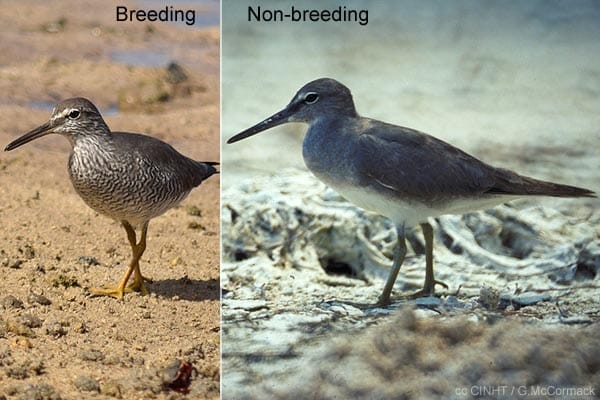
Wandering Tattler, Breeding and non breeding adults – Cook Islands, Rarotonga – Gerald McCormack
Typically the traditional names for the plover-of-the-grass reflect the “TUUU-REE” alarm call: Törea (Rarotonga, Mangaia, Manihiki and Rakahanga), Toretörea (ºÄtiu, Maºuke and Mitiºäro), and Tuli (Penrhyn, Pukapuka and Nassau). And in a similar manner the names for the tattler-of-the-shore reflect its “RI-RI-RI-RI” alarm call: Kuriri, Kulili, Kururi and Kolili.
During a summertime survey on Aitutaki, several of the more elderly residents of Aitutaki were individually asked about the traditional name of the plover-of-the-grass, which was common on grassed areas at the time. Five said it was the Kuriri (the Törea being a different bird); two said it was the Kuriri (the Törea being the same bird); two said it was the Törea (the Kuriri being a different bird); and two said it was the Teuea (or Teuvea). In all cases, the elders reported that the traditional name for the plover-of-the-grass was based on the call of the bird.
There was no doubt that on Aitutaki many residents had reversed the traditional names of the plover-of-the-grass and the tattler-of-the-shore compared to residents on other islands of the Cook Islands. The Cook Islands Törea was usually Kuriri on Aitutaki, and the Cook Islands Kuriri was usually Törea on Aitutaki. Why most people on Aitutaki have reversed the traditional names of these two birds is unknown.
One factor in the reversal of names may be the well-known story of Ngaºuru. Long ago it happened that Vaipae and Taºutu were at war, and the people of Taºutu had escaped to several of the reef-islets (motu). Ngaºuru knew of a cave on Motu Räkau where he took his daughter to hide. Three times during the night the daughter woke and called “Ngaºuru e Törea, Ngaºuru e Törea” (Ngaºuru, the Törea), fearing that the Törea was calling because it had been disturbed by the searching Vaipae warriors. Each time Ngaºuru calmed her with “Emai emoi e taki mai” (Go to sleep my child, the tide rises and the tide falls), telling her that the Törea was calling because of the changing tide. Unfortunately he was mistaken, and the enemy smoked them out and killed them.
This story refers to the Aitutaki Törea as a bird of the shoreline and, by implication, not the plover-of-the-grass. Having allocated the name Törea to a shorebird, the inland plover-of-the-grass became, by default, the Aitutaki Kuriri – despite its contradictory alarm call.
For whatever reason, today, most people on Aitutaki have reversed the traditional names of the plover-of-the-grass and the tattler-of-the-shore compared to people on the other islands of the Cook Islands.


