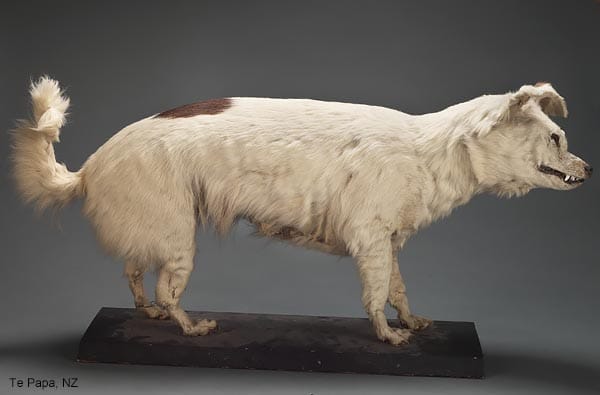
What did Polynesian Dogs look like?
After Europeans arrived in Polynesia their dogs interbred with and rapidly replaced the docile Polynesian Dogs. The only preserved specimen is of a hunting dog collected in 1876 from southern South Island NZ. White was the favourite colour of NZ Māori dogs and the longer hair was used to make esteemed cloaks or kahu.
Tropical Polynesian Dogs were described as smaller than a large spaniel with a very long back, bowed forelegs, broad head, pointed snout, upright ears and small eyes. They had short to long white, brown or black hair. They were sluggish, yelping rather than barking.
Tuamotu dogs were distinctive in having very long white hair, 10-15cm. Tahitian warriors arrived by canoe to trade bark-cloth for the esteemed hair to decorate their breast-plates.
As a food, dogs were preferred over hogs. The dogs were mainly vegetarian, commonly eating Taro and Breadfruit, with some fish.
Polynesian Dogs in Tropical Polynesia
When the first Europeans arrived in Polynesia they encountered Polynesian Dogs in Samoa, the Societies, Tuamotus, Hawai‘i and New Zealand. They were absent from the Marquesas, Rapanui, Cook Islands or Tonga, despite often being present in the archeological record.
When Captain Cook stood off Ātiu in April 1777 one group would only take a dog in exchange for a hog, plantains and coconuts. Eventually Cook gave them one of Omai’s two British dogs. The locals called it Kurī, the widespread traditional Polynesian name for dog. After visiting Ātiu Captain Cook went to Tonga where there were no dogs and he gave a chief a male and female Polynesian Dog from Tahiti. They flourished and Mariner reported in 1811 that dogs were common.
By the time the Missionaries arrived on Rarotonga in 1823 with dogs the people had completely lost the traditional name Kurī and coined Puaka-aoa, literally “barking pig”.
The origin of the Polynesian Dog
The illustration shows the origin of the Polynesian Dog based on three genetic markers (Oskarsson et al 2011).

Map Depicting the origin of the polynesian dog based on 3 characteristics – Origin Maps, Gerald McCormack
Dogs were domesticated in South China before 10,000 years ago and they had genetic markers #1,2 and 3. They were taken by people southward through Southeast Asia to Indonesia where some lost one or more markers. Some dogs with the #3 marker were taken to PNG giving rise to the New Guinea Singing Dog while another group with #3 went directly to Australia about 5,000 years ago and developed into the Dingo.
About 4000 years ago the Austronesian people in Outer Indonesia acquired dogs with markers #1 and 2 and took them throughout the Lapita Triangle and eventually throughout the Polynesian Triangle, as the Polynesian Dog.
The first settlers to Madagascar were also Austronesians from Indonesia arriving there about 2000 years ago. However Madagascan dogs do not contain the #2 marker of Indonesian and Polynesian dogs and therefore did not come from Indonesia. They were of African origin. (Ardalan et al 2015) .
The origin of all Domestic Dogs
The ancestor of all domestic dogs is the Gray Wolf (Canis lupus) and they have subspecies status. Their scientific name is Canis lupus familiaris, literally the “friendly gray wolf”.
The domestication occurred separately in Western Europe and China by about 14,000 years ago, although semi-domestication probably started about 30,000 years ago.
First published in the CINEWS (2019)