



Gerald McCormack, CINHT
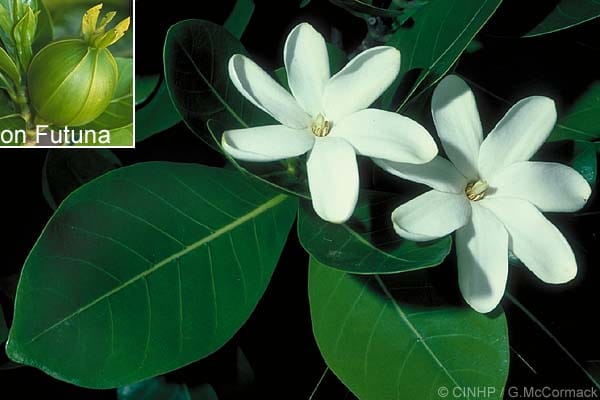
Tiare Maori, Flowers and leaves, and fruit insert – Cook Islands, Rarotonga – Gerald McCormack
The Tiare Mäori (Gardenia taitensis), or simply Tiare, of the Cook Islands is typically a small branching shrub with fragrant, pure white flowers having 6-9 petals and reaching to 10 cm in diameter. The flowers, which open in the evening and are abundant from October to April, are famous in personal adornment as a single flower tucked over the ear or embedded in the hair, or as a collection threaded into neck (ºei kakï ) or head garlands (ºei katu). It is the essential ingredient of a popular scented coconut oil (ºAkari Tiare, Manongi Tiare, or Mori Tiare) used as a body lotion, and it is used in several traditional herbal medicines.
The ºAkari Tiare is made by extracting oil from a mixture of grated coconut and whole Tiare Mäori flowers, using the digestive glands of the Chocolate Hermit (Unga Pätua, Coenobita spinosus) or the Ghost Crab (Koºiti, Ocypode pallidula) and the warmth of the sun. The first clear oil is removed on about the fourth day, and this can be repeated each day for more than a month. The oil is bottled and will remain fresh for several years.
The Tiare Mäori is a native shrub or small tree of Melanesia and Western Polynesia, from Vanuatu through Fiji to Tonga, and probably Samoa. In Fiji it is a shrub or gnarled tree to 6 metres growing on the coral soils near the coast, and occasionally in cultivation. It is called Mbua or Mbua Toka. The yellow-green fruits have the seeds embedded in an orange pulp. In Samoa, where it is known as Pua or Pua Samoa, it is now rare in the wild and not very common in cultivation.
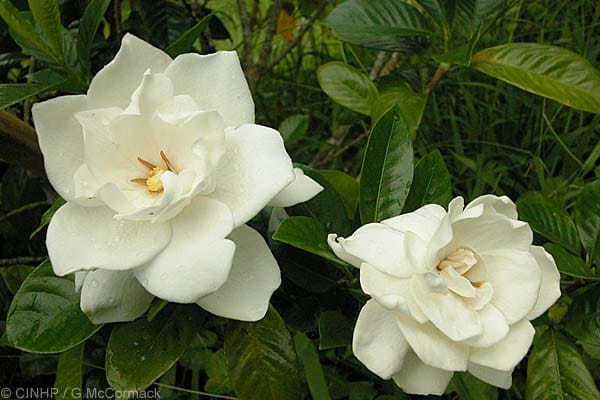
Tiare Teina, Double flowers – large and small – Cook Islands, Rarotonga – Gerald McCormack
The plant was transported to the Cook Islands, French Polynesia and probably Hawaii by the early Polynesian settlers. In these islands it is always propagated by people, as it never sets fruit. The first specimen collected for scientific study was from Tahiti and, after the collection location, it was named Gardenia taitensis. The misleading scientific name and the derived common name of Tahitian Gardenia, conspire to maintain the mistaken idea that the plant is a native of Tahiti.
In Tahiti and the rest of French Polynesia this pre-European introduced ornamental is known as Tiare, Tiare Tahiti or Tiare Maohi. It has the same uses as in the Cook Islands.
The closest relative of the Tiare Mäori in the Cook Islands is the Common Gardenia or Gardenia, which has the scientific name of Gardenia augusta or Gardenia jasminoides. The two local varieties of this species are both two metre shrubs with fragrant, white, double-flowers to 8 cm diameter.
As this beautiful flower was not recorded by Wilder during the 1920s, we should conclude that it has been introduced since that time, presumably from Tahiti, where it had been introduced around 1845 by Dr Johnstone. The Gardenia is a native of the China-Japan-Taiwan area where the single- and double-flowered forms grow wild, and people eat the orange fruit which is about 4 cm long.
In Tahiti the Gardenia became known as Tiare Taina, literally “China Flower”, and this name came with the plant to the Cook Islands. Although both varieties are cultivated as garden ornamentals, the variety with smaller flowers, which was introduced first, has been occasionally planted beside tracks and on peaks in the inland of Rarotonga. This earlier variety is sometimes called Tiare Taina ºEnua. Although both varieties flower abundantly, neither develop fruit in the Cook Islands.
First published 1996


