Miti‘āro

The Kura on Ātiu – the 10th anniversary

The Kura on Ātiu – the 10th anniversary

Gerald McCormack, CINHT

Ten years ago, on 24th April 2007, Air Rarotonga flew 27 Kura (Rimatara Lorikeets, Vini kuhlii) on a direct flight from Rimatara to Ātiu, where the bird had been absent for 200 years.

Map showing route the Rimatara Lorikeets took to get to Ātiu and eventually Mitiaro

This was the first transboundary reintroduction of a bird in the Pacific and was reported by more than 130 major news outlets around the world. TVNZ showcased the event with Greg Parker’s “Spirit of the Queen” documentary, which is on YouTube at www.youtube.com/kokamedia.

In pre-historic times the Kura were found throughout the Southern Cooks and eastward to Rimatara and Rurutu in French Polynesia. It had been lost on all islands, except Rimatara, by the over-harvesting of its red feathers for personal adornment.

The purpose of the reintroduction project was to establish a second population to maintain the Kura within its former natural range in case it were devastated on Rimatara by an invasion of Ship Rat(Rattus rattus). The Natural Heritage Trust and MANU, the Ornithological Society of French Polynesia, took six years to negotiate approvals with government agencies and the Rimatara community, which gave the birds into the care of Rongomatane Ariki and the Ātiu community.
Continue reading →

Posted by Gerald in Animals, Birds, 0 comments
Pacific Pigeon (Rupe) – It’s Call

Pacific Pigeon (Rupe) – It’s Call

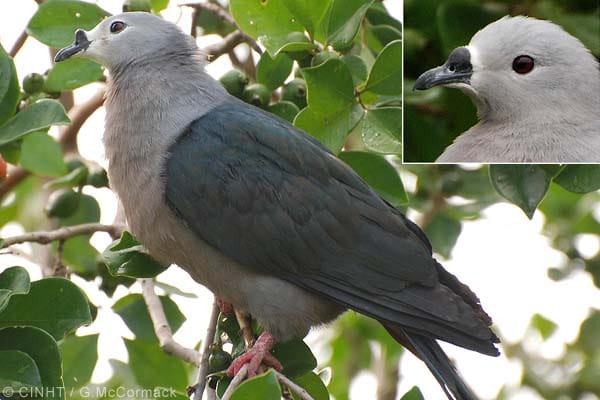
Adult Rupe – Gerald McCormack -2010

The Pacific Pigeon (Rupe, Ducula pacifica) is the largest forest bird of the Cook Islands. It is dark green on the upper wings and back, with a pale grey neck, head and underside. The adult has a prominent lump on top of its beak. The sexes are identical in appearance. The pigeon has two distinctive calls and many residents believe the calls are gender specific. This article presents detailed observations by Don Organ that support this idea.

The Pacific Pigeon has a native range from the Lau Group (eastern Fiji) through Samoa and Tonga to the Cook Islands. It feeds on fruits, especially Guettarda (‘Ano, Guettarda speciosa), Pacific Banyan (Ava, Ficus prolixa), Perfume Tree (Mata‘oi, Cananga odorata), Kapok buds (Mama‘u, Ceiba pentandra) and Cecropia (Rau-Māniota, Cecropia pachystachya). It is present on the Southern Group islands of Rarotonga, ‘Ātiu, Ma‘uke, Miti‘āro, and Palmerston. In the Northern Group it is present on Manihiki and Pukapuka. Why this native pigeon is missing from Mangaia, while it survives on other similarly man-modified uplifted islands, is a mystery. Continue reading →

Posted by Gerald in Animals, Birds, 0 comments