




Adult in flight – Cook Islands, Takūtea – Gerald McCormack
Gerald McCormack, CINHT
The Red-tailed Tropicbird (Tavake Phaethon rubricauda) is a snow-white seabird with a red bill and slender red tail. It nests during the winter months in moderate numbers on the cliffs behind Avarua and is often seen flying over the island. It has a raucous call and performs dramatic loop-the-loop courtship displays. The largest Cook Islands colonies are on Takutea (near Atiu), Suwarrow, and Palmerston and a small population on Mā’ina-iti, Aitutaki.
It is a rare nester on most peopled-atolls because it is a favourite traditional food and domestic dogs often disturb the nests. Palmerston is an interesting exception because the tropicbird remains common despite more than a hundred years of harvesting. The secret of its survival has been that Palmerston islanders harvest the “mature” nestlings only every 28th day, and enough fledge between harvests to maintain the colony.
The Tavake of Mā’ina-iti, Aitutaki
The few Tavake on Mā‘ina-iti (Honeymoon Island) have brought many people immense pleasure and they will remain there if everyone shares the responsibility of protecting them;
1) Do not wander into the scrubland where the birds nest.
2) Please stand at least five metres away from nesting birds and move away immediately if a parent is trying to land.
3) For the irresistible close-up photo please crawl slowly and alone but remain at least 3m away. As soon as you have your photographs, crawl slowly away. Move away immediately if the chick or parent becomes agitated – beak open and ruffled feathers.
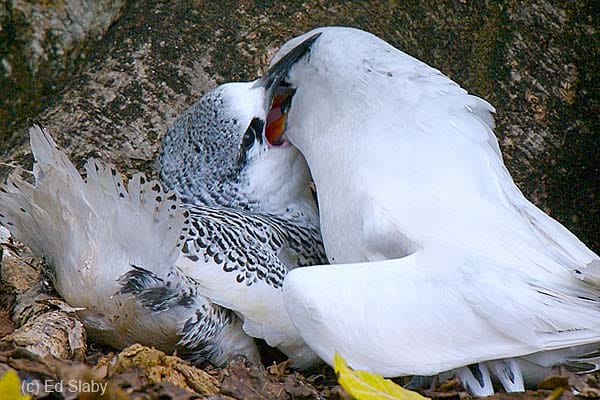
Red-Tailed Tropic Bird Juvenile being fed by adult – Ed Slaby
When people are too close, the chick will move away and the parent will have difficulty finding it, especially if it moves into denser vegetation. The returning adults are reasonably determined to feed their nestling, but the close proximity of people can interfere with it landing and finding
its chick, and interrupt the elaborate feeding process in which the adult regurgitates the food directly into the throat of the young. If the food is dropped, it is not retrieved.
The Tavake are rare seabirds on inhabited islands, because their nest sites are usually disturbed by people and dogs. It is exceptional and wonderful that they persist in breeding under the shrubs on Mā‘ina-iti on Aitutaki.
Tavake take six weeks to hatch their egg and 13 weeks to raise the chick until it can fly. Although the birds on Mā‘ina-iti have not been monitored, it is likely that their peak laying season is March-April and the young will leave their nests July-August. There are usually a few nesting at other times. The single egg is incubated by both parents and after it hatches the chick is tended by one parent until it requires both to provide food. The parent birds leave before dawn to fish far away from the island. The most intense activity is in the early afternoon when most adults return. Elaborate aerial courtship displays are performed by pre-nesting birds.


