



Gerald McCormack, CINHT,

Pacific rat, Adult – Cook Islands, Rarotonga – Gerald McCormack
When the Polynesians first sailed through the Cook Islands, probably more than 2000 years ago, they carried the Pacific Rat, also called the Polynesian Rat (Kiore, Rattus exulans). Whether they carried it accidently, or purposefully, is unknown. Either way, the Kiore established itself throughout Polynesia, and was often used as a source of food.
A Pacific Rat (Kiore,) can weigh 100 grams, have a body length (nose-to-tailbase) of 140mm, and its tail is typically 25% longer than its body. They are mainly vegetarian, often nest near the ground, but are agile climbers and can nest in the crowns of Coconut Palms. Although often annoying to people, this small rat is rarely destructive to native landbirds. We could well call it a “harmless rat”.

Norway rat, Adult – French Polynesia, Rimatara – Gerald McCormack
When the Missionaries arrived, during the 1820s, they accidently introduced the large, lumbering Norway Rat (Rattus norvegicus). This species of rat often makes extensive tunnels, and usually nests under the ground. It can weigh up to 400 grams, have a body length of up to 250mm, and its tail is the same length as, or shorter than its body length. Although the large Norway Rat can be destructive of ground nesting birds, it doesn’t disturb tree nesting species. Today, the once common Norway Rat is restricted to villages and rubbish dumps.
Sometime, probably after the 1880s, a new rat started to invade the Cook Islands. The Ship Rat(Rattus rattus) also called the Roof Rat or Black Rat, is a medium-sized, agile climber, which often nests in ceilings and trees. It is easily confused with the Kiore, except that it grows larger (to 200 grams), has a longer body (to 200mm), and has a relatively longer tail (typically 50% longer than the body).
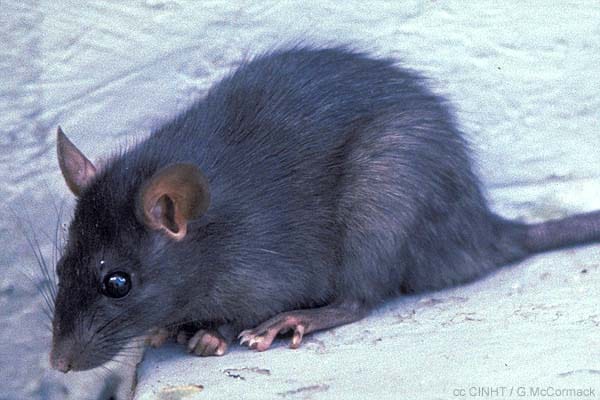
Ship Rat, Dark form – Cook Islands, Miti‘āro – Gerald McCormack
On Rarotonga the name Kiore Toka, meaning “stone rat”, probably originally applied to the burrowing Norway Rat, but now more commonly refers to the common house rat, which is typically the Ship Rat. To distinguish between the three rats in Mäori we can have: Kiore (Pacific Rat), Kiore Toka (Ship Rat) and Kiore Toka Nöruë (Norway Rat).
Although the Pacific Rat can damage young coconut fruit, the rat which causes serious damage is the Ship Rat. A good indication that the Ship Rat has invaded a particular island is the presence of metal bands around the trunks of Coconut Palms. At present, the Ship Rat is known to be abundant on Rarotonga, Mangaia, Mitiºäro and Penrhyn.
The Ship Rat is the most common rat in the inland mountains of Rarotonga, and is the rat which brought the small Rarotonga Flycatcher (Käkeröri, Pomarea dimidiata) to the verge of extinction: 29 individual birds in late 1988. Rat-poisoning and protecting the nests from rats dramatically improved the breeding success of the bird such that by late 1993 there were 60 birds.
Throughout French Polynesia the flycatcher relatives of the Käkeröri have also decreased or disappeared from islands invaded by the Ship Rat. And the small Blue Lorikeet, which was on about 20 islands a hundred years ago, is now on only five. In the cases that have been investigated, the usual conclusion is that the disappearance of the lorikeet was associated with the flourishing of the Ship Rat.
The Blue Lorikeet (Vini peruviana)also flourishes on Aitutaki, where it is called the Kurämoºo. Does the bird flourish on Aitutaki despite the presence of the Ship Rat? Extensive rat-trapping programmes during 1993 and 1994 failed to find any Ship Rat on Aitutaki – an unexpected result, as three Ship Rats were trapped on Aitutaki in 1963, and this rat flourishes on most other Southern Group islands. Unfortunately we do not know why the Ship Rat has disappeared or become very rare on Aitutaki.
In the meantime, it would be ideal to prevent new Ship Rats from invading Aitutaki, because it may flourish and destroy the Kurämoºo. Keeping new rats off Aitutaki will take a coordinated and persistent programme by Quarantine, especially as the harbour facilities continue to develop. Nevertheless it is better to close the gate now, than wait until the new Ship Rats have bolted onto the island. The present scientific opinion, is that an island can have a lorikeet or the Ship Rat – not both.


