



Gerald McCormack, CINHT
Mariri was the first settler of Ātiu, probably around 1300AD, and he called the island ‘Enua Manu, “land of animals”, in response to the great abundance of animals. The oral traditions do not define the type of animals, and it is commonly thought they were birds, hence “land of birds”. Another interpretation refers to pesky insects that so annoyed Mariri that he went back to ‘Avaiki and returned with some birds to control them.
Today Ātiu has more native landbirds than any other local island so it is very deserving of the interpretation “land of birds” rather than the “land of insects”. The island is a birder’s paradise with nine of the twelve native landbirds that breed in the Cook Islands.
The breeding native landbirds of Ātiu are the Cook Islands Fruit-dove (Kūkupa, Ptilinopus rarotongensis), Pacific Pigeon (Rupe, Ducula pacifica), Ātiu Swiftlet (Kōpeka, Aerodramus sawtelli), Chattering Kingfisher (Ngōtare Todiramphus tutus), Rarotonga Flycatcher (Kākerōri, Pomarea dimidiata), Rimatara Lorikeet (Kura, Vini kuhlii ), Grey Duck (Mokorā Taetaevao, Anas superciliosa), Pacific Reef Heron (Kōtuku, Egretta sacra), and Spotless Crake (Mo‘o, Zapornia tabuensis).
To see the other three breeding native landbirds, the nature enthusiast needs to visit inland Rarotonga for the Rarotonga Starling (‘Ī‘oi, Aplonis cinerascens), and Mangaia for the Mangaia Kingfisher (Tanga‘eo, Todiramphus ruficollaris) and Cook Islands Reed-Warbler (Kereārako, Acrocephalus kerearako) – the latter is also common on Miti‘āro. The famous Blue Lorikeet (Kurāmo‘o, Vini peruviana) that flourishes on Aitutaki is not native but an early (pre-1899) introduction from the Society or Tuamotu Islands where it is native.
Here we use the term breeding native landbirds for birds that breed and live permanently on islands. The other landbirds breeding in the wild are introduced birds, which are foreign birds introduced by people that have naturalised. The most widespread and abundant is the Common Myna (Manu Kavamani, Acridotheres tristis), a native of India introduced from 1906 to 1916 from Tahiti. The second most common is the Feral Fowl (Moa Rere-vao, Gallus gallus), a native of Burma introduced by the Polynesian settlers in ancient times. There are also large flocks of the small Chestnut-breasted Mannikin (Toa Kere-a-Rangi, Lonchura castaneothorax) on Mangaia, and a small flock of Eastern Rosella (Platycercus eximius) on southern Rarotonga – both are native of Australia.
The everywhere white bird, the White Tern (Fairy Tern, Kākāia, Gygis candida) is a seabird because, although it rests, roosts and nests on land, it feeds at sea beyond the reef. However, what about the brown birds running around lawns and grassy areas which do not have webbed feet and do not feed in the ocean beyond the reef?
These landbirds are Pacific Golden-Plovers (Tōrea, Pluvialis fulva) which are native or indigenous, but do not breed in the Cook Islands, i.e. they are non-breeding native landbirds. They breed in Alaska and Siberia and migrate the 9,000km to the Cook Islands for holidays when their home country is experiencing winter – sensible! Their more common Alaskan relatives are the Wandering Tattler (Kuriri, Tringa incana) and the Bristle-thighed Curlew (Teue, Numenius tahitiensis). The other migratory landbird here to avoid a winter at home is the Long-tailed Cuckoo (Karavia / Pātangaroa / ‘Aravi‘i / ‘Ātangaroa, Urodynamis taitensis), which breeds in New Zealand during the southern summer and flies the 3,000km to the Cook Islands for the southern winter.
Here we provide photographs and brief notes on the nine breeding native landbirds of Ātiu, while the migratory visitors from Alaska and New Zealand will be a subject for a future article.
Cook Islands Fruit-dove

Cook Islands Fruit-Dove, Adult & juvenile – Cook Islands, Rarotonga – Gerald McCormack
The Cook Islands Fruit-dove (Kūkupa) is only on Ātiu and Rarotonga, and it therefore has a special international status as a Cook Islands endemic – in this case, a 2-island endemic. The Ātiu subspecies lacks the magenta on the breast. It is common everywhere on Ātiu and has two plaintive cooing calls: a descending “OOOOO-OOOO-oooo-ooo-oo-oo” and an ascending-then-descending “ooooo-OOOOO-ooooo”.
This beautiful bird, about the size of a myna, builds a simple platform of twigs on which it incubates a single egg and raises its young. The Golden Cane Palm fruit shown in the photograph at about 15mm diameter is the largest fruit it can swallow.
Pacific Pigeon
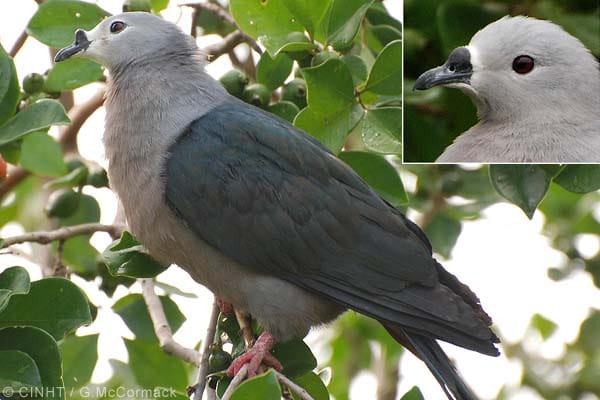
Pacific Pigeon -Adult – Cook Islands, Ātiu – Gerald McCormack 2010-01
The Pacific Pigeon (Rupe) is the largest breeding native landbird and it has two common calls – a brief rolling “RRRRRRR” and a long cooing “MOOOOOOOOO”. They are native on islands from near Papua New Guinea to the Cook Islands, where they are on most islands including the northern atolls.
Their favourite native fruits are Pacific Banyan (Ava) and Guettarda (‘Ano), and nowadays they often fed on introduced plants, such as the fruits of the Red Strawberry Guava (Tūava Papa‘ā) and the Manila Palm, and the buds of the Kapok (Vavai).
Ātiu Swiflet

Kōpeka Adult and juvenile on the nest 2 – Cook Islands, Ātiu – Gerald McCormack
The Ātiu Swiftlet (Kōpeka) is the most unusual bird in the Cook Islands and it is unique to Ātiu where it lives in only two caves: Anatakitaki and Vaitupuranga.
The Ātiu Swiftlet is one of only fourteen species of bird that have developed the ability to roost and nest in deep caves by using echolocation to “see” in total darkness. Unlike microbats, which use the echoes of ultrasonic sounds to navigate and find prey, the swiftlets use the echoes of sonic or human-audible clicks to navigate in the dark around obstacles to their nests and roost sites.
They emerge just before sunrise and outside the cave they never land. They fly continuously and use their incredible eyesight to catch tiny flying insects, mainly “whiskey bugs”, which are small wood-boring beetles.
This 1-island endemic is the most threatened Cook Islands endemic landbird with recent surveys estimating a total population of about 420. The Kōpeka population is limited by the lack of other suitable caves, and within the two caves by the predatory activity of the Long-legged Landcrab (Discoplax longipes, Iārave). This landcrab is found only on makatea islands in the Pacific where it prefers to live in limestone caves. The flashlight photo shows an adult and young swiftlet on a nest made of coconut fibre.
Chattering Kingfisher
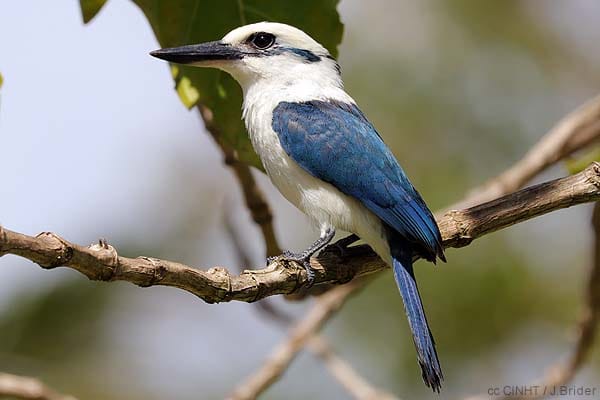
Chattering Kingfisher – Cook Islands, Ātiu – Gerald McCormack 2013-05
The Chattering Kingfisher (Ngōtare) is a small bird with a large beak that lives on Ātiu, Ma‘uke and in the Society Islands. They pair for life and maintain large territories in which there is a suitable tree to dig a hole in which they can raise two to four young during the summer.
The Ngōtare is usually seen sitting on a low branch or power line over a grassy area from which it periodically swoops down to momentarily stand on the ground while it grabs an insect, spider or skink. It carries the prey back to its perch, or another nearby, where a small prey to about a centimetre is juggled to align and swallowed, while a larger prey is softened by thwacking on the branch before slithering down the throat. With no tradition of being hunted by people I am amazed at how quickly they fly away with a screeching alarm call – will they never learn?
People are surprised by our non-fishing kingfisher. However they are not incapable. On Ātiu I once watched a kingfisher on a branch about a metre above the lake dive periodically to catch aquatic prey near the surface – probably fingerling fish.
Rimatara Lorikeet

Rimatara Lorikeet – Left: Adult on a banana flower, Right: nestling in a tree nest – Ātiu – Gerald McCormack 2008
The Rimatara Lorikeet (Kura) was reintroduced to Ātiu after an absence of around two hundred years. It was anciently on most of the Southern Group islands but died out through over-harvesting for its esteemed red feathers, which were used for adornment. Within its former natural range it survived only on Rimatara in French Polynesia. Although feather harvesting is no longer a threat, an invasion of Ship Rat (Rattus rattus) on Rimatara would destroy it. Ātiu is also free of Ship Rat and was therefore a perfect island to establish a reserve population.
The Natural Heritage Trust led the international programme that reintroduced 27 Kura to Ātiu in April 2007 – after six years of negotiations. Within two months four birds flew to Miti‘āro where they have increased to about a dozen, which is surprising, because the island has Ship Rat.
In August 2008 two nests were found. The photo shows the parents coaxing one of their two nestlings out of the nest. After it climbed onto the branch it was knocked to the ground by mynas and this led to an ongoing project to reduce or eradicate mynas on Ātiu.
Despite the problems with mynas, the lorikeets are increasing rapidly and estimates put the number at over 300. Small flocks are seen over most of the inland hills and in the villages feeding on flower nectar and pollen, especially from Coconut Palms, hibiscus and banana.
Rarotonga Flycatcher
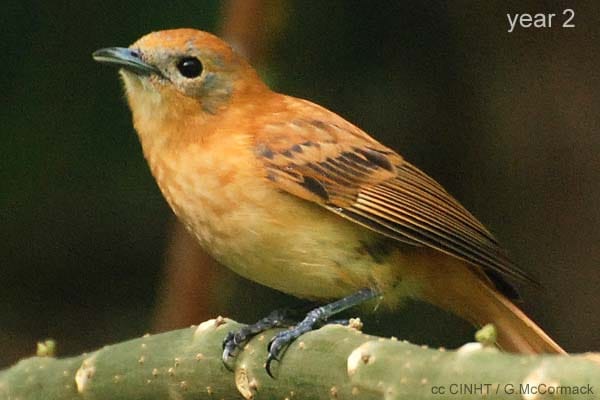
Rarotonga Flycatcher, Subadult – Atiu – Gerald McCormack, 2012
The Rarotonga Flycatcher (Kākerōri) is a single-island endemic of Rarotonga. It was formerly widespread on the island but went into serious decline around the mid-1800s probably mainly because of recently arrived Ship Rats, while at that time Rev. Wyatt Gill thought that hurricanes and cats were the main factors.
Although rare, they hung on until 1987 when there were about 38 in the headwaters of four valleys and as we started to study them in detail they plunged to 29 in two years. Fortunately, by that time a rat control programme was underway and the population rose steadily until there were about 150 in 1996 when the landowners established the Takitumu Conservation Area (TCA). They numbered about 250 in 2001 when ten were introduced to Ātiu to start a reserve population on a Ship Rat-free island – with a further ten in 2002 and ten in 2003. In 2011 another ten were introduced for greater genetic variety.
The introduced flycatchers have bred well and are now very common. They are easily found because they maintain their territories with lots of loud chirping and hissing, and their signature song of “kaakeee-roy”, which inspired the name Kākerōre.
The young birds are orange for two years, mainly grey in their third year and fully grey in the fourth. They make small cup-shaped nests of filmy mosses and usually lay two eggs.
Grey Duck
The Grey Duck (Mokorā Taetaevao) is native from Australia and New Zealand eastward to the Marquesas Islands (check). They are common on Ātiu and because they are not hunted they are seen all over the inland on grass areas and they enjoy the puddles along the unsealed roads. The most constant place to see them is beside and on the lack, but walking past any vacant swampland will probably put a few into the air.
Within the Cook Islands the Grey Duck is flourishing on the makatea islands but it fails to establish on Rarotonga because of the many feral cats and dogs near their swampy habitat.
The Spotless Crake
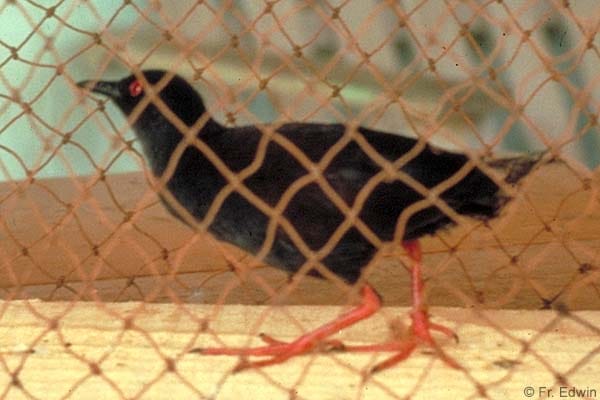
Adult – Ātiu (temporarily caged) – Cook Islands, Ātiu – Fr. Edwin 1980s
The Spotless Crake (Mo‘o) is widespread in the Pacific from Australia south to New Zealand, north to Philippines and Micronesia and eastward to Oeno Atoll in the Pitcairn group. This widely distributed flying crake is the ancestor of flightless crakes in Micronesia, Hawai‘i and Henderson Island (Pitcairn group).
Unfortunately it is in decline in the Cook Islands probably because of feral cats. It is now absent from Rarotonga and rare on the makatea islands except for in the vast swamplands of Miti‘āro. On Ātiu, its low numbers and secretive nature mean it is more likely to be heard than seen. It is a small bird, smaller than a myna, which searches for small invertebrates among the swamp plants. Photo by Jon Irvine, Australia.
Pacific Reef Heron

Pacific Heron, 3 morphs – Cook Islands, Rarotonga – Gerald McCormack
The Pacific Reef Heron (Kōtuku) is a widespread Pacific landbird. Although it is often feeds on land in the swamplands, streams and grassed areas, it more commonly feeds on the exposed reef and in the very shallow parts of the lagoon.
On Ātiu, other makatea islands and Rarotonga most are dark grey which is thought to provide better camouflage in most environments for it to stalk close enough to its prey to grab it by simultaneously lunging and extending its neck. On the reef it is not unusual to see a heron with wings extended dancing back and forth trying to herd small fish as it repeated lunges after them.
Other herons are pure white and this is thought to be an advantage on limestone sands and these are in moderate numbers on Ātiu. However, the genetics of heron colour is not as simple as “you’re dark grey” or “you’re pure white”. Although rare, there are pied or mixed-colour birds which vary of nearly all grey to nearly all white.
Reef Herons are very wary and difficult to approach. During the non-breeding season they have solitary feeding areas. They are usually silent but can give a few brief “craaak-craaak” calls when interacting with other herons. They nest in trees and usually have four young.
First published in the CINEWS (July 2012)


