Plants

Searching for Rare Plants

Searching for Rare Plants

Gerald McCormack, CINHT
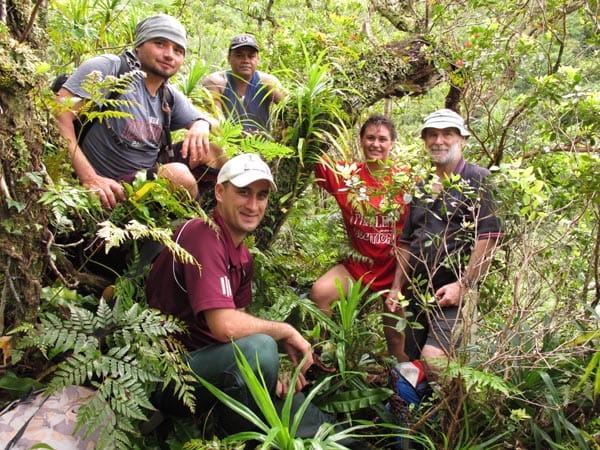
The expedition team from left to right: Jason Tuara, Joe Brider, Edwin Apera (back), Jacqui Evans, Gerald McCormack and photo by Judith Kunzlé.

It has long been hoped that pristine forests at the base of remote and almost inaccessible cliffs might have thriving populations of some of Rarotonga’s rarest plants – maybe even the Pilea, which has not been seen for 80 years.

In July (2010) the Natural Heritage Trust launched a project to assess the status of Rarotonga’s rarest plants. With the assistance of two New Zealand botanists, they explored the island’s native forest, but unfortunately, with one exception, only saw previously known plants. The top ridges of the main mountains were visited, but there is one area the survey failed to get to: the cliffs below the highest ridge, between Te Manga and Te Atukura, in the upper Avana. Continue reading →

Posted by Gerald in Plants, 0 comments
The Origin of the Coconut Palm

The Origin of the Coconut Palm

Gerald McCormack, CINHT

Did the Coconut Palm (Cocos nucifera) originate in the Americas? Was it in the Cook Islands when the first Polynesians arrived?

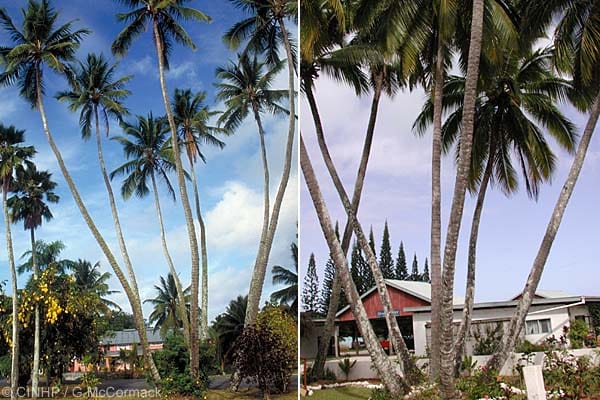
Palms, fruit, flowers and leave – Cook Islands, Rarotonga – Gerald McCormack

The first Western record of Coconut Palms was in 545AD by Cosmos, an Egyptian, who saw them in India and Sri Lanka. Other reports followed, and Marco Polo reported them in Indonesia in 1280. The Portuguese Vasco de Gama discovered the route around Africa to India in 1498. He did not find Coconut Palms on the Atlantic coast of Africa nor in southern Africa. His first record of ‘coquos’ was at Malindi in Kenya. On his way home he left coconuts at Cape Verde, the first in the Atlantic.

In the 1490s Columbus erroneously reported Coconut Palms in the Caribbean. It is now concluded that Diego Corenco, a former pastor of Cape Verde, introduced the first coconuts into the Caribbean to Puerto Rico in 1549. A recent re-evaluation of early Spanish records has concluded that coconuts were pre-Spanish on the Pacific coasts of Costa Rica, Panama and northern Colombia. The writers concluded that coconuts had reached America naturally by floating or they may have been carried by ancient voyagers. Continue reading →

Posted by Gerald in Culture, Plants, 0 comments
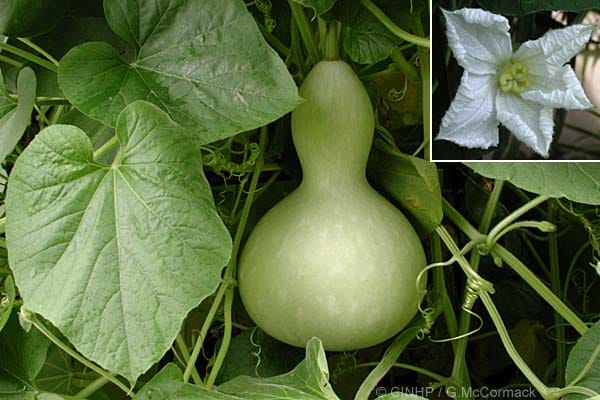
The Bottle Gourd (Hue, ‘Ue) of ancient Polynesia

The Bottle Gourd (Hue, ‘Ue) of ancient Polynesia

Gerald McCormack, CINHT

The ancient Polynesians brought many plants into Polynesia from Melanesia and Asia. Was this the source of the Bottle Gourd or did it come from the Americas?

In the Cook Islands there are 39 useful, or formerly useful, plants that were purposefully introduced by the Polynesian settlers before contact with Europeans. In addition there are 17 weedy plants that were probably accidentally introduced in those ancient times, although some are used in herbal medicines and might have been purposeful introductions. In total: about 56 Polynesian Introduced plants.

Among the Polynesian Introduced plants there are two that probably came from the Pacific coast of South America: the Sweet Potato (Kūmara, Kūara, Ipomoea batatas) and the Bottle Gourd (Hue, ‘Ue, Lagenaria siceraria).

Continue reading →

Posted by Gerald in Culture, Plants, 0 comments
Seven Palms from One Coconut?

Seven Palms from One Coconut?

7 palms 1 nut – Rarotonga, Gerald McCormack

Gerald McCormack, CINHT

On Rarotonga it is sometimes claimed that the seven palms east of the Avarua roundabout grew from one seednut. On Aitutaki it is claimed that the six palms at the Visitor Centre grew from one seednut. Are these claims fact or fiction?

Both curiosities are now gone but were present at the time this article was written in 2003.

A coconut has three pores at the base and, typically, a lone sprout emerges from the single soft pore. Sometimes the embryo forms a twin and two sprouts emerge through the soft pore. On very rare occasions, as once on a Lever Brothers plantation in the Solomons, an embryo developed under each of the three pores and each embryo twinned to give rise to six shoots – although only four survived. Continue reading →

Posted by Gerald in Culture, Plants, 0 comments
Mato – Cyclones Make it Flower

Mato – Cyclones Make it Flower

Gerald McCormack, CINHT

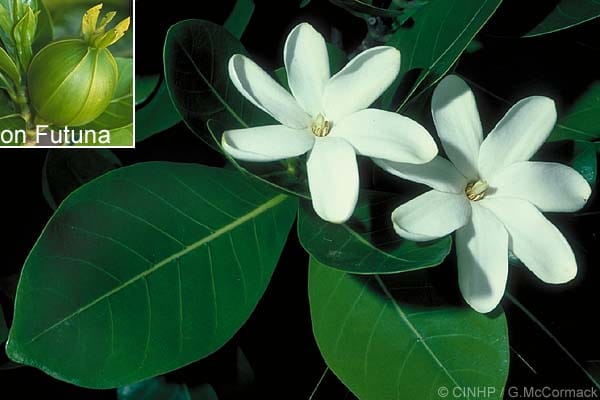
Flowering Mato tree – Rarotonga, Cook Islands – Gerald McCormack

Rarotonga has one of the last pristine native-forests in Polynesia. The ancient Polynesian settlers removed the forest on the lower hills and as these became infertile they developed into the Fernlands. After European Contact, especially after 1823, many new plants were introduced and some of these were planted in the mountains, especially cotton, coffee, and bananas. A Disturbed Forest of Tree Hibiscus (‘Au, Hibiscus tiliaceus) and invasive shrubs now cover these areas. Inland of the Fernland and the Disturbed Forest there remains a near-pristine native forest, protected from people by being too steep for horticulture and by the absence of trees suitable for timber. Continue reading →

Posted by Gerald in Plants, 0 comments