



Gerald McCormack, CINHT,

Neinei Tree, Leaves and flower – Cook Islands, Rarotonga – Gerald McCormack
The Neinei tree of Rarotonga has such a spectacular flower that the tree itself is often called the Pua Neinei (Flower-of-the-Neinei). The Neinei (Rarotonga Fitchia) is a small tree common in the mountains, from the base of low valleys to the top of the highest mountains. It is not found anywhere else in the world, although it has a few shrubby relatives in French Polynesia.
The large leaves are in terminal bunches, and they often have conspicuous grooves, cut inward from the edge. These are the feeding grooves of the 15mm Neinei Weevil (Rhyncogonus lineatus), which feeds exclusively on the young leaves of the Neinei. Like the plant, this weevil is not found anywhere else in the world, although it does have close relatives in Hawaii as well as in French Polynesia.
The Neinei flowers from April to June. The flowers are large, spiky, bright orange and full of nectar.
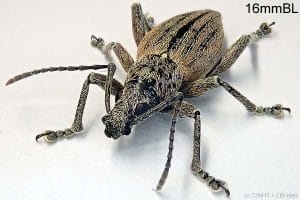
Neinei weevil, Adult [16mmBL] – Cook Islands, Rarotonga – Joseph Brider 2020-12
The Rarotonga Starling is not found anywhere else in the world, and its closest relative, the Mauke Starling (Aplonis mavornata) of Maºuke, which was last recorded about 150 years ago, in 1825. In the olden days the `Ī´oi was the protector of fugitives and food-gatherers in the forest, because it called when other people approached. A famous traditional saying was: `Ī´oi -karanga (starling warns).

Rarotonga Starling, Adult emerging from nest-hole in tree trunk – Cook Islands, Rarotonga – Gerald McCormack
The fame of the starling’s warning call was reflected in the first anti-government newspaper, the Ioi Karanga, published during 1898.
Moss launched the bilingual Te Torea in 1894, it was published by Henry Nicholas, a European-NZ Maori in Rarotonga since the 1860s, on the leased Government printing press. The first Catholics and SDAs settled on Rarotonga in 1894. The SDAs included the American SDA Dr Caldwell, who became the first resident doctor in 1894 and a makeshift hospital was opened in May 1896. In October he was told to stop having religious meeting in the hospital. The Craig brothers arrived in March 1897 and Dr George Craig was within weeks made hospital superintendent. Craig and a number of Europeans started to strongly oppose Moss’s administration. In January 1898 Makea Ariki, exploiting anti-Moss situation, had the printing press forcibly taken from Nicholas as part of her own campaign against Moss. She then started to print the Ioi Karanga on the press. A short-lived newspaper. In mid-1898 Moss, in ill-health and 71 years old, resigned. He left in September. Gudgeon immediately appointed George Craig as medical officer.
First published CINEWS(3 July 199) updated (September 2010)


