Cook Islands

The spread of the “farmers friend” – the myna

The spread of the “farmers friend” – the myna

Gerald McCormack, CINHT
The myna is locally much loathed as a pest, yet it arrived in the early 1900s with such high hopes as the “farmer’s friend”. We follow its triumphant march from India to many countries, including the Cook Islands.

The “farmer’s friend”

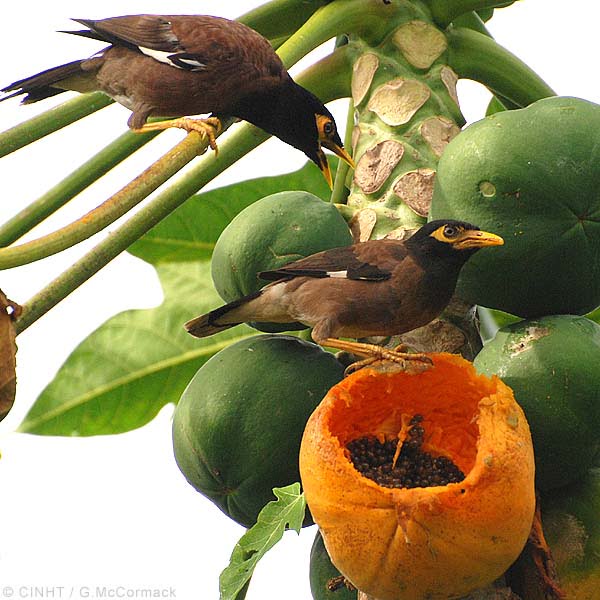
A couple of common myna birds competing for the right to feed on the fruit of the pawpaw.

The Common Myna is indigenous to southern Asia, primarily India. It lives in open woodlands but is strongly associated with people in agricultural and urban areas. It is known as the “farmer’s friend” because it helps control insects.

It was probably the first animal introduced to another country as a biocontrol, when the French took some from southeast India to Mauritius and Réunion islands in 1763 to control locusts/grasshoppers in the sugarcane fields. The French colonists called them “Martin” after Captain Martin of the ship “Gracieuse” that had brought them. The locusts were soon much reduced and the Martin was given the credit.

A little later, in 1766 Linnaeus considered this bird to be a bird of paradise and named it Paradisea tristis, meaning the dull  bird of paradise. In 1816 Vieillot made the genus Acridotheres meaning grasshopper-hunter,and our myna became Acridotheres tristis; literally meaning the dull grasshopper-hunter. An obvious misnomer for a bird that is not dull in behaviour or appearance.

These birds and their relatives are Asian starlings and they are known in Hindi as Mainā, meaning “delightful”, referring to their varied calls and speech mimicry. Mainā is rendered into English as mynah or myna, while the French name is martin. Our particular myna is the Common Myna or Indian Myna, and it is identified in French as Martin triste.

Continue reading →

Posted by Gerald in Agriculture, Animals, Biocontrol Species, Invasive Species, 0 comments
Keanui’s Biodiversity Bonanza

Keanui’s Biodiversity Bonanza

Gerald McCormack, CINHT

Entomologist at work!

Residents often talk about Cook Islands biodiversity, but few have discovered as many unrecorded species as 6-year-old Keanui Selam.  His recent insect-catching expeditions led to the discovery of eight unrecorded species of Heteroptera, a group of insects known as true bugs, or typical bugs.

True bugs all have a proboscis of long tubular mouthparts, which some use to suck the sap of plants; while others use it to spear and suck the juices out of caterpillars and other insects. The first group are farmers’ foes, while the latter are farmers’ friends. Continue reading →

Posted by Gerald in Animals, 0 comments
Will nodule mining destroy our deep sea ecosystem services?

Will nodule mining destroy our deep sea ecosystem services?

Gerald McCormack, Natural Heritage Trust
First published Cook Islands News (29 May 2021),  updated here (29 May 2021)

In an article concerning the possibility of seabed nodule mining in the Cook Islands (Cook Islands News 27 March), Te Ipukarea Society wrote “We are confident that further research will show that the goods and services that the ocean provides humanity are actually worth many times more than what we will get from mining, and for a much longer term.”

In discussing this claim I will focus on deep sea services because with a precautionary approach to nodule mining the main impacts will be in the deep sea rather than the surface waters. The variety and global values of the main deep sea services are presented in the 2020 Food and Agriculture Organisation (FAO) circular: “Economic value of ecosystem services from the deep sea and the areas beyond national jurisdiction” (Ottaviani 2020).((Ottaviani (2020) Economic value of ecosystem services from the deep seas and the areas beyond national jurisdiction. FAO Fisheries and Aquaculture Circular No. 1210. Rome, FAO.)) Although the circular is focused on the “areas beyond national jurisdiction” (ABNJ), or International Waters, it also includes the deep sea within “exclusive economic zones” (EEZs), which makes it inclusive of the Cook Islands polymetallic nodule fields. Continue reading →

Posted by Gerald in Deep Seabed Mining, Ecology, 0 comments
Cook Islands Seabed Minerals – the booklet

Cook Islands Seabed Minerals – the booklet

Gerald McCormack, Natural Heritage Trust
Booklet published 2016. Available here 28 April 2021

An oblique view of the seabed across the South Penrhyn Basin to the Manihiki Plateau.

The Trust’s booklet “Cook Islands Seabed Minerals – a precautionary approach to mining” was published in 2016 after three years of research.

The booklet provides baseline information on the environment and the possible impacts of a typical nodule mining scenario. The information should enable everyone to develop their own views and questions to participate in discussions.  And, in particular, to participate in the Environmental Impact Assessment (EIA) that will decide if mining can occur or not.

You can open it to read and download here:  The Trust’s Booklet

Continue reading →

Posted by Gerald in Deep Seabed Mining, Marine, 0 comments
We’re away, home again in September

We’re away, home again in September

Gerald McCormack, Natural Heritage Trust
First published (14 April 2021), short version CI News (14 April 2021)


Plover in breeding plumage ready for April departure.

The Pacific Golden Plover, or Tōrea, is our most common Alaskan migrant. It is conspicuous on larger grassy areas during the summer and most are now in their dramatic breeding plumage and ready to depart. Continue reading →

Posted by Gerald in Animals, Ecology, Terrestrial, 0 comments