birds

The Status of Cook Islands Birds -1996

The Status of Cook Islands Birds -1996

Gerald McCormack, CINHT

The Cook Islands is fifteen small islands (total land area 240km²), scattered over an area approaching the size of Western Europe, in the tropical South Pacific. Although the 18,000 residents, almost all Polynesian, carry New Zealand passports, the country has been internally self-governing since 1965, and is independently responsible for all environment matters.

Two divisions of Government are specifically concerned with the environment: (1) the Environmental Service (formerly the Conservation Service) implements the environment act, with a special emphasis on Environmental Impact Assessment; and (2) the Natural Heritage Project undertakes research, and prepares publications, to integrate traditional and scientific knowledge on all aspects of the environment. The latter project, formalised in 1990 by the Prime Minister, Sir Geoffery Henry KBE, is unique in the South Pacific.

The limited availability of specialist staff, and of financial resources, has meant that overseas volunteers and funding have been of fundamental importance in monitoring and maintaining the inherently fragile terrestrial and coral-reef ecosystems. Land is under family-inherited ownership and, although it cannot be sold, a small amount is leased to the Government and to non-family people.

The fifteen islands divide socially and physically into a Northern Group of six islands and a Southern Group of nine islands. The five atolls and one sand-cay of the Northern Group, support extensive Coconut Palm plantations for a fickle copra industry. The only resident landbird is the Pacific Pigeon (Rupe, Ducula pacifica), which lives on three atolls, feeding mainly on the fruits of the indigenous Beach Gardenia(Ano, Guettarda speciosa).

Continue reading →

Posted by Gerald in Animals, Birds, 0 comments
Long-tailed Cuckoo – Part 1

Long-tailed Cuckoo – Part 1

Gerald McCormack, CINHT

The Long-tailed Cuckoo (Karavia, Urodynamis taitensis) winters in tropical Polynesia and migrates to New Zealand in October and November to breed by duping other birds to incubate its eggs and raise its young. This post explores its behaviour in the Cook Islands and New Zealand and the discovery that it is a migrant.

Tropical behaviour

Long-tailed Cuckoo, adult on branch and in flight – Cook Islands, Ātiu – Gerald McCormack 2010-04

The Long-tailed Cuckoo is dark brown with pale brown spots topside and white with brown streaks below; its conspicuously long tail is dark brown with pale brown bars.

In the tropics the cuckoo is solitary, secretive and inconspicuous except for the occasional loud screeching “wrrrrisssSST” call from high in trees. They are sometimes seen in fast direct flight between trees or slinking along tree branches in search of insects and lizards.

On Ātiu, twice in March and once in November, I have seen gregarious behaviour of small groups with much chasing associated with a rattling “chi-chi-chi-chi-chi-chi” call. The significance of this behaviour is unknown.

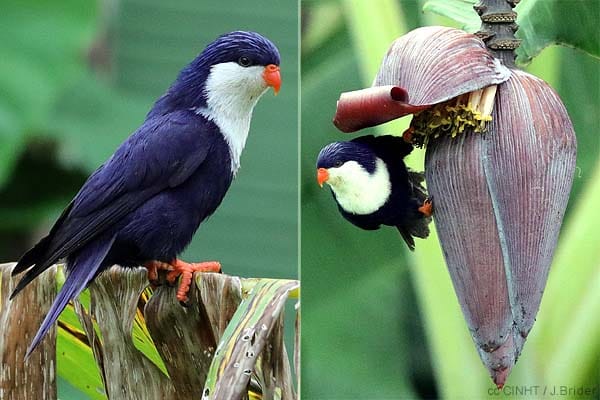
Nesting birds in the Cook Islands, such as the Rarotonga Flycatcher (Kākerōri, Pomarea dimidiata) and the Rimatara Lorikeet (Kura, Vini kuhlii) react very strongly to the presence of a cuckoo and chase it away. In New Zealand the cuckoo is a well-known predator on the eggs and nestlings of other birds and presumably they do the same here when the chance arises. Continue reading →

Posted by Gerald in Animals, Birds, Migration, 0 comments