Rarotonga

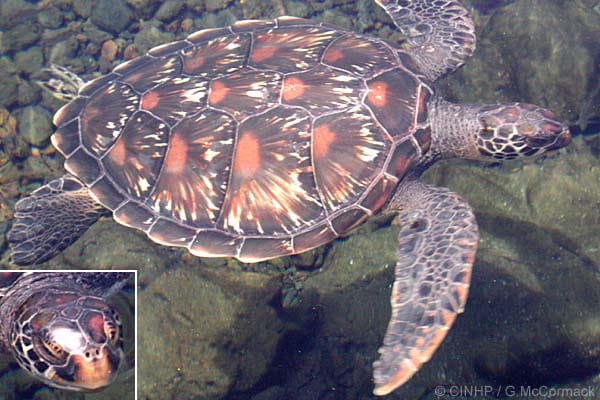
Cook Islands Green Turtle, ‘Onu  – a migratory turtle

Cook Islands Green Turtle, ‘Onu – a migratory turtle

Gerald McCormack, CINHT

Turtle tourism has become a popular year-round activity in Rarotonga, with both Government and civil society groups working to make it safer for turtles and people. The industry is built around “resident” Green and Hawksbill Turtles.

Green Turtle – Gerald McCormack

Recently, Te Ipukarea Society (CI News 22 Feb. 2025) reported 90 Green and 19 Hawksbills. They highlighted one Green Turtle seen in Avaavaroa Passage since 2021 as “a good example of a ‘residential turtle’ that is quite happy spending its days in Vaimaanga”. The following article will focus solely on Green Turtles, which have a distinct lifecycle compared to Hawksbill Turtles.

The presence of around 90 “residential” Green Turtles is a dramatic change from the 1980s and ’90s when such turtles were very rarely seen. What caused this dramatic change? Has there been a local population boom? Have these migratory turtles found a good home and stopped migrating? Can these “resident” turtles contribute to the survival of their endangered species?

Continue reading →

Posted by Gerald in Animals, Marine, 0 comments
The Bottle Gourd (Hue, ‘Ue) of ancient Polynesia

The Bottle Gourd (Hue, ‘Ue) of ancient Polynesia

Gerald McCormack, CINHT

The ancient Polynesians brought many plants into Polynesia from Melanesia and Asia. Was this the source of the Bottle Gourd or did it come from the Americas?

In the Cook Islands there are 39 useful, or formerly useful, plants that were purposefully introduced by the Polynesian settlers before contact with Europeans. In addition there are 17 weedy plants that were probably accidentally introduced in those ancient times, although some are used in herbal medicines and might have been purposeful introductions. In total: about 56 Polynesian Introduced plants.

Among the Polynesian Introduced plants there are two that probably came from the Pacific coast of South America: the Sweet Potato (Kūmara, Kūara, Ipomoea batatas) and the Bottle Gourd (Hue, ‘Ue, Lagenaria siceraria).

Continue reading →

Posted by Gerald in Culture, Plants, 0 comments
The Status of Cook Islands Birds -1996

The Status of Cook Islands Birds -1996

Gerald McCormack, CINHT

The Cook Islands is fifteen small islands (total land area 240km²), scattered over an area approaching the size of Western Europe, in the tropical South Pacific. Although the 18,000 residents, almost all Polynesian, carry New Zealand passports, the country has been internally self-governing since 1965, and is independently responsible for all environment matters.

Two divisions of Government are specifically concerned with the environment: (1) the Environmental Service (formerly the Conservation Service) implements the environment act, with a special emphasis on Environmental Impact Assessment; and (2) the Natural Heritage Project undertakes research, and prepares publications, to integrate traditional and scientific knowledge on all aspects of the environment. The latter project, formalised in 1990 by the Prime Minister, Sir Geoffery Henry KBE, is unique in the South Pacific.

The limited availability of specialist staff, and of financial resources, has meant that overseas volunteers and funding have been of fundamental importance in monitoring and maintaining the inherently fragile terrestrial and coral-reef ecosystems. Land is under family-inherited ownership and, although it cannot be sold, a small amount is leased to the Government and to non-family people.

The fifteen islands divide socially and physically into a Northern Group of six islands and a Southern Group of nine islands. The five atolls and one sand-cay of the Northern Group, support extensive Coconut Palm plantations for a fickle copra industry. The only resident landbird is the Pacific Pigeon (Rupe, Ducula pacifica), which lives on three atolls, feeding mainly on the fruits of the indigenous Beach Gardenia(Ano, Guettarda speciosa).

Continue reading →

Posted by Gerald in Animals, Birds, 0 comments
Rare Seabirds on Aitutaki and Rarotonga

Rare Seabirds on Aitutaki and Rarotonga

Gerald McCormack, CINHT

Laughing Gulls

Adults (right & top), Juvenile (bottom) – Cook Islands, Aitutaki – Gerald McCormack

Seagulls are such common seabirds in New Zealand, Australia and America, that it always comes as a surprise for visitors to find no seagulls in the Cook Islands, assuming they ignore the two plastic ones at the Deli in Foodland. Although seagulls seem like the most adaptable scavengers we can imagine, they have not managed to establish themselves on the islands of tropical Polynesia. The nearest island to have resident seagulls is New Caledonia.

It was therefore surprising when people reported a dull brown seagull at Avatiu and at Muri in April 1992. It stayed a few weeks and then disappeared. Since then a similar type of seagull has been reported during the early months of 1995, 1997 and 1998. These birds were all first-year Laughing Gulls (Leucophaeus atricilla). This means that on each occasion it was a different bird that was seen, and only on one occasion did two birds visit together.

Continue reading →

Posted by Gerald in Animals, Birds, 0 comments
Seven Palms from One Coconut?

Seven Palms from One Coconut?

7 palms 1 nut – Rarotonga, Gerald McCormack

Gerald McCormack, CINHT

On Rarotonga it is sometimes claimed that the seven palms east of the Avarua roundabout grew from one seednut. On Aitutaki it is claimed that the six palms at the Visitor Centre grew from one seednut. Are these claims fact or fiction?

Both curiosities are now gone but were present at the time this article was written in 2003.

A coconut has three pores at the base and, typically, a lone sprout emerges from the single soft pore. Sometimes the embryo forms a twin and two sprouts emerge through the soft pore. On very rare occasions, as once on a Lever Brothers plantation in the Solomons, an embryo developed under each of the three pores and each embryo twinned to give rise to six shoots – although only four survived. Continue reading →

Posted by Gerald in Culture, Plants, 0 comments