New Bird on Mangaia Identified

New Bird on Mangaia Identified

Gerald McCormack, CINHT

Adult and Juvenile Chestnut-breasted Mannikin – Mangaia, Cook Islands – Gerald McCormack

In the CI News (13 May 2006) Sue Ngatokorua described a new bird on Mangaia, and the author suggested it might be a Chestnut-breasted Mannikin (Lonchura castaneothorax). In late May Peter Ngatokorua, who provided the original information for the news article, took Ian Karika and the author to see the birds in Veitatei swamp, and they were confirmed as Chestnut-breasted Mannikins. Groups of up to 30 were seen, and the population might be near 100.

Peter and others had concluded that the bird arrived naturally, because arrival of any cage bird would have sent the inevitable buzz-of-curiosity throughout the Mangaian community. To honour the birds’ great flight to Mangaia, Peter had suggested it be called Toa Kere-ā-Rangi, literally “mighty warrior of Rangi”. While other Veitatei planters suggest it should be named Pātiki-‘Enua-ō-Rangi, an alternate name for Veitatei district, where it was first seen in 1999. Continue reading →

Posted by Gerald in Animals, Biodiversity, Birds, Introduced Species, 0 comments
Long-tailed Cuckoo – Part 1

Long-tailed Cuckoo – Part 1

Gerald McCormack, CINHT

The Long-tailed Cuckoo (Karavia, Urodynamis taitensis) winters in tropical Polynesia and migrates to New Zealand in October and November to breed by duping other birds to incubate its eggs and raise its young. This post explores its behaviour in the Cook Islands and New Zealand and the discovery that it is a migrant.

Tropical behaviour

Long-tailed Cuckoo, adult on branch and in flight – Cook Islands, Ātiu – Gerald McCormack 2010-04

The Long-tailed Cuckoo is dark brown with pale brown spots topside and white with brown streaks below; its conspicuously long tail is dark brown with pale brown bars.

In the tropics the cuckoo is solitary, secretive and inconspicuous except for the occasional loud screeching “wrrrrisssSST” call from high in trees. They are sometimes seen in fast direct flight between trees or slinking along tree branches in search of insects and lizards.

On Ātiu, twice in March and once in November, I have seen gregarious behaviour of small groups with much chasing associated with a rattling “chi-chi-chi-chi-chi-chi” call. The significance of this behaviour is unknown.

Nesting birds in the Cook Islands, such as the Rarotonga Flycatcher (Kākerōri, Pomarea dimidiata) and the Rimatara Lorikeet (Kura, Vini kuhlii) react very strongly to the presence of a cuckoo and chase it away. In New Zealand the cuckoo is a well-known predator on the eggs and nestlings of other birds and presumably they do the same here when the chance arises. Continue reading →

Posted by Gerald in Animals, Birds, Migration, 0 comments
Kōpeka – The remarkable Ātiu Swiftlet

Kōpeka – The remarkable Ātiu Swiftlet

Gerald McCormack, CINHT

The Ātiu Swiftlet (Kōpeka, Aerodramus sawtelli) lives only on Ātiu. They roost and nest inside totally dark caves, where they navigate by echolocation. They emerge at dawn to fly continuously after flying-insects and they rest only if they return to their cave. With a population of less than 200 breeding pairs, the Ātiu Swiftlet is the second most endangered unique Cook Islands bird – after the Rarotonga Flycatcher (Kākerōri, Pomarea dimidiata).

Continue reading →

Posted by Gerald in Animals, Biodiversity, Birds, Endangered, 0 comments
Are there snakes in the Cook Islands?

Are there snakes in the Cook Islands?

Gerald McCormack, CINHT

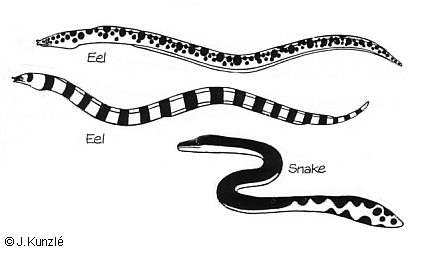
Illustration depicting spotted and banded snake eel and a sea snake – J. Kunzlé

Inshore sea-snakes are common on and around the reefs of Fiji, Samoa, Tonga and Niue, but have never been recorded in the Cook Islands. The snake-like creatures in our lagoons are scaleless fish in the Snake-eel Family.

Snake-eels differ externally from sea-snakes in having a dorsal fin along most of the body, a more-or-less pointed tail, and protruding nostrils on the upper lip. Although they are not poisonous, they do have lots of small sharp teeth.

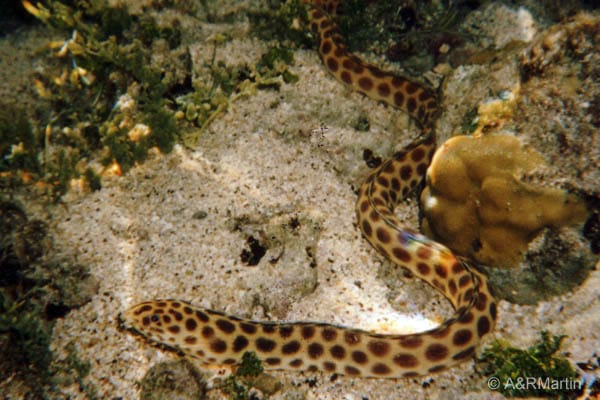
Spotted Snake-eel, (Myrichthys maculosus) – A&R Martin

The most common snake-eels are the Spotted Snake-eel (Myrichthys maculosus) and the Banded Snake-eel or Barred Snake-eel (Myrichthys colubrinus). The Spotted Snake-eel is up to 80cm, cream in colour with black spots. The Banded Snake-eel is a similar length with dark bands completely encircling its white body. And a less common third species has its bands reduced to dark saddles.

Although we have no inshore sea-snakes, we share with the rest of the tropical Pacific, the oceanic Yellow-bellied Sea-snake (Pelamis platurus). Like the inshore sea-snakes, the Yellow-bellied Sea-snake has external scales, a vertical paddle-like tail, no dorsal fin, and non-protruding nostrils. They swim to the surface to fill their lungs with air and can remain submerged for about two hours.

Continue reading →

Posted by Gerald in Animals, Biodiversity, Marine, 0 comments
Cook Islands’ Needlefishes

Cook Islands’ Needlefishes

Gerald McCormack, CINHT

Illustration showing identifying features of the four needlefish species found in Cook Islands

The Cook Islands’ biodiversity database lists 650 species of marine bony-fishes. In looking at the distribution of fishes across the Pacific it is obvious that there must be at least another hundred to be recorded locally. The Trust is always interested in information on new and unusual records.

For the needlefish family the database lists four species: Keeled Needlefish (Miro Va‘a-roroa, Platybelone platyura), Houndfish or Crocodile Needlefish (‘Aku, Tylosurus crocodilus), Reef Needlefish (‘Aku, Strongylura incisa ) and the Flat Needlefish (Pāpā, Ablennes hians).

The Keel-jawed Needlefish has been recorded across the South Pacific, but not specifically in the Cook Islands. However, it is an off-shore species and therefore very unlikely to have been caught in Ngatangi‘ia harbour.

Many species of fish have distinctive features and are reasonably easily identified from photographs, but some require a more detailed analysis of specimens. In the illustration we show some of the more conspicuous features of the four species of needlefish positively identified in the Cook Islands. Continue reading →

Posted by Gerald in Animals, Biodiversity, Marine, 0 comments
Load more