



Gerald McCormack, CINHT
The Ātiu Swiftlet (Kōpeka, Aerodramus sawtelli) lives only on Ātiu. They roost and nest inside totally dark caves, where they navigate by echolocation. They emerge at dawn to fly continuously after flying-insects and they rest only if they return to their cave. With a population of less than 200 breeding pairs, the Ātiu Swiftlet is the second most endangered unique Cook Islands bird – after the Rarotonga Flycatcher (Kākerōri, Pomarea dimidiata).
Swiftlets

Kōpeka adult and juvenile on the nest – Cook Islands, Ātiu – Gerald McCormack
The swift family is made up of about 70 typical swifts and needletails, and about 30 small swifts known as swiftlets or cave swiftlets. The swiftlets are famous for using echolocation or sonar to navigate inside totally dark caves, and for using saliva to glue their nests together. Furthermore they cannot walk or stand on branches or horizontal surfaces, although they can cling to vertical surfaces in caves to roost at night.
The Ātiu Swiftlet is black above and grey below, with a pale saddle over the rump. It has a total body length of only 10cm, with a wingspan of 25cm. It is extremely light with a total weight of about 10g – the weight of two teaspoons of sugar!
The Ātiu Swiftlet is known to roost and nest in only two caves: Anatakitaki in the southeast makatea, and Vaitupuranga in the southwest makatea.
Marathon bird
The birds emerge from their caves at first light and rarely return until dusk, except during the breeding season. While outside the cave they never land to rest. In flight they find small flying insects with their extremely keen vision and by acrobatic flying they scoop them into their momentarily gaping mouth.
The flight speeds of Ātiu swiftlets have not been measured but can be estimated. Its relative, the White-rumped Swiftlet can swoop at 110kph and probably cruises most of the time at 20-30kph, with bursts to around 50kph. At an average of 25kph, the Ātiu Swiftlet would fly 300 kilometres a day, which is equivalent to flying to Rarotonga and halfway home again. This tiny bird undertakes this non-stop marathon every day, except during the month of egg-sitting when it probably flies half as far.
Echolocating microbats
Echolocating animals make a series of clicks or short chirps and use the echoes to locate objects, and the higher the frequency or pitch of each click the smaller the object they can detect. The most widespread and well-known echolocators are the hundreds of insect-eating microbats. They use clicks of around 45,000Hertz, which we call ultrasound because they are above the upper limit that people can hear, which is 20,000Hz. (See Figure 1: Voice and hearing frequencies) At 45,000Hz microbats can find and capture flying moths, as small as 8mm long. Some bats use clicks with a frequency up to 120,000Hz, the highest frequency ultrasound used by any land animal, and at this pitch they can find insects a mere 3mm across!
Although there are more than 800 species of microbat in the world there are none in the Cook Islands or French Polynesia. Our nearest microbats are two species that live in Samoa. The Pacific Fruit-bat (Moa Kirikiri, Pteropus tonganus), which lives on Mangaia and Rarotonga, is not a microbat and it does not echolocate.
Echolocating birds
There are about 9,800 birds in the world and only fourteen can echolocate: thirteen are cave swiftlets, and the fourteenth is the totally unrelated Oilbird of northern South America, which lives in caves and feeds on fruits throughout the night.
In contrast to the complex ultrasonic clicks used by microbats to find and catch insects, swiftlets navigate in the dark with simple clicks people can hear – audible clicks. People are most sensitive to sound-frequencies between 100 and 8,000Hz, which includes our speech, and most can hear up to 12,000Hz, although young people can hear up to around 20,000Hz. Swiftlet echolocating clicks are from 3,000 to 9,000Hz, which means people can hear the whole click – there is no ultrasonic or inaudible component.
The theoretical analysis of the sound frequency of swiftlets indicates they can detect obstacles down to 4cm across, although experiments with some swiftlets show they can detect obstacles to 2cm across. Regardless of whether it is 2cm or 4cm, the system is adequate to avoid slender stalactites, find open spaces to fly through, and locate their nests, which are about 8cm across.
Voice and hearing frequencies
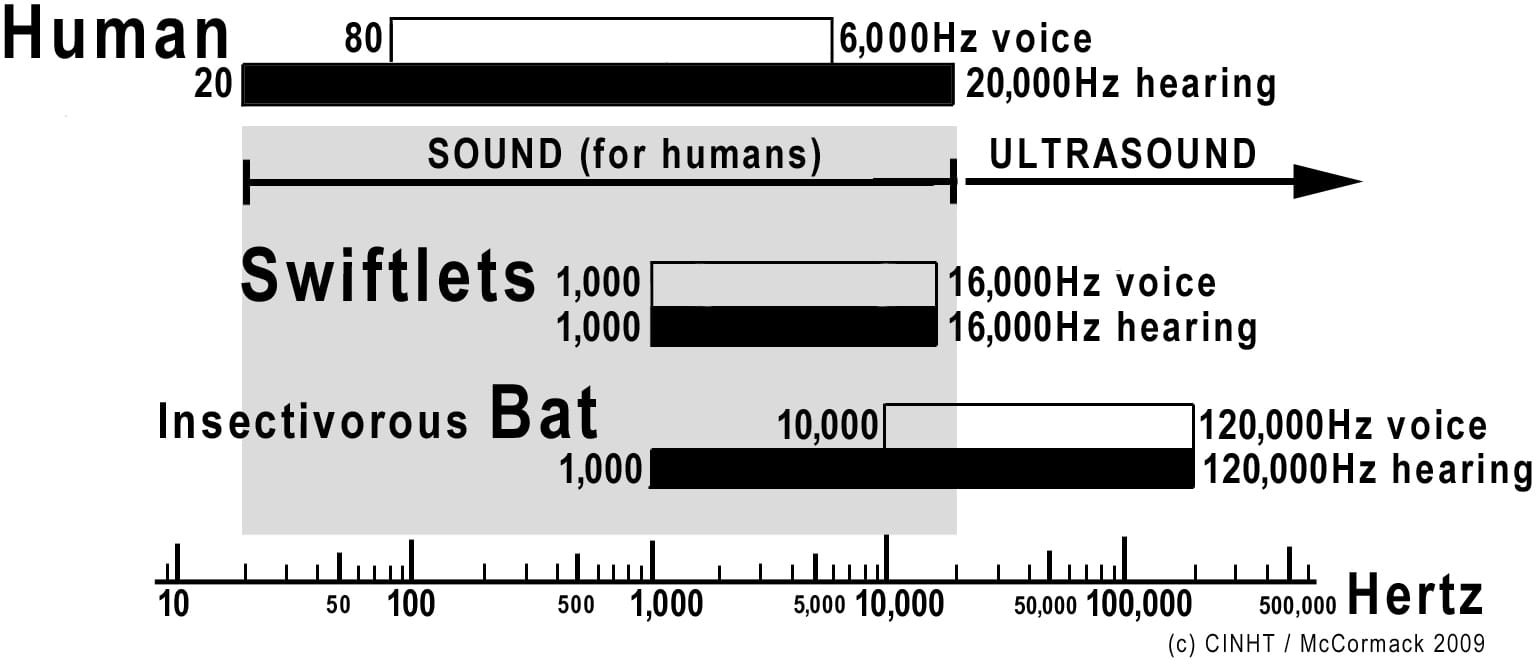
Figure 1: Voice and hearing frequencies of humans, insectivorous bats and Swiftlets
The shaded area depicted in Figure 1, from 20 to 20,000Hz, are frequencies able to be heard by people – at least, by young people. Above this range, to the right, are ultrasounds, which people cannot hear. The cat is interesting. Its talking is audible to people, but it can hear well into the ultrasonic range. This is useful because some of its prey, such as mice, mainly talk in ultrasonic frequencies. [Strange scale? The scale is geometric to increasingly compress the upper frequencies. If it was plotted on a linear or arithmetic scale the illustration would be over two metres wide.]
Kōpeka clicks and chirps
When we listen to echolocating swiftlets we are not hearing changes in frequency, we are hearing the loudness of each click and the interval between clicks – the beat or click-frequency. The clicks for general navigation last 1-3 milliseconds with a beat of about 8-per-second when cruising and and increase to about 12-per-second when approaching objects. See Figure 2: the oscillogram, which shows the loudness of the clicks and the interval between them.
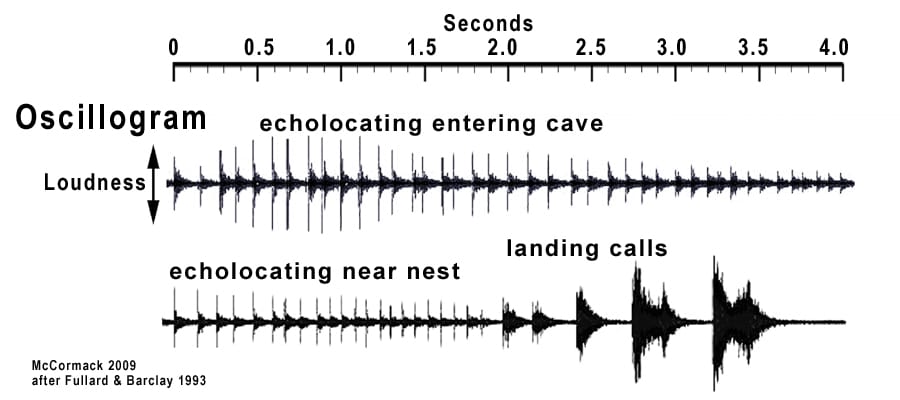
Figure 2: Oscillogram shows interval between each click and chirp of the Atiu Swiftlet while entering the cave and nearing the nest.
Outside their caves Ātiu Swiftlets sometimes give echo-navigation clicks when entering deep shade in the evening, probably to detect and avoid objects that they might not see in poor light. When flying close together chasing insects they sometimes give more prolonged chirps, possibly related to the landing calls, these might warn other birds away or communicate some other message.
The lower oscillogram in Figure 2 shows that as the swiftlet prepares to land on its nest echolocating clicking stops and it gives five chirps of increasing loudness and duration. In English we might render the navigating clicks as “ch-ch-ch-ch-ch” and the landing chirps as “chee-chee-chee-cheerup-CHEERUP”. In the last two landing chirps we can also hear a change in the frequency of the sound – although only volume changes are shown in an oscillogram. These landing chirps are probably warning any bird on the nest to hunker down to avoid a collision.
Aitu Swiftlet Landing chirps
Aitu Swiftlet entering the cave
Population – low but stable?
Typically the nesting season starts in August and finishes in late March. Mike Tarburton undertook a detailed study of Kōpeka nesting in late 1987 and early 1988. He found 190 active nests (74 in Anatakitaki and 116 in Vaitupuranga). Some nests were in the 30 metre long twilight chamber but most were in the deeper totally-dark interior, up to 150 metres from the entrance. Internally the nests were 5cm across and had a 1.5cm wall of coconut crown fibre and lichens welded together with saliva. The nests were glued with saliva onto small ledges or directly onto vertical surfaces. Most nests were more than three metres off the cave floor and more than two metres from other nests.
The parents shared the incubation of the two eggs for about 25 days, and then worked together to feed the nestlings six-times-a-day for about 53 days when the young flew from the nest. How fledglings find their way, for the first time, to the cave entrance in total darkness is not known.
Of the eggs laid only 31% produced a flying young: 10% failed to hatch, 36% disappeared before hatching, and 23% were lost as nestlings – usually by falling out of the nest, but sometimes as a result of predation by the Long-legged Land-crab (Cardisoma longipes) or the Coconut Crab (Birgus latro). In total, the 380 nesting adults produced 118 fledglings.
Swiftlets probably live about 10 years, which means 10% die each year. In theory, the 120 fledglings would replace the 40 adults that die each year and have a surplus of 80 to grow the population.
In 1994 and in 1995 Ron Dobbs undertook new nest surveys. In the first season he found 172 nests (82 in Anatakitaki and 90 in Vaitupuranga), and in 1995 he found 175 (69 and 106 respectively). The number of nests showed that the breeding population had reduced slightly. The 80 young birds had not increased the population. Presumably they died during their first year, as do many Kākerōri.
The main conservation questions are: What keeps the Ātiu swiftlet population at a mere 400 breeding birds? What can be done to increase the number of nest sites, or to reduce the number of eggs and nestlings being lost?
An unexpected ancestor
To the west there is the incredibly widespread White-rumped Swiftlet from Niue and Tonga westward through Fiji to Vanuatu and New Caledonia.
DNA studies have shown a most unexpected ancestry for the Ātiu Swiftlet. While we would expect it to be most closely related to the neighbouring White-rumped Swiftlet, its DNA shows its nearest relative is the Guam Swiftlet in Micronesia, which is 7,000km from Ātiu!
This strange connection is also supported by swiftlet lice – or rather the absence of lice. Because swiftlets nest in isolated caves their lice are passed down within each isolated colony and as the birds evolve so do their lice. All swiftlets investigated to date have lice except the Guam and Ātiu Swiftlets.
Another curious feature of the Ātiu Swiftlet is that it is one of only two swiftlets that echolocate with a single click – the other dozen use a double click. Although swiftlets can distinguish the two clicks – a mere 15-20 milliseconds apart, people cannot distinguish a single clicker from a double clicker without special equipment. The other single clicker is the Black-nest Swiftlet of Myanmar (Burma) eastward to Indonesia and Philippines. These two birds are not genetically closely related and it is thought that they have independently abandoned the ancestral system of double clicking. It is not known why they evolved the single click system.
In the Cook Islands there was formerly a Mangaia Swiftlet on Mangaia, but it was lost sometime before the missionaries arrived in 1823. To the east there are two swiftlets: the Tahiti Swiftlet now only on Tahiti; and, the Marquesas Swiftlet, which is on most islands of the Marquesas.
The three East Polynesian swiftlets are very closely related although they behave differently. The Ātiu Swiftlet echolocates in deep caves and has widely-spaced nests. The Tahiti Swiftlet has close-packed nests on shaded cliffs and it does not echolocate; while the Marquesas Swiftlet has close-packed nests on cliffs and in caves – and in the latter situation they echolocate. Unpublished reports indicate that they lack lice, as we would expect. We would also expect them to use a single rather than a double click. When their DNA is analysed we will know who is ancestral to who and who is closest to the Guam Swiftlet.
First published CINEWS(30 January 2010)


