Birds

Rare Seabirds on Aitutaki and Rarotonga

Rare Seabirds on Aitutaki and Rarotonga

Gerald McCormack, CINHT

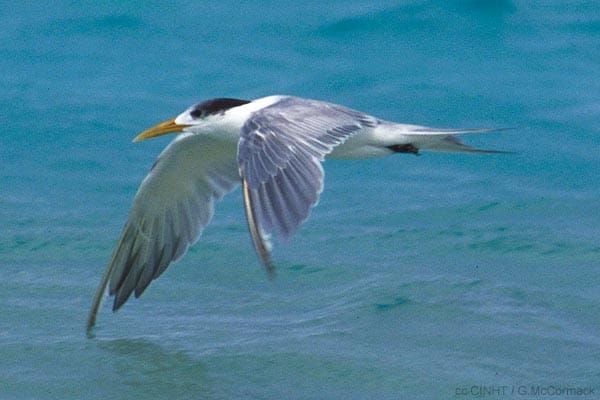
Laughing Gulls

Adults (right & top), Juvenile (bottom) – Cook Islands, Aitutaki – Gerald McCormack

Seagulls are such common seabirds in New Zealand, Australia and America, that it always comes as a surprise for visitors to find no seagulls in the Cook Islands, assuming they ignore the two plastic ones at the Deli in Foodland. Although seagulls seem like the most adaptable scavengers we can imagine, they have not managed to establish themselves on the islands of tropical Polynesia. The nearest island to have resident seagulls is New Caledonia.

It was therefore surprising when people reported a dull brown seagull at Avatiu and at Muri in April 1992. It stayed a few weeks and then disappeared. Since then a similar type of seagull has been reported during the early months of 1995, 1997 and 1998. These birds were all first-year Laughing Gulls (Leucophaeus atricilla). This means that on each occasion it was a different bird that was seen, and only on one occasion did two birds visit together.
Continue reading →

Posted by Gerald in Animals, Birds, 0 comments
Pacific Pigeon (Rupe) – It’s Call

Pacific Pigeon (Rupe) – It’s Call

Adult Rupe – Gerald McCormack -2010

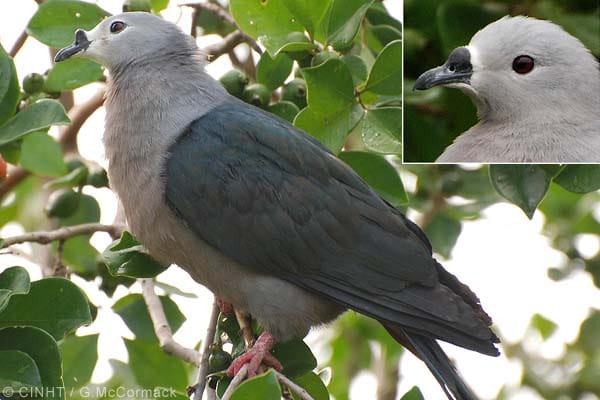
The Pacific Pigeon (Rupe, Ducula pacifica) is the largest forest bird of the Cook Islands. It is dark green on the upper wings and back, with a pale grey neck, head and underside. The adult has a prominent lump on top of its beak. The sexes are identical in appearance. The pigeon has two distinctive calls and many residents believe the calls are gender specific. This article presents detailed observations by Don Organ that support this idea.

The Pacific Pigeon has a native range from the Lau Group (eastern Fiji) through Samoa and Tonga to the Cook Islands. It feeds on fruits, especially Guettarda (‘Ano, Guettarda speciosa), Pacific Banyan (Ava, Ficus prolixa), Perfume Tree (Mata‘oi, Cananga odorata), Kapok buds (Mama‘u, Ceiba pentandra) and Cecropia (Rau-Māniota, Cecropia pachystachya). It is present on the Southern Group islands of Rarotonga, ‘Ātiu, Ma‘uke, Miti‘āro, and Palmerston. In the Northern Group it is present on Manihiki and Pukapuka. Why this native pigeon is missing from Mangaia, while it survives on other similarly man-modified uplifted islands, is a mystery. Continue reading →

Posted by Gerald in Animals, Birds, 0 comments
Cook Islands Fruit-Dove (Kūkupa)

Cook Islands Fruit-Dove (Kūkupa)

Adult and chick – Joseph Brider, 2021

Gerald McCormack, CINHT

The Cook Islands Fruit-Dove (Kūkupa, Ptilinopus rarotongensis) lives only on the islands of Rarotonga and Ātiu, making it a 2-island endemic of the Cook Islands. It was recorded on Ma‘uke in the 1820s but was lost sometime before 1970 – cause unknown. It was also in the fossil record of Mangaia but was lost before the arrival of the Missionaries. Continue reading →

Posted by Gerald in Animals, Birds, 0 comments
Rimatara Lorikeet Reintroduction Programme

Rimatara Lorikeet Reintroduction Programme

Gerald McComack, CINHT

Left: Adult Rimatara Lorikeet – Gerald McCormack. Right: illustration of traditional headress from Ātiu, using the feathers of the Rimatara lorikeet – Judith Kunzlé

It is planned to reintroduce the endangered Rimatara Lorikeet (Ura, Vini kuhlii) to Ātiu in the Cook Islands from Rimatara in French Polynesia in July 2007 to establish a reserve population. The programme is being implemented by four organisations: the Cook Islands Natural Heritage Trust (CINHT), an agency of the Cook Islands government; Te Ipukarea Society (TIS), the Cook Islands affiliate of BirdLife International; the Ornithological Society of Polynesia (MANU), the French Polynesia affiliate of BirdLife International; and Zoological Society of San Diego (San Diego Zoo).

The programme has the support of the President of French Polynesia, Oscar Temaru, the Ministre de l’Environment, the Cook Islands Government, the community of Rimatara, and the traditional chiefs of Atiu. Most of the funding will be provided by the 2006 British Birdwatching Fair through BirdLife International, with co-funding from Fonds Français pour le Pacifique, San Diego Zoo, NZ Department of Conservation, Air Rarotonga, and the Pacific Development and Conservation Trust. Continue reading →

Posted by Gerald in Animals, Birds, Culture, 0 comments
New Bird on Mangaia Identified

New Bird on Mangaia Identified

Gerald McCormack, CINHT

Adult and Juvenile Chestnut-breasted Mannikin – Mangaia, Cook Islands – Gerald McCormack

In the CI News (13 May 2006) Sue Ngatokorua described a new bird on Mangaia, and the author suggested it might be a Chestnut-breasted Mannikin (Lonchura castaneothorax). In late May Peter Ngatokorua, who provided the original information for the news article, took Ian Karika and the author to see the birds in Veitatei swamp, and they were confirmed as Chestnut-breasted Mannikins. Groups of up to 30 were seen, and the population might be near 100.

Peter and others had concluded that the bird arrived naturally, because arrival of any cage bird would have sent the inevitable buzz-of-curiosity throughout the Mangaian community. To honour the birds’ great flight to Mangaia, Peter had suggested it be called Toa Kere-ā-Rangi, literally “mighty warrior of Rangi”. While other Veitatei planters suggest it should be named Pātiki-‘Enua-ō-Rangi, an alternate name for Veitatei district, where it was first seen in 1999. Continue reading →

Posted by Gerald in Animals, Biodiversity, Birds, Introduced Species, 0 comments