Rarotonga

Life in the Karekare Bee Hotel

Life in the Karekare Bee Hotel

Gerald McCormack, CINHT
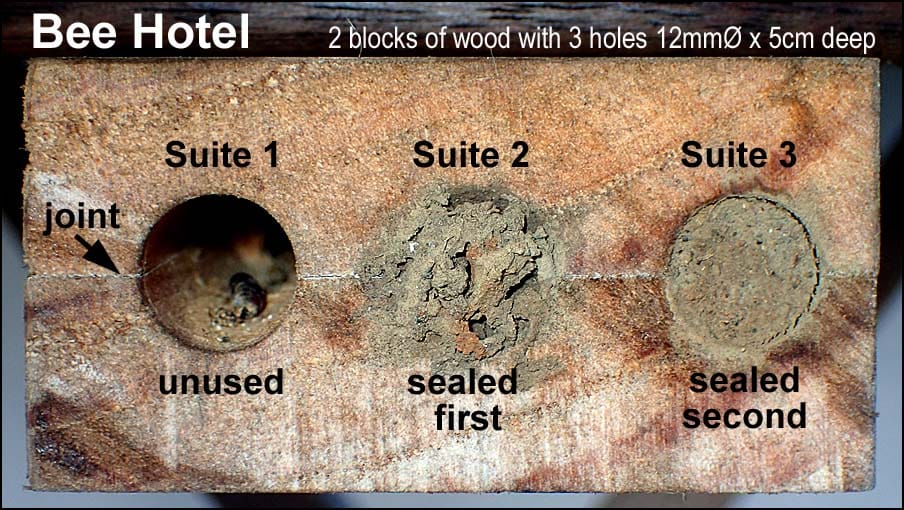
Karekare Bee Hotel at 6pm on 28th December 2021 with suites numbered left to right

We built a small hotel to study the behaviour of the local Leaf-cutter Bee, which usually nests around March or April. The hotel had three 12mm holes about 50mm long drilled to overlap two blocks of wood so that separating them would open the holes for inspection. As a hotel, each hole is a suite and any occupying bee or wasp makes its own rooms by building partitions or doors. Within a suite, Room 1 is the first to be partitioned and will contain the oldest offspring.

Early morning on the 28th December 2021 it was unexpectedly noticed that a large Tahitian Mason Wasp had already sealed Suite 2 with mud and was starting work on Suite 3, which she sealed in the early evening.  Suite 1 remained vacant. Twelve days later, on the 9th January the hotel was opened for inspection. Continue reading →

Posted by Gerald in Animals, Biodiversity, Terrestrial, 0 comments
Rarotonga’s largest skink is now an endemic

Rarotonga’s largest skink is now an endemic

Gerald McCormack, CINHT

In 2010 scientists studied the DNA of Rarotonga’s largest skink and concluded that it was a new species, unique or endemic to Rarotonga. In February they named it Emoia tuitarere – Māori for wanderer, stranger, alien or sailor. For an English name we’ll call it the Wandering Skink. Continue reading →

Posted by Gerald in Animals, Lizards, 0 comments
Keanui’s Biodiversity Bonanza

Keanui’s Biodiversity Bonanza

Gerald McCormack, CINHT

Entomologist at work!

Residents often talk about Cook Islands biodiversity, but few have discovered as many unrecorded species as 6-year-old Keanui Selam.  His recent insect-catching expeditions led to the discovery of eight unrecorded species of Heteroptera, a group of insects known as true bugs, or typical bugs.

True bugs all have a proboscis of long tubular mouthparts, which some use to suck the sap of plants; while others use it to spear and suck the juices out of caterpillars and other insects. The first group are farmers’ foes, while the latter are farmers’ friends. Continue reading →

Posted by Gerald in Animals, 0 comments
We’re away, home again in September

We’re away, home again in September

Gerald McCormack, Natural Heritage Trust
First published (14 April 2021), short version CI News (14 April 2021)


Plover in breeding plumage ready for April departure.

The Pacific Golden Plover, or Tōrea, is our most common Alaskan migrant. It is conspicuous on larger grassy areas during the summer and most are now in their dramatic breeding plumage and ready to depart. Continue reading →

Posted by Gerald in Animals, Ecology, Terrestrial, 0 comments
Tree-ferns – Our Living Fossils

Tree-ferns – Our Living Fossils

Joseph Brider, Natural Heritage Trust.
First published online (16 Feb 2021).

Tree-fern

Budding Tree-fern (Cyathea decurrens). Photo: CINHT

Scattered throughout the Rarotonga inland forest are our Tree-ferns, known locally as Panga. These plants are not trees, they are ferns which have evolved a trunk-like stem to lift their leaves up off the forest floor in order to seek life-sustaining sunlight.
Continue reading →

Posted by Joseph in Ecology, Plants, Terrestrial, 0 comments