


Gerald McCormack, CINHT
In 2010 scientists studied the DNA of Rarotonga’s largest skink and concluded that it was a new species, unique or endemic to Rarotonga. In February they named it Emoia tuitarere – Māori for wanderer, stranger, alien or sailor. For an English name we’ll call it the Wandering Skink.
Our lizards: geckos and skinks
Lizards in the Cook Islands are either day-active, glossy-scaled skinks or nocturnal, matt-skinned geckos. The geckos are famous for walking up glass windows and across ceilings, a feat achieved by minute, adhesive filaments under their broad toes. In contrast, skinks have long slender toes with long claws. They have very acute vision to hunt insects and to avoid predators.
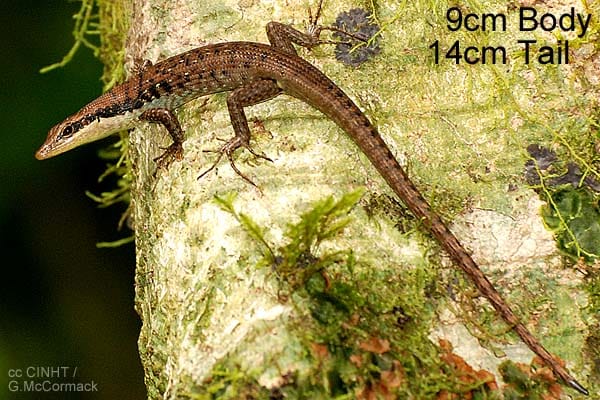
Emoia tuitarere – Gerald McCormack
Ocean-voyaging skinks
Eight of our lizards are geckos, six are skinks. The skinks and geckos reproduce by laying eggs, except the Moth Skink which gives birth to one or two live young.
The distribution of skinks in the South Pacific has lead scientists to conclude that while some got themselves through the Solomons, Vanuatu and Fiji, as far east as Samoa and Tonga, those of the Cook Islands and French Polynesia were probably all stowaways on ancient voyaging canoes.
In the case of the Moth Skink, a study of its DNA showed very limited variation in Oceania, which showed it had spread very rapidly from Vanuatu eastward through Fiji to the Tuamotu and Marquesas islands of French Polynesia and Hawai‘i. This rapid dispersal was achieved as stowaways on voyaging canoes long before the arrival of European ships in the Pacific.
Evidence shows that the seafaring Lapita People began their Pacific odyssey in Indonesia passing along northern Papua New Guinea and the Solomons, then southward to New Caledonia and eastward to Fiji, Tonga and Samoa, where they arrived about 800BC. After a settled life of nearly two thousand years, during which they became the Polynesians, something happened that made them take to their canoes again. Around 1000AD they colonised the Society Islands where they apparently settled again for nearly two hundred years and then they quite quickly colonised Rapanui, the Marquesas, Hawai‘i and New Zealand.
Eastward of Samoa, the Polynesians transported forty or fifty useful plants and four useful animals: pigs, fowls, dogs and rats. Not noticed or tolerated were stowaways on their canoes, including about twenty weeds, a few insects, including the filariasis-spreading Polynesian Mosquito, and several skinks and geckos.
From Dandy to Wandering
The large tree-climbing skink of Rarotonga was first recorded by scientists in 1987 and they concluded that it was the same kind of skink found in Fiji a little earlier. The Fiji skink is known as Emoia trossula, which is Latin for “dandy”, because its colourful pattern reminded the scientists of the flamboyant clothes of a dandy (a sharp dresser). The Natural Heritage Trust used the English name Dandy Skink for the one on Rarotonga, while Barred Tree Skink and Gibbons’ Emo Skink were used elsewhere.
With the recent discovery that the Dandy Skink is a new species, we will now call it the Wandering Skink. It’s body is about 8cm long and its tail twice as long, about 16cm – a total length 24cm (~10 inches). It is more than twice the length of the other five skinks in the Cook Islands.
It has a rich brown colour with a varying pattern of black markings, from a few black spots to blotches or bars with white flecks. A broken black stripe on the side of the head separates the brown upper body from the cream chin and throat.
Our skink had widespread publicity in New Zealand in 2010 when it helped Dillion Anderson win the coveted title of New Zealand Geographic Photographer of the Year, competing with over 1,000 other photographers. The winning photo was also reproduced in the Cook Islands News (6 December). Although the photo is very artsy, it is clear that it is a Wandering Skink.
The Wandering Skink is known only from Rarotonga, making it an endemic of Rarotonga, and it is the only endemic lizard east of Tonga. It has not been found on any of the Outer Islands. It is typically seen in the mountains on the trunks of trees, and when disturbed it quickly moves to the other side of the truck and heads upwards. It is uncommon to rare on the lowlands because it is preyed upon by domestic and feral cats.
Its relatives
The first large skink described in the South Pacific was Emoia samoensis in 1851, and it became the yardstick as related skinks were discovered. During the mid-1900s large skinks were found in Fiji and they were generally thought to be insignificant variants of Emoia samoensis. It was not until the 1986 that they were divided into several species, and the new Emoia trossula was the closest species of the now Samoan endemic, Emoia samoensis.
Emoia trossula is widespread on the islands of Fiji, except for the two main islands where it is thought to have been destroyed by the Small Indian Mongoose, introduced in 1883, and feral cats. Emoia trossula was subsequently reported from Rarotonga in 1987 and from Tonga in 1988.
The 2010 DNA study of Emoia trossula and some close relatives in the samoensis-group has radically changed our knowledge of these skinks. The big surprise is that the Rarotonga skinks are clearly distinct from all other species in the analysis, and furthermore they are not most closely related to the trossula of Tonga, Fiji and Rotuma, or to samoensis of Samoa. Instead they are most closely related to three endemic skinks in Vanuatu, 1000km west of Fiji. This blew apart the convenient idea that our large skink was a descendent of the widespread Emoia trossula and that it had simply moved another step to the east, either naturally or with the voyaging canoes heading east from Tonga or Samoa.
Incidentally the DNA data for Tonga showed that their Emoia trossula has been separated from the Emoia trossula of Fiji for eons and it will eventually also warrant a new name as an endemic skink of Tonga.
Its origin
What did the DNA tell us about the origin of our Wandering Skink? DNA is a wonderful research tool for tracing origins, although often the results are more suggestive than conclusive. In the case of our Wandering Skink ,the results are downright confusing and leave us with two very different possible scenarios.
The first scenario is that more Wandering Skinks live undiscovered on one of the islands of Vanuatu or the Solomons, and the ancestors of our skinks arrived here in relatively recent times, presumably on a voyaging canoe. If this turns out to be the case, our skink will lose its present international fame as the only endemic lizard east of Tonga and it will be just another stowaway lizard.
The other scenario is that it does not exist anywhere in Melanesia. Instead it left its Melanesian homeland in very ancient times and wandered one way or another over 2-3,000km to end up on Rarotonga. As it was island-hopping, or after it arrived, it evolved into a new species. This is not as impossible as it might sound. There are many examples of animals being widespread in the fossil records and surviving today only in remote locations, because those on the stepping-stones were displaced by more advanced late-comers or the arrival of predators.
The final chapter of the origin of the Wandering Skink of Rarotonga is yet to be revealed.
Author’s notes
First published CINEWS (12 March 2011)
References:
Hamilton, A.M.; Zug, G.R. and Austin, C.C. (2010) Biogeographic anomaly or human introduction: a cryptogenic population of tree skink (Reptilia: Squamata) from the Cook Islands, Oceania. Biological Journal of the Linnean Society, 100:318–328.
Zug, G.R.; Hamilton, A.M. and Austin, C.C. (2011) A new Emoia samoensis group lizard (Squamata: Scincidae) from the Cook Islands, South-central Pacific. Zootaxa, 2765: 47–57.
Brown, W.C. and Gibbons, J.R.H. (1986) Species of the Emoia Samoensis group of lizards (Scincidae) in the Fiji Islands, with descriptions of two new species. Proceedings of the California Academy of Sciences, 44(4): 41-53.
Crombie, R.I. & Steadman, D.W. (1987) The lizards of Rarotonga and Mangaia, Cook Island Group, Oceania. Pacific Science, 40: 44–57


