Migration

The long-tailed Cuckoo – Part 2

The long-tailed Cuckoo – Part 2

Gerald McCormack, CINHT

This post is the second in a 2-part blog about The Long-tailed Cuckoo (Karavia, Urodynamis taitensis) which winters in tropical Polynesia and migrates to New Zealand in October and November to breed by duping other birds to incubate its eggs and raise its young. Part 2 explores the birds polynesian names and the possibility it was linked to early navigation.

Polynesian names

Figure 1: Polynesian names of the Long-Tailed Cuckoo throughout the Pacific

The initial Polynesian culture developed in the Fiji, Samoa and Tonga area starting about 3,000 years ago (1000 BC). After 2000 years, around 1000 AD, they began to explore eastward to find and settle the Society Islands; continuing eastward, they soon settled the Tuamotu, Marquesas, Pitcairn and Rapanui. Around 1200 AD they probed north from the Marquesas to discover Hawai‘i. At a similar time, from the Societies and Rarotonga, they persisted to the southwest into difficult winds and cold seas to discover New Zealand.

As each new community formed their inherited language and culture changed by varying degrees. Sometimes known plants and animals were given new names, but more commonly earlier names were maintained with a new pronunciation which was later preserved in the written language. Such words are called cognates; a good example is the Cook Islands Rupe (Pacific Pigeon, Ducula pacifica), a cognate of Samoa Lupe, with R replacing L.

Linguistic research shows that the ancient name for our cuckoo was Kāleva and this name survives unaltered in Tonga, Tokelau and Pukapuka. The name survives as cognates throughout most of Polynesia:  ‘Āleva in Samoa with glottal for K; Kā‘eva‘eva in Marquesas with glottal for L; Kārevareva  in Tuamotu with R for L; and in Tahiti ‘Ārevareva, with glottal for K and R for L.  See Figure 1.

In the Cook Islands, except for Pukapuka, the traditional Polynesian name has been replaced by new names:  Karavia (Rarotonga and Aitutaki), ‘Aravi‘i (Ātiu),  Pātangaroa (Mangaia), ‘Ātangaroa (Ma‘uke),  Koekoeā (Penrhyn) and Kokorove (Manihiki, Rakahanga and Palmerston). It is not known when or why there was a widespread development of new names in the Cook Islands.

The situation in New Zealand is interesting. The Māori arrived with the traditional cuckoo name as the cognate Kārewarewa from tropical Eastern Polynesia but they applied it to the New Zealand Falcon, which is superficially similar to the Long-tailed Cuckoo. For the cuckoo, the best known Māori name is Koekoeā which is probably a cognate of the now forgotten ‘Ō‘ōea, for the cuckoo, in the 1851 Davies’ Tahitian dictionary. Tongareva probably got its Koekoeā from the same source.

Other New Zealand Māori names include Kawekaweā, Kaweau, Kawekaweau and Kōhoperoa. The name Kaweau is also the name of the Tuatara Lizard and the three related names might be derived from the ancient belief that the cuckoo turned into a lizard during the winter. The name Kōhoperoa might have been obtained from an unrecorded Tahitian name in which hope-roa meant “tail-long” and was a common Tahiti prefix.

The navigators guide to Aotearoa?

One of the best known “traditions” of the discovery of Aotearoa was published in 1913 and translated by Percy Smith in the “The Lore of the Whare-wananga, Part 2, Chapter 3″ which was recorded in about 1865 from the traditional teacher Te Matorohunga. It recounts that a Tahiti chief Kupe discovered Aotearoa in his waka Matahorua accompanied by his friend Ngake in a second waka. They were chasing a troublesome giant octopus belonging to a man Muturangi. It led them to the North Cape of Aotearoa and down the eastern coast until they killed it near the South Island. They explored both islands and returned to Ra‘iatea and Tahiti.

There is no known Māori oral tradition suggesting that the cuckoos were migratory or implicated in the original discovery of Aotearoa. This hypothesis was first suggested by Percy Smith in 1907 as the editor of the Journal of the Polynesian Society commenting on an article by Taylor White which suggested in general terms that navigators’ at sea would sometimes notice migrating birds and could easily sail in the same direction. Percy Smith commented: “We think there is a great deal of probability in Mr. Taylor White’s theory, and would suggest that it was the flight of the kohoperoa, or long-tailed cuckoo, that first induced the Polynesian voyagers to come as far South as New Zealand. The kohoperoa winters in the Islands from Samoa to Tahiti.” (JPS 16:92)

In 1913 Smith translated the well-known Kupe story and he wrote in his preamble: “the probable inducement to Kupe to undertake the long voyage from Tahiti to New Zealand, was the flight of the Kohoperoa, or long-tailed Cuckoo, which an observant people like the Maoris on seeing this bird coming year after year from the South West, and well knowing that it was a land bird, would immediately conclude that land of considerable size lay in that direction.”

In his famous 1972 book “We, the Navigators” David Lewis concluded that Polynesian navigators could have converted observed landbird flight paths into directions on their star compass, but cautioned: ” I want to stress that the hypotheses about following migratory bird paths remain entirely speculative.”

The Pacific Golden-Plover (Tōrea, Pluvialis fulva) is a conspicuous landbird on the shore and open areas. In April its departure northward to Alaska is very conspicuous: the birds gather into groups at staging areas and then they depart directionally in large groups, and afterwards there is a dramatic decrease in the number of plovers.  It is widely accepted and there seems no reason to doubt that the plover’s northward migration inspired the early Marquesas navigators to persist northward until they found the Hawai’i islands.

In contrast to the departure of the plover, the October-November departure of the Long-tailed Cuckoo is very inconspicuous with them leaving alone or in small groups without any fanfare and with no apparent dramatic decrease in their numbers. Furthermore, the recent evidence showing that many Eastern Polynesia cuckoos drift westward after June and go to Aotearoa from around Tonga, means there are much fewer birds flying direct from the Cooks and Societies to New Zealand. I conclude that using the flight path of the Long-tailed Cuckoo to find Aotearoa is unlikely but not impossible.

Other guides to Aotearoa

Although the direction of migrating cuckoos would have been difficult to detect, there are other birds migrating across tropical Polynesia to New Zealand around November that were more easily observed because of their great numbers.

Figure 2: Depicting three pacific flyways

In November 1985 I was on the Ravakai from Penrhyn to Rarotonga and for more than a day small petrels, similar to Cook’s Petrel (Pterodroma cookii), were flying past on a somewhat similar course. There is no petrel nesting in large numbers in the Southern Group so it seemed likely they were heading to New Zealand.

In recent years, mainly using electronic systems, the circum-Pacific migratory paths of Sooty Shearwater (Titi, Muttonbird, Ardenna grisea) and Cook’s Petrel (Titi) have been mapped in detail. These birds undertake indirect loop paths from New Zealand to their favourite feeding grounds off Peru, Southern California, Alaska and Japan but when they fly back to New Zealand in October and November they fly along remarkably straight flyways across Polynesia.

The Peru – Southern New Zealand Flyway used by Cook’s Petrel is a little too far south of tropical Polynesia to have alerted navigators of land to the southwest.

The Hawai‘i – New Zealand Flyway is used by an immense numbers of Sooty Shearwaters and Cook’s Petrels. This popular flyway runs down just west of the Cook Islands past Samoa and Tonga to New Zealand. Despite the immense number of birds using this flyway it might not have been known to navigators in the Southern Cooks and Societies.

It is the California – New Zealand Flyway used by Cook’s Petrel that has distinct possibilities of being the ancient navigators guide to New Zealand. This flyway passes through the Cook Islands and even today around 250,000 petrels use this route, and this is a population decimated by people and introduced predators. In the ancient past the numbers of petrels using this path would have been immense and would have been an overwhelming pointer to distant lands for any navigator. As Lewis pointed out, the navigator would interpret the direction into his star map and could navigate when convenient in that direction.

Author’s notes

First published CINEWS (15 March 2014)
Posted by Gerald in Animals, Birds, 0 comments
Rare Seabirds on Aitutaki and Rarotonga

Rare Seabirds on Aitutaki and Rarotonga

Gerald McCormack, CINHT

Laughing Gulls

Adults (right & top), Juvenile (bottom) – Cook Islands, Aitutaki – Gerald McCormack

Seagulls are such common seabirds in New Zealand, Australia and America, that it always comes as a surprise for visitors to find no seagulls in the Cook Islands, assuming they ignore the two plastic ones at the Deli in Foodland. Although seagulls seem like the most adaptable scavengers we can imagine, they have not managed to establish themselves on the islands of tropical Polynesia. The nearest island to have resident seagulls is New Caledonia.

It was therefore surprising when people reported a dull brown seagull at Avatiu and at Muri in April 1992. It stayed a few weeks and then disappeared. Since then a similar type of seagull has been reported during the early months of 1995, 1997 and 1998. These birds were all first-year Laughing Gulls (Leucophaeus atricilla). This means that on each occasion it was a different bird that was seen, and only on one occasion did two birds visit together.

The really surprising thing about these solitary visitors is that they have come all the way from the eastern United States or the Caribbean, where they left their nests in July or August. After the breeding season the adults and young spread out mainly going to the southern part of the breeding area in the Caribbean, and into South America. Many also fly to the Pacific coast of North America, and they often spread down the South American coast, sometimes reaching Chile. For many years it has been known that a few birds have overshot the American coast and made their way to Hawaii. It now seems that every year or two a young bird somehow finds its way to the Cook Islands.

While the young birds reported have been almost uniformly dull brown, a visit to the Sandspit or “Honeymoon Island” on Aitutaki in April [1998] revealed two Laughing Gulls in their more dramatic plumage. The more mature one had grey and black wings, a white body with a dramatic black hood over the head and a black band on the tail. After much e-mail correspondence with American ornithologists it has been concluded that these birds were second-year Laughing Gulls, and that they have another year to go before they are ready to breed. It is not known if after April they flew back to America to be there when the adults were breeding during the middle of the year, or if they have remained in Aitutaki to fly back to America next April or May when they will be mature.

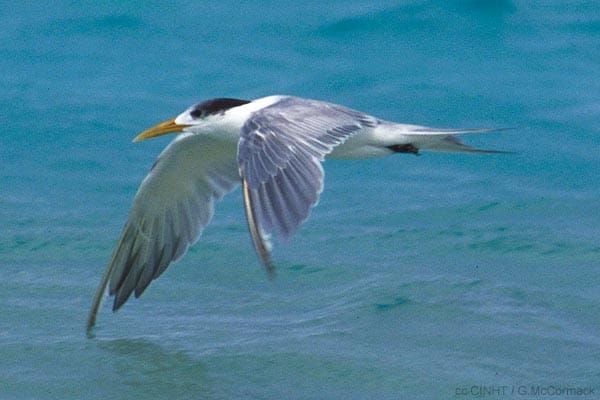
Crested Terns

Adult in flight, first known national record – Cook Islands, Aitutaki – Gerald McCormack 1998-04

The April [1998] visit to Aitutaki revealed another very rare seabird, the Crested Tern(Thalasseus bergii). This tern breeds in Fiji and Tonga in the west, the Societies and Tuamotu in the east, but not in the Cook Islands or Samoa. This is an unusual pattern and it is difficult to see how the Cook Islands and Samoa differ from the islands both east and west on which the tern breeds. It is certainly the most conspicuous seabird on the shoreline of atolls and high islands throughout French Polynesia.

The Crested Tern is a pale grey and white seabird about the size of the Brown Noddy (Ngōio, Anous stolidus). It is distinguished from other terns by the large yellow beak and the black crest on the head. It was enjoyable to see two on Aitutaki and, who knows, maybe this species will eventually settle down and breed there. Hopefully the students of Araura College will continue to watch out for this new seabird.

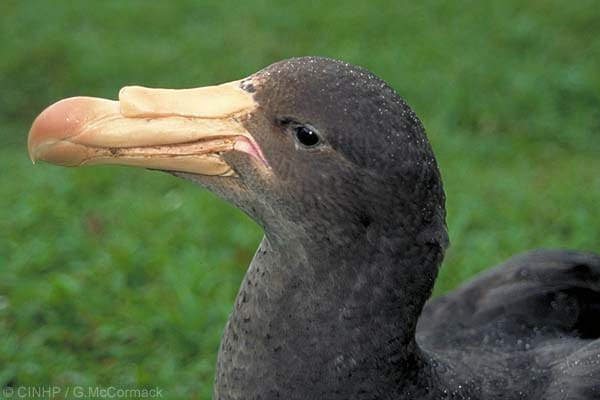
Giant-Petrels

Sub-adult colour-phase (Rarotonga 1997) – Cook Islands, Rarotonga – Gerald McCormack

While commenting on rare seabirds, I should mention the enormous brown bird that Junior Papa managed to keep alive on halfbeaks (miromiro, Euleptorhamphus viridis) for a few months. Quite a number of people reported a seabird, resembling a dark brown goose, flying around Muri and Titikaveka last September [1997].

This enormous seabird, with a two-metre wingspan, was a young Northern Giant-petrel (Macronectes halli). They breed on remote islands near Antarctica but otherwise live on the wing throughout the cold Southern Ocean. The young birds sometimes wander northward and this is the second juvenile positively identified in the Cook Islands, the other being on Mauke (1970). A similar bird on Aitutaki (1985) may have been this species, but it may also have been the very similar Southern Giant-Petrel (Macronectes giganteus). Unfortunately, it was a one-way journey for all three young giant-petrels. There is no definite Polynesian name for these gigantic but uncommon visitors, although the Ruro of Mangaia may have been this species.


Author’s notes

First published CINEWS (08 August 1998)


Posted by Gerald in Animals, Birds, 0 comments
Cook Islands’ Largest Butterfly – the Monarch

Cook Islands’ Largest Butterfly – the Monarch

Monarch Butterfly (Danaus plexippus) Left: Caterpillar Right: adult butterfly – Gerald McCormack

Gerald McCormack, CINHT

Our largest native butterfly is the Monarch Butterfly(Pepe Renga, Danaus plexippus) which is present on all the Southern Group islands. It is orange and black, with a wingspan to 10cm. It is usually seen near the Red Cottonweed(Tirika, Asclepias curassavica), a wayside weed. The adult sucks nectar from a variety of flowers, while the caterpillar requires a plant in the milkweed family, such as Red Cottonweed (aka Butterfly Weed, Bloodflower). The caterpillars grow to 5cm in length, and are covered with narrow yellow, black, and white bands.

Colonising the Pacific

The Monarch was originally an American butterfly but as people spread the American milkweeds to other countries the butterfly was able to colonise them – it is now circumtropical. In the Pacific, the first records were: Hawai‘i 1840, Tonga 1863, Samoa 1867, Rarotonga 1869, Tahiti 1872, Queensland 1870. The first New Zealand records were rather confused but it was regularly collected from 1873, with a possible earlier collection in 1868. These dates are consistent with the theory that the butterfly spread naturally by flying from the Americas to Hawai‘i; then to the Fiji-Tonga area; and, then west to Queensland, east to the Cook Islands and French Polynesia, and southwest to New Zealand.

In the Cook Islands the butterfly is present all the year round, while in North America it undertakes a remarkable migratory journey that takes four or five generations to complete each year. In the Cook Islands we have the Long-tailed Cuckoo(Karavia, Urodynamis taitensis) that migrates each year to New Zealand (3000km each way), and the Pacific Golden-Plover(Tōrea, Pluvialis fulva) that breeds each year in Alaska (9,000km each way) – but imagine a butterfly that can fly from southeast Canada to Mexico (4,000km).

The North American Migration

Monarch Butterflies cannot hibernate and therefore they must migrate from cold regions, like southern Canada and most of the USA, to tropical areas, like Mexico or southern California. In the Cook Islands there is no need to migrate, while in parts of New Zealand there is a partial migration of monarchs to a few warmer wintering sites. However, it is in North America that the migration is most remarkable.

In August the monarchs that develop in southern Canada and in central and eastern USA do not reach sexual maturity, and the nectar they drink is stored as fat rather than used to make eggs. During the fall (August – October) they use their efficient soaring flight, and take advantage of favourable winds, to migrate to the mountains of central Mexico, where they hang in crowds in tall trees from November thru January. Under favourable conditions butterflies from Canada can do the 4,000km journey in about two months – averaging around 70km-a-day. The known record for a one-day passage was a tagged butterfly that covered 430km in 24 hours!

They migrate during the day, and rest up at night and during rainstorms. They navigate using the position of the sun, using their biological clock to compensate for its “movement” across the sky, thereby maintaining a steady course to Mexico. If the sun is hidden by cloud they know its position from the pattern of polarised light in any patch of blue sky. While day-to-day navigation is relatively well understood, how they inherit the information to go to particular wintering sites in Mexico is a mystery.

Many butterflies die during the long migration, especially when the weather is unfavourable. For example, in 2004/2005 few butterflies arrived at the El Rosario reserve, one of the five in Mexican sites. They hung in trees covering a mere 2.2hectares – the least successful migration in 14 years. The cause was thought to be adverse weather. By comparison, the most successful migration was in 1996/97 when they occupied 18 hectares at El Rosario – an estimated 160 million butterflies.

In Mexico in the spring, around February and March, the females mature, mate, and start a northward migration laying their eggs on milkweeds as they go. These wintering butterflies die of old age at around 8 months. The northward migration continues with the next generation (the first generation), who take the usual month to become adults and live for up to six weeks, during which time they lay more than 700 eggs. The migration continues until the fourth or fifth generation, when the shortening days and cooling nights trigger the emergence of the special immature adults. These adults store fat, and undertake the incredible journey to Mexico.

Author’s notes
First published Cook Islands Bishop Museum biodiversity and Natural Heritage website (December 2005), modified/updated (if applicable)
Based on several sources including:
http://www.monarchwatch.org
http://www.learner.org/jnorth/search/Monarch.html – Page no longer exists
Ram, Anahi (2005) Mexico sees bigger butterfly migration. Reuters, Nov 20. El Rosario, Mexico.
Gibbs, G.W. (1980) New Zealand Butterflies – Identification and Life History. Collins, Auckland.
Moorhouse, Anna (2005) Migrating Monarchs Need UV Light to Stay on the Straight and Narrow Journal of Young Investigators. Vol. 12.


Posted by Gerald in Insects, 0 comments
Long-tailed Cuckoo – Part 1

Long-tailed Cuckoo – Part 1

Gerald McCormack, CINHT

The Long-tailed Cuckoo (Karavia, Urodynamis taitensis) winters in tropical Polynesia and migrates to New Zealand in October and November to breed by duping other birds to incubate its eggs and raise its young. This post explores its behaviour in the Cook Islands and New Zealand and the discovery that it is a migrant.

Tropical behaviour

Long-tailed Cuckoo, adult on branch and in flight – Cook Islands, Ātiu – Gerald McCormack 2010-04

The Long-tailed Cuckoo is dark brown with pale brown spots topside and white with brown streaks below; its conspicuously long tail is dark brown with pale brown bars.

In the tropics the cuckoo is solitary, secretive and inconspicuous except for the occasional loud screeching “wrrrrisssSST” call from high in trees. They are sometimes seen in fast direct flight between trees or slinking along tree branches in search of insects and lizards.

On Ātiu, twice in March and once in November, I have seen gregarious behaviour of small groups with much chasing associated with a rattling “chi-chi-chi-chi-chi-chi” call. The significance of this behaviour is unknown.

Nesting birds in the Cook Islands, such as the Rarotonga Flycatcher (Kākerōri, Pomarea dimidiata) and the Rimatara Lorikeet (Kura, Vini kuhlii) react very strongly to the presence of a cuckoo and chase it away. In New Zealand the cuckoo is a well-known predator on the eggs and nestlings of other birds and presumably they do the same here when the chance arises.

New Zealand behaviour

Each year the Long-tailed Cuckoo is first noticed in New Zealand in October and November. Although generally inconspicuous, they make their presence known with an occasional “wwrrrrissST” call while perched high in a tree or when flying. Around mid-November the males start to gather in small choral groups singing “wwwrrrissST” and “chi-chi-chi-chi-chi”  to attract females which are receptive from mid-November to mid-December. After mating the females go their own way, in search of food and a suitable nest into which they can lay an egg.

In the North Island the cuckoo lays exclusively in the cup-nest of the common Whitehead (Pōpokatea/ Pōpokotea, Mohoua albicilla), while in the South Island they lay mainly in the cup-nest of the common Brown Creeper (Pipipi, Mohoua novaeseelandiae) and also into the tree-hole-nest of the endangered Yellowhead (Mōhua, Mohoua ochrocephala). These closely-related bush birds are tiny compared to the cuckoo – a mere 15cm long and 20g versus 40cm long and 130g.

The cuckoo approaches the nest of prospective adoptive parents with stealth, for if they detect her they are alarmed and chase her away – only to have her sneak back again and again. The host nest usually has 2-4 eggs; the cuckoo lays directly into the nest and its egg is usually not noticed because it is similar in colour, even if significantly larger (23x17mm compared to 20x15mm). It is not known if the Long-tailed Cuckoo uses its beak to remove one of the host’s eggs before laying, as is known for some other species of cuckoo.

The cuckoo egg hatches in 16 days and the nestling is an aggressive beggar for food and grows rapidly. As soon as possible it pushes the host’s eggs or hatchlings out of the nest. The adoptive parents struggle to keep up with its demand for food. They must be relieved when after three weeks the nestling leaves the nest, only to discover that it will sit on a nearby branch demanding to be fed for another month. At this stage it is six times the size of its foster parents and it is ready to fly away to find its own food. In total, the small birds worked for nine weeks to get rid of their super-sized foster child and it is then too late in the season to have a family of their own.

The mystery bird

Māori and early naturalists in New Zealand were very aware that the two cuckoos – the Shining Cuckoo (Pīpīwharauroa, Chalcites lucidus) and Long-tailed Cuckoo – appeared in Spring and disappeared for the winter.

The cuckoos were well-known to Māori as the  joyful harbinger of Spring. But where they went for winter was a mystery. There was a widespread belief that the cuckoos buried themselves for the winter – in riverbed mud, in holes in Puriri (Vitex lucens) trees, or in rock crevices. Some believed that when buried they transformed into lizards and they reversed the process in Spring. There was no suggestion that the cuckoos arrived and departed over the ocean.

By the 1850s, New Zealand ornithologists increasingly believed that the cuckoos were tropical migrants. In contrast, overseas biologists were less convinced as we see in 1876 when the great Alfred Wallace, cofounder of the theory of evolution with Darwin, wrote that New Zealand ornithologists had “insufficient evidence” to prove that the cuckoos migrated over a thousand miles of open ocean, which he thought was “extremely improbable”. Undaunted, two years later, in 1878 Walter Buller declared in his Royal Society paper that the Long-tailed Cuckoo “migrates every winter to the Society Islands”. In the 1888 classic “The History of the Birds of New Zealand”, Buller mentioned the cuckoo in Fiji, Samoa, Tonga, Societies and Marquesas and declared that it migrated to New Zealand.

Hutton in 1901 and Fulton in 1903 both presented a wide range of scientific evidence before the Royal Society and established beyond reasonable doubt that the Long-tailed Cuckoo migrates between New Zealand and the islands of the tropical Pacific.

Meanwhile on islands in the tropical Pacific some of the collectors of cuckoo specimens, including immatures, were claiming the bird bred in the tropics. As late as 1917, the renowned American ornithologist Alfred Wetmore accepted the claims that the cuckoo bred in the tropics, and with further support from a difference of plumage colour he proposed two subspecies: Urodynamis taitensis taitensis breeding in the tropical Pacific islands, and Urodynamis taitensis pheletes breeding in New Zealand.

Figure 1: Winter and summer ranges for the Long-tailed Cuckoo throughout the Pacific

Finally, in 1937 Bogert undertook an extensive study of specimens and established the modern understanding of the migration and wintering distribution of the Long-tailed Cuckoo.

After breeding in New Zealand the adult cuckoos leave during January and February to migrate to the tropical islands of the Pacific, mainly to the islands of Fiji, Samoa, Tonga, Cook Islands, the Australs and Societies which are 3000 to 4000km from North Island. In many cases they are thought to undertake a direct overwater flight – the longest of any landbird.

The cuckoo has been recorded in New Zealand flying 80km/hr and if we assume it can sustain a modest 50km/hr during migration, it would take two-and-a-half days to fly the 3,000km to Rarotonga. With the initial support of the common westerlies it probably transits in less than two days.

Some cuckoos migrate much further afield to Micronesia in the west and the Marquesas and Pitcairn in the east, 5,000 to 6,000km from New Zealand. Future satellite tracking would show if they island-hop or fly direct.

The young cuckoos leave New Zealand in March and April and migrate by themselves northward to the tropical islands using inherited knowledge. Recent evidence shows that young cuckoos do not just fly north and stop at the first island. Their knowledge enables them to migrate to the full adult wintering distribution from Micronesia to French Polynesia.  Amazing.

The juvenile birds have conspicuous cream spots above and a pale brown underside; by September most have changed into adult plumage. It is not known how many first year birds accompany the breeding adults south in October and November, but it is thought that the adults in the tropics during the summer are first-year birds which will migrate to breed in their second year.

The migration story took a surprising twist in 2012 when Gill and Hauber undertook a new study of specimens and observations. They concluded that many cuckoos in tropical Eastern Polynesia, such as the Cook Islands, do not migrate directly southwest to New Zealand. Beginning in June they use the persistent Southeast Trades to move westward to Samoa, Tonga and Fiji and it is from there that they migrate to New Zealand in October and November thereby avoiding the unfavourable westerlies below 30°S.


Author’s notes

First published CINEWS (08 March 2014 ), modified/updated (03 March 2026)

Posted by Gerald in Animals, Birds, Migration, 0 comments
We’re away, home again in September

We’re away, home again in September

Gerald McCormack, Natural Heritage Trust
First published (14 April 2021), short version CI News (14 April 2021)


Plover in breeding plumage ready for April departure.

The Pacific Golden Plover, or Tōrea, is our most common Alaskan migrant. It is conspicuous on larger grassy areas during the summer and most are now in their dramatic breeding plumage and ready to depart. Continue reading →

Posted by Gerald in Animals, Ecology, Terrestrial, 0 comments