Gerald McCormack, CINHT
The Cook Islands is fifteen small islands (total land area 240km²), scattered over an area approaching the size of Western Europe, in the tropical South Pacific. Although the 18,000 residents, almost all Polynesian, carry New Zealand passports, the country has been internally self-governing since 1965, and is independently responsible for all environment matters.
Two divisions of Government are specifically concerned with the environment: (1) the Environmental Service (formerly the Conservation Service) implements the environment act, with a special emphasis on Environmental Impact Assessment; and (2) the Natural Heritage Project undertakes research, and prepares publications, to integrate traditional and scientific knowledge on all aspects of the environment. The latter project, formalised in 1990 by the Prime Minister, Sir Geoffery Henry KBE, is unique in the South Pacific.
The limited availability of specialist staff, and of financial resources, has meant that overseas volunteers and funding have been of fundamental importance in monitoring and maintaining the inherently fragile terrestrial and coral-reef ecosystems. Land is under family-inherited ownership and, although it cannot be sold, a small amount is leased to the Government and to non-family people.
The fifteen islands divide socially and physically into a Northern Group of six islands and a Southern Group of nine islands. The five atolls and one sand-cay of the Northern Group, support extensive Coconut Palm plantations for a fickle copra industry. The only resident landbird is the Pacific Pigeon (Rupe, Ducula pacifica), which lives on three atolls, feeding mainly on the fruits of the indigenous Beach Gardenia(‘Ano, Guettarda speciosa).
Two unpeopled seabird islands
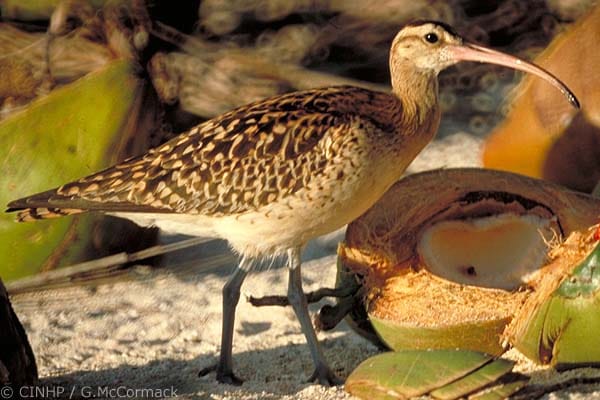
Adult Bristle-thighed Curlew (Numenius tahitiensis)- non-breeding – Cook Islands, Rarotonga – Gerald McCormack 2011/10
The most important avian-island in the Northern Group is the uninhabited atoll of Suwarrow, which has been a national park since 1978. Its reef-islets, a mere 1.6km², support regionally significant colonies of Sooty Terns (Onychoprion fuscatus (100,000 pairs)), Lesser Frigatebirds (Fregata ariel,(5,000 pairs)), Red-footed Boobies (Sula sula, (1,000 pairs)), Red-tailed Tropicbirds (Phaethon rubricauda,(500 pairs)), and locally significant colonies of Great Frigatebirds (Fregata minor, (200 pairs)), Brown Boobies (Sula leucogaster, (100 pairs)) and Masked Boobies (Sula dactylatra, (10 pairs)).
The other special seabird-island is Takūtea, an uninhabited sand-cay (1.2km²) in the Southern Group. Its traditional owners, the people of ‘Ātiu, have maintained Takūtea as a wildlife sanctuary since early this century. It has the country’s largest colony of Red-tailed Tropicbirds (1,500 pairs), and the only Southern Group colonies of Great Frigatebirds (100 pairs), Red-footed Boobies (100 pairs) and Brown Boobies (20 pairs). Takūtea is also a regionally important wintering site for the Bristle-thighed Curlew (Numenius tahitiensis), an Alaskan migrant listed as “Vulnerable” in BirdLife’s Birds to Watch 2.
The Southern Group
The Southern Group, with 90% of the land and 90% of the population, is physically diverse with a young volcanic island (Rarotonga), four raised-reef islands (Mangaia, ‘Ātiu, Ma‘uke and Miti‘āro), an almost-atoll (Aitutaki), two atolls (Manuae and Palmerston) and a sand-cay (Takūtea). Rarotonga, the commercial and administrative centre of the country, is the largest (67km²), highest (653m) and most populated (10,000) island. The inhabitants live on narrow, coastal lowland with a highly-modified vegetation, while the mountainous interior is a near-pristine tropical forest supporting three endemic landbirds.
The Southern Group, which includes Endemic Bird Area F29, supports eleven indigenous, non-migratory landbirds. These include: four single-island endemics (Rarotonga Flycatcher (Pomarea dimidiata),Rarotonga Starling (Aplonis cinerascens), Atiu Swiftlet (Aerodramus sawtelli) and Mangaia Kingfisher (Todiramphus ruficollaris); two two-island endemics (Cook Islands Fruit-Dove (Ptilinopus rarotongensis) and Cook Islands Reed-Warbler (Acrocephalus kerearako)); and seven multi-island non-endemics (Grey Duck(Anas superciliosa), Reef-Heron(Egretta sacra), Pacific Pigeon (Ducula pacifica), Spotless Crake(Zapornia tabuensis) and Chattering Kingfisher(Todiramphus tutus)). Only three introduced landbirds have naturalised: Red Junglefowl (Gallus gallus), Blue Lorikeet(Vini peruviana), and Common Myna(Acridotheres tristis).
The birds of special international interest are the six endemic landbirds, which are all listed as “Vulnerable” or “Critically Endangered” in BirdLife’s Birds to Watch 2. The other bird of special international interest is the introduced Blue Lorikeet, which is endemic to neighbouring French Polynesia, where it has decreased its indigenous range from more than 20 islands at the turn of the century to six islands today.
Critically endangered Rarotonga Flycatcher
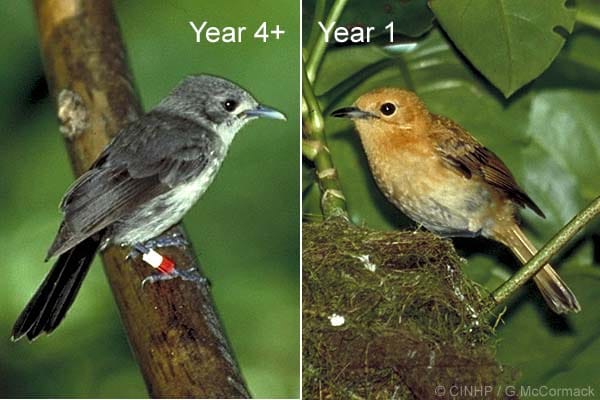
Rarotonga Flycatcher – Gerald McCormack
The single “Critically Endangered” species, and now the most well known Cook Islands bird, is the Rarotonga Flycatcher (Kākerōri), or Rarotonga Monarch. In 1885 a naturalist recorded that the flycatcher, which had formerly been abundant everywhere on the island, had undergone a serious decline and was almost extinct. Nearly a hundred years later, in the first national bird survey of 1972, British ornithologist David Holyoak saw two, heard three, and estimated the population at one or two dozen pairs. In 1983, British ornithologist David Todd reported 21 birds, and two nests, in the headwaters of adjacent valleys on the south side of the island. In the spring of 1987, New Zealanders Rod Hay, Hugh Robertson and myself launched the Kākerōri Recovery Programme, under the auspices of the Cook Islands Conservation Service, with volunteers from New Zealand, and financial support from the New Zealand Government and the South Pacific Regional Environment Programme (SPREP).
The first two breeding seasons established: (1) that the total population of 38 Kākerōri were restricted to an area of about 150 hectares in the headwaters of adjacent valleys; (2) that their eggs and nestlings were being destroyed by rats, the most common being the Ship Rat (Rattus rattus); and (3) that the population decline was accelerating! New Zealander Ed Saul became the backbone of the programme during the third season (1989): poisoning rats, protecting nests and documenting nest success. As a result of his continued efforts, initially as a volunteer and later as a member of the Cook Islands Conservation Service, the number of Kākerōri has risen from the low of 29 initiating his first season to more than 132 at the start of the 1996 breeding season.
Mangaia Kingfisher
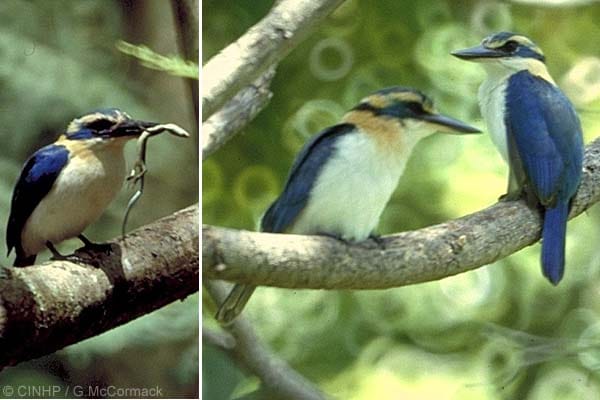
Left: Adult with dinner in its beak. Right: pair of Adult Mangaia Kingfishers – Gerald McCormack
Mangaia, nearly the same size as Rarotonga, has eroded volcanic hills in the centre surrounded by a kilometre-wide limestone palisade – a raised-reef – reaching 60m elevation and supporting a healthy tropical forest. The fossil record shows that Mangaia had 13 resident landbirds, of which only five have survived, including the Mangaia Kingfisher (Tanga‘eo), a single-island endemic. We treat this rufous-collared kingfisher as a separate species, although some taxonomists have it as a subspecies of the more widespread Chattering Kingfisher.
During the early 1980s, residents of Mangaia were reporting that their kingfisher was declining in numbers, and they blamed the Common Myna, which was successfully introduced around 1960. I talked about this problem at the BirdLife World Conference in Hamilton New Zealand in 1990, which lead to Stella Rowe and other volunteers from the Ornithological Society of New Zealand carrying out a baseline study during October and November 1992. From the 149 birds seen/heard, they estimated the population at between 250 and 450 birds. They also concluded that the kingfishers bred more successfully in the dense Barringtonia patch-forests, and less successfully in open modified-forests where they were disturbed by the Myna. Ship Rat and Pacific Rat (Rattus exulans) were both common in most forest types, including the Barringtonia patch-forests, but were not suspected of involvement in any nest failure.
During 1996 Camilla Baker, and other students from Oxford University, supported by the Heritage Project, estimated the numbers of birds on Mangaia using a different method to the Rowe team, and carried out detailed vegetation and rat surveys. Although their conclusions on the distribution of kingfishers showed significant differences, their population estimate of 400 to 700 birds, supported the earlier work. They also estimated that there were 9,000 (± 1,000) Mynas on the island.
Ātiu Swiftlet

Kōpeka Adult and juvie on the nest 2 – Cook Islands, Ātiu – Gerald McCormack
Ātiu, another raised-reef island, has six indigenous resident-landbirds including the Ātiu Swiftlet (Kōpeka), a single-island endemic. This swiftlet is unusual in using an audible clicking to navigate in the pitch-black interior of its breeding caves. Australian Mike Tarburton investigated the Kōpeka during the 1987 breeding season and found that the species was restricted to two caves, which supported only 190 nests, and that some nests were destroyed by a large land-crab. Because one of the caves has become a popular eco-tourism destination, the Heritage Project designed a standardised system to monitor the swiftlet population. New Zealand volunteers Ron and Joan Dobbs implemented the survey over the 1994 and 1995 breeding seasons, and although the relative numbers of active nests in the two caves varied from year to year, the totals were stable at 172 and 175.
The fourth single-island endemic frequently raising concern is the Rarotonga Starling (‘Ī‘oi), which is restricted to the rugged inland of Rarotonga. Although this species has not been quantitatively surveyed, it is widespread throughout the inland. However, because they occupy relatively large territories, their total number may be relatively low, in the vicinity of, say, 500 birds.
The two two-island endemics, the Cook Islands Fruit-Dove (Kūkupa) and Cook Islands Reed-Warbler (Kereārako), are relatively common. The fruit-dove is common on Rarotonga and Ātiu, while the reed-warbler is common on Mangaia and Miti‘āro.
Blue Lorikeet of Aitutaki
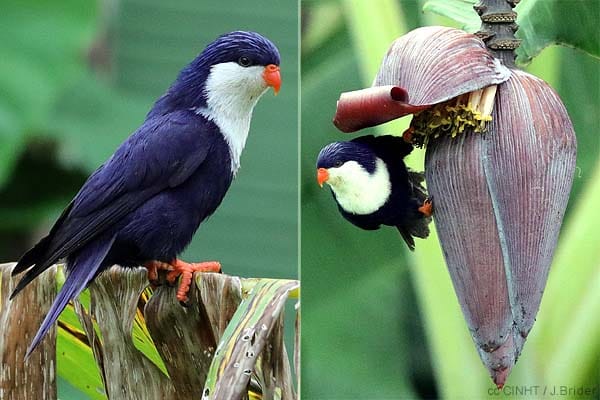
Blue Lorikeet on a banana plant – J Brider 2021
The last resident landbird of special international interest is the Blue Lorikeet (Kurāmo‘o) on the almost-atoll of Aitutaki. American palaeobiologist David Steadman has fossil evidence from several islands to show that the indigenous lorikeet of the Southern Cooks was the Rimatara Lorikeet (Kura). Unfortunately, this species supplied the red feathers widely used by chiefs and in ceremonial headdresses, and excess harvesting was probably the main factor in its extirpation from the Cook Islands sometime prior to the arrival of European settlers in the 1820s.
The first mention of the Blue Lorikeet on Aitutaki was in 1899 when it was referred to as the pet of the natives. Presumably it arrived as a cage-bird in the early 1800s on one of the many sailing ships from French Polynesia, where the species was still widespread.
The Blue Lorikeet population has been surveyed several times in the last twelve years, although the lack of a standardised methodology has prevented realistic comparison of the results. The estimates of the total population typically ranging from about 750 to 1000 bird. The Natural Heritage Project developed a simplified technique for use by the students of the local high school. In March 1994 the students saw/heard 120 birds the first day, and 123 two days later – and extrapolated to a total population of 1200 birds.
The most interesting question about the Blue Lorikeet on Aitutaki is how does it survive in the presence of Ship Rat, when circumstantial evidence elsewhere indicates that the presence of the Ship Rat leads to a decline of lorikeets. In July 1993 New Zealander Kerry-Jane Wilson undertook a preliminary trapping on Aitutaki, and caught three Pacific Rat and one House Mouse (Mus musculus). The Natural Heritage Project developed a standardised methodology and undertook an extensive survey in 1994: trapping 27 Pacific Rats and one mouse, but still no Ship Rats. More recent trappings continue to confirm the absence of Ship Rat. Aitutaki has had a busy port since the 1820s, so why the Ship Rat has not successfully colonised the island is a mystery – but good news for the Blue Lorikeet.
Other than the Ship Rat and habitat destruction, the other serious threat to indigenous landbirds on isolated islands is the introduction of an exotic avian disease for which local birds lack immunity. Fortunately, successive administrations in the Cook Islands have been very conservative on introducing exotic birds. Early this century the Common Myna was introduced to several islands to control the plague-prone Coconut Stick-insect, and while there have been no stick-insect plagues in recent times, the Myna itself has reached plague proportions, especially on Rarotonga. Although its aggressive behaviour has been blamed for the demise of indigenous landbirds on Rarotonga, none have actually been lost this century, and studies have shown that the Myna does not carry any pathogens likely to damage indigenous species. Nevertheless there remains a concern that harmful pathogens could be accidentally introduced by cage-birds, despite quarantining in the country of origin, typically New Zealand.
The present indigenous landbirds of the Cook Islands are those that survived the two massive environmental upheavals: the arrival of the Polynesians about 2,000 years ago, and the arrival of Europeans since the 1820s. However, provided the Ship Rat (and maybe the Myna) can be controlled, the prognosis for their continued survival is very good. The Natural Heritage Project continues to support standardised monitoring of all species of conservation concern. With adequate forewarning of any decline, and prompt action, it is hoped that all species of special national or international interest can be maintained in their present environments.
First published World Birdwatch(March 1997)Volume 19 (1): 13-16.
Bishop museum (24 September 2005)
A condensed version was published in Tiraa, A. and Smith. E. (1998) Environmental Concerns in the Cook Islands, pp.7-10. Takituma Conservation Area, Rarotonga. (images: Rarotonga Flycatcher, Bristle-thighed Curlew).
Posted here is the original text with new images.