Gerald McCormack, CINHT
Turtle tourism has become a popular year-round activity in Rarotonga, with both Government and civil society groups working to make it safer for turtles and people. The industry is built around “resident” Green and Hawksbill Turtles.

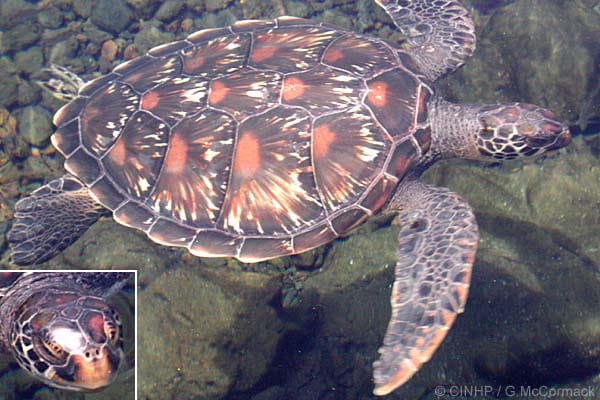
Green Turtle – Gerald McCormack
Recently, Te Ipukarea Society (CI News 22 Feb. 2025) reported 90 Green and 19 Hawksbills. They highlighted one Green Turtle seen in Avaavaroa Passage since 2021 as “a good example of a ‘residential turtle’ that is quite happy spending its days in Vaimaanga”. The following article will focus solely on Green Turtles, which have a distinct lifecycle compared to Hawksbill Turtles.
The presence of around 90 “residential” Green Turtles is a dramatic change from the 1980s and ’90s when such turtles were very rarely seen. What caused this dramatic change? Has there been a local population boom? Have these migratory turtles found a good home and stopped migrating? Can these “resident” turtles contribute to the survival of their endangered species?
Green Turtles are listed on the IUCN Red List as Threatened due to a global population decline, although they have increased in some areas. It is also listed in Appendix 1 of CITES, which gives it the highest level of protection, prohibiting all commercial trade of animals or their parts, with minor non-commercial exceptions.
Our Pacific neighbours, the Society Islands and American Samoa, have undertaken years of detailed research on their turtles. We will include their turtles with our own, as turtles of “our area” or “our region” to increase the data to discuss (1) post-breeding migrations, (2) local breeding activities, (3) the natural migratory lifecycle, and (4) migration disruption.
Post-breeding migrations
Historically, Green Turtles bred in our area during the southern Summer and disappeared for the winter. It was not known where they went until scientific studies started in the 1970s.
Within our region, Scilly atoll, 900km east of Palmerston in the Society Islands, was long recognised as a most important breeding site for Green Turtles. We will refer to it as Scilly, although it is now known as Manuae, which can lead to confusion with our Manuae, east of Aitutaki.
For twenty years (1952-1971), Scilly residents sent a few hundred turtles a year to Tahiti to be butchered, and they ate about one a week themselves. The turtles were protected in 1971, and in April 1972, the 67 held in lagoon pens “awaiting transportation” were confiscated, flipper-tagged with metal tags and released on the 30th of April. The initial results were interesting, with single recaptures in July and August in Fiji and Tonga, respectively.
Between 1973 and 1984, metal tags were attached to an additional 461 turtles, including 448 females. All turtles were adults, and most females had shell lengths ranging from 90 to 110 cm, with the smallest at 80 cm. The upper shell of a turtle is technically called the carapace, and it is usually measured in a curve known as the Curved Carapace Length (CCL). We will refer to this as shell length.
As of 1995, thirteen Scilly-tagged turtles had been recaptured (and invariably consumed): five in Fiji (3,000km westward), three in Vanuatu (4000km), and two in New Caledonia (4500km), which are areas with extensive meadows of seagrass, the nutritious favourite food of Green Turtles.
The other recaptures, one in Wallis (2500km), one in Tonga (2000km), and one in the Cook Islands at Palmerston (900km), are areas with little or no seagrass and likely represent interrupted migrations to Fiji. No tagged turtles were recaptured in French Polynesia, which has very little seagrass and no evidence of turtles being present during the non-breeding season. See illustration. (Anon. 1974; Balazs et al. 1995, Siota 2011, Mckenzie et al. 2020)
Figure 1: Post-breeding migrations of tagged turtles from our region typically swim to the shallow seagrass meadows in Fiji. Bold names indicate the main Green Turtle rookeries. Gerald McCormack
In 1996-’97 it was found that 37% of the turtles in the Suva market were of French Polynesian origin, offering further support for the mass westward post-breeding migration of our turtles. (Boyle 1998)
While flipper tags display only the start and end points of an adult turtle’s post-breeding migration, satellite tags reveal the entire track until transmission ceases. Satellite tagging began in 1993 on Rose Atoll, the easternmost island of American Samoa, located immediately west of our Exclusive Economic Zone (EEZ).
By 1995, seven had been sat-tagged, with six post-breeding migrations directly southwest to seagrass areas in Fiji. One swam in the opposite direction to near Raiatea, northwest of Tahiti, where the transmission stopped – there is always one!.(Craig et al. 2004) Those swimming to Fiji typically averaged 41-43km/day. Additionally, 46 turtles were flipper-tagged on Rose Atoll, with three returns: two to Fiji and one to Vanuatu. It has been estimated that 105 females breed on the atoll (Seminoff et al. 2015).
In the Cook Islands, we have had only one satellite-tagged turtle. Mama Onu left Palmerston atoll on the 8th of February 2001 and swam directly to Fiji. She covered the 2,150km in 52 days (41km/day) to settle around Vatulele Island, 30km south of Viti Levu. See the map of Mama Onu’s journey.
Map of Mama Onu’s journey: Satellite tracking of Mama Onu from Palmerston to Fiji in 2001. She covered 2,150km in 52 days, averaging 41km/day. For comparison, humpback whales migrate at speeds of 70-140 km/day – Gerald McCormack
In 2010-2011 the first satellite tagging in French Polynesia occurred on Tetiaroa Atoll, 50km north of Tahiti. Two transmitters soon failed, but those on Vahinerii Myssy, Vaimiti and Maruia remained active until the three reached Fiji. They covered about 3,300km in 90 days (37km/day), 65 days (51km/day) and 51 days (65km/day), respectively.
Of the above 27 tagged turtles, 26 undertook westward post-breeding migrations, mainly to Fiji or beyond, which is overwhelming evidence that green turtles in our area are seasonal visitors, not year-round “residents”.
Why live in Fiji? The simple answer is its extensive seagrass meadows. Fiji likely has approximately 500km² of nearshore seagrass meadows, extending from the intertidal zone to depths of around 25m. A few meadows also have seaweed (macroalgae) beds, which turtles eat, and they also opportunistically eat benthic invertebrates and dead fish left by fishermen. Seaweeds have about half the nutritional value of seagrass (Piovano et al. 2020).
Elsewhere in the South Pacific, seagrass estimates are: Vanuatu 27km2, Wallis-Futuna 24km2, America Samoa 1km2, Tonga 23km2, Cooks 0km2, and French Polynesia 29km2. (McKenzie et al. 2021) There is little doubt that the immense seagrass meadows of Fiji are turtle heaven for our turtles.
Local breeding activities
On Tetiaroa atoll near Tahiti, the NGO Te Mana o te Moana has been researching the Green Turtle since 2004, with detailed breeding research since November 2007. The primary nesting season lasts three months, from November through January, with nesting extremes in July and May.
Figure 2: Nesting graph TT2017-’18 – a good season. Penrhyn and Tetiaroa nesting. The nests preseason varies greatly. Coincidentally, the 2017-18 season was spectacular on both islands. Both had a major peak from November to January, although Penrhyn had more breeding during non-peak months – Gerald McCormack
One interesting discovery was that the number of nests is very variable. In the booming 2017-’18 season, 1,316 nesting events were recorded, including 629 (48%) active nests, which averaged 86 eggs/nest with 91% hatching success. In contrast, during the 2018-’19 season, there were only 88 active nests. (See nesting graph TT2017-’18 – a good season.) (Touron et al. 2018, Touron et al. 2019)
Although the methods and criteria for recording nesting events differed, we can loosely compare nesting on Tetiaroa and Penrhyn atoll, where Dr White made extensive records. By coincidence, the 2017-’18 season was a boomer on both atolls, with 1,617 nesting events on Penrhyn and 1,316 on Tetiaroa. There was a significant peak in activity on both atolls from October through February. The main difference in the breeding profiles was the higher level of off-season nesting activity in Penrhyn. (White 2012) There is a need to attach satellite tags to some Penrhyn turtles to better understand their location during the non-breeding season.
In addition to Penrhyn, Palmerston atoll has long been recognised as an important breeding site in the Cook Islands, and, recently, Manuae atoll has been recognised as a significant rookery.
Despite Palmerston’s importance, there has never been a systematic study over an entire breeding season. The only substantial record of active nests was a Ministry of Marine Resources (MMR) count of 37 on the 6th of November, 2018. With nesting continuing for at least another two months, we can estimate that Palmerston may have had over 120 active nests that season, which could indicate approximately 25 females, based on 3-5 nests per female.
Manuae was surveyed by MMR in early November 2017 and found 57 active nests. (Morejohn et al. 2017 and 2019) With the season continuing for a further two months, we can speculate that during the season, there could have been approximately 150 active nests on Manuae, involving around 35 females. No active nests were found during a mid-October 2024 survey. (Steibl et al. in press)
One of the ironies of turtles from our region, which mainly live on seagrasses close to the islands of Fiji, is that Fiji has relatively few nesting turtles, with only a hundred or two females. (Piovano et al. 2019) The cause of such low numbers is believed to be a long-standing tradition of overharvesting. After years of various harvesting regimes, Fiji fully protected its green turtles under its Endangered and Protected Species Act 2002, with a few permitted exceptions.
Knowing how many active nests have been found on Rarotonga would be interesting. My enquiries to the Ministry of Marine Resources, Te Ipukarea Society and the National Environment Service revealed no records of Rarotonga nesting events. However, a few elders did recall some nesting about sixty years ago.
Despite the lack of published information, I can report on a few historic turtle nests on Rarotonga: three in 1982, one in 1985 and one around 2005.
Faimau Robati lived on motu Oneroa until 1982, when he was thirteen. He recalls three successful nests in 1982 on the seaward side of Oneroa and Motutapu and had noticed similar nesting in previous years. (pers. comm. 2025-02)
In February 1985, students Rangi Tuiravakai and Vaiaia Henry found a nest on the beach near the present Tūpapa Health Clinic. They observed approximately 40 eggs and four hatchlings, with two dead and two alive. They took the live hatchlings home and fed them bread and grated coconut for about two weeks before releasing them. (CINHT records)
Capt. Tama (2025-01 pers. comm.) recalls seeing the remains of turtle eggs on a beach in central Tītīkāveka circa 2005. He concluded that dogs had destroyed it.
The historical rarity of nesting attempts on Rarotonga is likely due to human and dog interference, resulting in a very low success rate. As discussed below, this would result in a severe shortage of hatchlings to mature on the feeding ground and migrate here to breed.
The Natural Lifecycle
Figure 3: Green Turtle Life Cycle. Our Green Turtles are migratory turtles, they primarily live on the seagrass in Fiji or nearby areas. They visit our islands every 3-5 years to breed, relying on their stored fat supplemented with local seaweeds.
The diagram illustrates the typical lifecycle of a wild Green Turtle feeding around Fiji and breeding on an island in our region, specifically American Samoa, the Cook Islands, and the Society Islands.
On Tetiaroa atoll, most nesting females had an average shell length of 90 to 110, with the smallest at 85cm. They nested 3-5 times (range: 2-6) at approximately fortnightly intervals (range: 12-15 nights).
Each female crawled ashore and, above high tide, used her hind flippers to dig a nest or egg chamber about 55 cm deep (range: 30-80 cm) with a bulbous base, into which she laid about 90 (range: 10-140) table-tennis-ball-sized eggs. After covering the nest, she moved away and disturbed the sand to create one or two “false nests” or “decoy nests” before returning to the ocean; the activity took about two hours, during which only 15 minutes were spent laying the eggs. Sometimes, a female would dig here and there but not find a suitable substrate and return to the sea. This type of activity is known as a “false crawl”.
The depth and amount of shading in a nest are crucial because they regulate the temperature of embryo development, which in turn determines the sex of the young. The sex of human embryos is set genetically at the time of conception. This is not the case for green turtles, where the embryo has no biological sex for the first trimester of 20 days. Their sex is determined during the second trimester, when higher temperatures produce more females (“hot chicks”) and lower temperatures produce more males (“cool guys”).
Above 31°C, all hatchlings are female; below 28°C, all are male. The pivotal temperature is about 29°C at which half will be female and half male. It is a sensitive system, and when temperatures change, so does the ratio of females to males. Most turtle populations are biased towards having more females, which is likely an advantage because males can mate with multiple females.
Raising the temperature of the eggs will result in a higher proportion of females than usual. This can be caused by climate warming, reduced shade, or people relocating eggs to shallower holes or sunnier locations.
After about 60 days (50-65 days), the eggs hatch. The hatchlings, with shells a mere 5 cm long, continue to feed on their yolk and, within a few days, dig up to near the surface. When the temperature drops, indicating it is night, they emerge en masse and frantically paddle-walk down the beach to enter the reef moat/lagoon, where predatory fish soon gather. The hatchlings immediately start a swim-frenzy to reach the ocean, where they continue their frantic swim away from the island to a lower concentration of predators.
While the swim-frenzy gave them a greater chance of avoiding predators, scientists have concluded that it is also a critical activity for innate learning. During this swim-frenzy, the Earth’s magnetic field imprints on the hatchling’s brain the geographic position in such a definitive way that, in 20-40 years, when it is sexually mature, it can navigate back to the beach on which it hatched.
After the swim-frenzy, they settle down and are mainly carried by the currents for about five years, known as the “lost years” because scientists cannot locate them. They are carnivorous at this stage, eating nearby invertebrates and small fish. They are dark above, making it difficult for predacious birds to spot them, and white below, making it difficult for predators below to see them against the bright sky. Despite the frantic running, swimming, and camouflage, almost all hatchlings are eaten or die of starvation during the “lost years”. It is sometimes said that less than 1% of hatchlings survive long enough to settle in their adult feeding areas. This extreme mortality is why turtles need to lay a large number of eggs. Every egg matters!
When our hatchlings arrive in the seagrass meadows of Fiji, they are 25-50 cm in shell length (Piovano et al., 2020) and are likely 3-10 years old. They transform from carnivores into herbivores, with some invertebrates or dead fish on the side. They also learn the geomagnetic position of the seagrass area where they settle.
Evidence from seagrass meadows in the Indian Ocean has shown that turtles feed for more than 80% of daylight hours (Taquet et al. 2006) and it is probably similar in Fiji. Green Turtles are the sheep of the sea.
After 20 to 30 years, they become sexually mature and have a shell length of at least 85cm. Both females and males navigate vast distances to return to the beaches where they hatched to breed.
Near their birth beaches, the females mate with several males and store their sperm, which they use to fertilise the eggs when they are laid. They typically dig 3-5 nests at 13-14 night intervals over a period of a couple of months and lay 70-100 eggs in each.
A mature female migrating from Fiji to breed on Palmerston would have little or no food for 6-7 months. While living mainly on her stored fat, she swims 2,000km to Palmerston, digs 3-5 deep nest holes, lays 300-500 eggs, and swims 2,000km back to Fiji. Although Fiji seagrass is very nutritious, it will take 3-5 years before she has rebuilt her fat reserves to undertake the journey again.
If lucky, she would have a reproductive life of 30-40 years, make the exhausting journey ten times and contribute about 4,000 eggs toward the survival of her species.
Migration disruption
The earliest report on breeding turtles in the Cook Islands was a 1957 article by Ron Powell, “Breeding Turtles for Profit”. Powell reported that in Palmerston adult turtles and their eggs were eaten, and it occurred to him that it might “be possible to develop a new industry … by breeding turtles in captivity”.
He outlined two preliminary attempts that gave encouraging results. In one, Ioapa Marsters hatched 30 eggs and raised the hatchlings in wire-covered wooden cages floating in the lagoon for ten months. They were fed on kitchen scraps, fish, and shellfish and grew to shell lengths of around 20 cm. Powell concluded that if they were fed for two or three years, they would find a “ready sale in Rarotonga and possibly in New Zealand”.
The second encouraging experiment involved taking six hatchlings in a drum of seawater to Rarotonga, where they thrived in a mixture of half fresh and half seawater while being fed on a wide variety of food scraps, including fresh fish, tinned beef and rice.
On Palmerston, it became routine to collect turtle eggs and rebury them in the village, then raise the hatchlings in floating wooden cages until they reached about a handspan in shell length. A few were released to maintain stock levels, others were consumed, and a few were preserved in formalin and gifted or sold as curios. The variations of this practice continued until around 1980, when it was concluded that the released turtles were not contributing to the local adult stock.
In 1973, the Cook Islands’ Director of Fisheries, Tom (now Sir Tom) Marsters, requested that the South Pacific Commission (SPC) establish a turtle farm on Rarotonga, with the aim of achieving both conservation and food outcomes.
In July 1974, an SPC Turtles Project Officer, Donald J. Brandon, was appointed on a three-year contract. As a young New Zealand zoology graduate with no turtle experience, it was assumed SPC would provide training and information. Both assumptions were incorrect. (Balazs 1977)
While there was some preparatory work in 1974, the project really got underway in January 1975 with the arrival of Brandon, the move into the defunct aquaculture building near the present Avana Fishing Club with two 6ft wide tanks of 12 and 24 feet, and the arrival of the first batch of 450 hatchlings from Palmerston.
Many of the hatchlings had been injured during transit in the drums. The staff concluded that it would be better to transport the eggs, and in early 1976, 260 eggs were collected on Penrhyn. The hatchery received 150 eggs and 110 hatchlings. This experiment provided 220 hatchlings, which all died between the sixth and tenth week when temperatures dropped to the low 20s.
Of the 450 Palmerston hatchings, only 48 survived two years. The young turtles were plagued with fungal and bacterial infections, and the staff struggled to find enough high-protein foods. After two years, they had shell lengths of approximately 25 cm and weighed a mere 2 kg, compared to hatchlings on Grand Cayman Island (Caribbean), which averaged 5 kg at two years, having been fed high-protein pellets of soybeans and fish meal.
Experiments with different foods found that these very young turtles readily ate fish, shark and shellfish, would eventually eat leaves and vegetable scraps, and would not eat the green Caulerpa seaweeds (Rimu Kai and its relatives). This was not surprising, considering that hatchlings during their “lost years” in the ocean are mainly carnivorous, and only after settling in the seagrass meadows do they become herbivores.
In April 1977, turtle expert George Balazs visited and concluded that the idea of farming turtles was based on unreliable and contradictory reports, and the project had not produced any important information. He recommended that SPC terminate its turtle project, solely the Rarotonga hatchery, which ceased after Brandon’s contract expired in July 1977. The 48 turtles seen by Balazs were mainly emaciated and injured (mostly missing portions of their hind flippers through cannibalism), and these were released.
While Rarotonga turtle farming is a thing of the past, the private flow of hatchlings from Penrhyn, Palmerston and Manihiki to Rarotonga has continued. When they have grown to one or two handspans in shell length, they have usually been released into the lagoon or ocean, with or without a tag. Adults have also been shipped to Rarotonga.
During the 1970s, Brandon reported that four to five were sold most years on Rarotonga, with a specific total of six being sold in 1976. (Balazs papers online) In November 1991, four large adults (140cm, 100cm, 100cm and 94cm shell length) were shipped to Rarotonga for local consumption, of which two died in transit, and the fate of the survivors is unknown. (CINews 22/11/1991) Two unrequested adults, a large male and a smaller female, were flown from Penrhyn in 2001 and released in the Muri lagoon. (Capt. Tama pers. comm.)
While the continuous trickle of hatchlings to Rarotonga has not been documented, one inflow to Aitutaki hit the news. In April 2019, over a hundred hatchlings were sent from Palmerston via Rarotonga to Aitutaki for release in the lagoon. (CI News 6-04-2019). Although expert George Balazs had recommended that most be released in the ocean away from the island, they were all released into the outer lagoon at Amuri. (Fimau Robati pers. comm.)
In 2001, Capt. Tama received 40 hatchlings from Penrhyn and kept them in a floating cage in Muri Lagoon during the day and inside containers at night. They were fed various seaweeds and diced sea cucumbers, mainly Rori Puakatoro and Rori Matu. They grew to about a handspan in length in six months and were released into the lagoon. (Capt. Tama pers. comm.)
In May 2023 several passengers flew from Manihiki to Rarotonga with hatchlings. Three weeks later, three were placed in the care of the Wildlife Centre, where they grew from approximately 10cm to a handspan in shell length in six months after being shell-marked and released. They have not been seen again. (Anon. pers. comm.)
There is little doubt that most of the year-round “resident” Green Turtles of Rarotonga are survivors of the hatchlings brought to the island. Some observers suggest that some “residents” migrated here and found the environment to their liking. The only turtles migrating within the South Pacific are mature breeders, which have a minimum size of about 85cm CCL. If some “residents” are mature adults who arrived looking for a breeding site, it raises the question of why they would remain in an area with a poor abundance of low-quality seaweeds rather than instinctively swim back to their traditional seagrass meadows in Fiji. This suggestion is a most unlikely scenario, although it might apply to the mature adults flown in from Penrhyn and released by Capt. Tama. The artificial displacement of 1400km might have interrupted their migratory behaviour.
These “residential” turtles are lost due to human interference in their navigation system. They did not perform the hatchling swim-frenzy to learn the geomagnetic location of their birth island, nor did they float on the seas to eventually settle in the nutritious seagrass areas of Fiji or thereabouts and learn that geomagnetic location. They cannot navigate from Rarotonga to any seagrass meadow. They are condemned to survive on a barely adequate diet of seaweeds with some sea cucumbers and jellyfish. The future will show, but it is unlikely that, under the present regime, they will find sufficient nutritious food to become sexually mature and nest locally, thereby contributing to the survival of their endangered species.
To confirm the status of these “resident” turtles, we need scientists to determine if any adults of more than 90cm CCL are reproductively mature and whether they are attempting to nest on Rarotonga. Are they healthy with full stomachs? Do they require supplementary food?
In the meantime, there should be a Cook Islands ban on interfering with adult turtles during their breeding season, from October through February, and on disturbing nests. Killing turtles during the non-breeding season should be restricted to the occasional traditional ceremony. We have done enough damage to this endangered species; it is time to protect them in their natural habitat, in situ.
Author’s notes
First published CINEWS (29 March, 05 April and 12 April 2025)
Caution: The numeric data comes from a wide variety of sources and are only indicative of Cook Islands turtles for which we lack data.
References in order of appearance:
- Te Ipukarea Society (22 Feb. 2025). Te Ipukarea Society: Citizen science to guide turtle conservation. Cook Islands News
- Anon. 1974 Development of the “Turtle Project” in French Polynesia. SPC Fisheries Newsletter 10:37-39
- Balazs et al. 1995. Ecological aspects of green turtles nesting at Scilly Atoll in French Polynesia. In: Richardson, J., Richardson, T. (Eds.), Proceedings 12th Annual Workshop on Sea Turtle Biology and Conservation, 1992, National Atmospheric and Oceanic Administration Tech. Memo. NMFS-SEFSC-361, pp. 7–10.
- Siota C (2011) Cook Islands TREDS report for 2010. www.sprep.org
- McKenzie, L. J., Nordlund, L. M., Jones, B. L., Cullen-Unsworth, L. C., Roelfsema, C., & Unsworth, R. K. F. (2020). The global distribution of seagrass. Environmental Research Letters, 15(7), 074041. https://doi.org/10.1088/1748-9326/ab7d06
- Boyle, M. Sea turtles of Fiji: aspects of population biology and conservation implications of harvesting. (University of Otago, 1998). PF turtles in Fiji market.
- Craig, P., Parker, D., Brainard, R., Rice, M., & Balazs, G. H. (2004). Migrations of green turtles in the central South Pacific. Biological Conservation, 116(3), 433–438.
- Seminoff, J. et al. (2015). Status review of the green turtle (Chelonia mydas) under the Endangered Species Act. U.S. Department of Commerce, NOAA Technical Memorandum NMFS-SWFSC-539.
- Piovano, S., Lemons, G. E., Ciriyawa, A., Batibasaga, A., & Seminoff, J. A. (2020). Diet and recruitment of green turtles in Fiji, South Pacific, inferred from in-water capture and stable isotope analysis. Marine Ecology Progress Series, 640, 201–213.
- McKenzie et al. 2021, Seagrass ecosystems of the Pacific Island Countries and Territories: A global bright spot, Marine Pollution Bulletin, 167, www.elsevier.com/locate/marpolbul
- Touron M. et al, (2018). Final report on the green sea turtle egg-laying season of 2017-2018 (Chelonia mydas) on the atoll of Tetiaroa, French Polynesia. Te mana o te moana.
- Touron M. et al. (2019) Final report on green sea turtle nesting season of 2018-2019(Chelonia mydas) on Tetiaroa atoll, French Polynesia. Te mana o te moana.
- White M (2012) Sea Turtles in the Cook Islands. Volume One: 2009-2012.
- Morejohn et al. (2019), Aitutaki and Manuae Nearshore marine Assessment, Ministry of Marine Resources
- Morejohn et al. (2017),Aitutaki and Manuae Nearshore Invertebrate
and Finfish Assessment, Ministry of Marine Resources
- Steibl et al. (2025), Terrestrial Biodiversity of Manuae Atoll, Cook Islands, BioOne Digital Library, University of Hawai’i Press, http://doi.org/10.2984/79.1.3
- Piovano et al (2019). Mixed stock analysis of juvenile green turtles aggregating t two foraging grounds in fiji reveals major contribution from the American Samoa Management Unit, Scientific Reports, www.nature.com/scientificreports
- Tarquet et al. 2006, Foraging of the green sea turtle Chelonia mydas on seagrass beds at Mayotte Island (indian Ocean), determined by acoustic transmitters, Marine Ecology Progress Series, Vol.306: 295-302
- Balazs, G. H. (1977). South Pacific Commission turtle project: A constructive review and evaluation with recommendations for future action. University of Hawaii, Hawaii Institute of Marine Biology. Report prepared for the South Pacific Commission, Noumea, New Caledonia.
- White, M. (2020). THE COOK ISLANDS – A Review of sea turtle distribution, threats & conservation for Kuki Airani. p.129-151. In: Work TM, Parker D, Balazs GH (Eds.) (2020). Sea Turtles in Oceania: MTSG Annual Regional Report 2020. Draft Report of the IUCN -SSC Marine Turtle Specialist Group, 2020.