



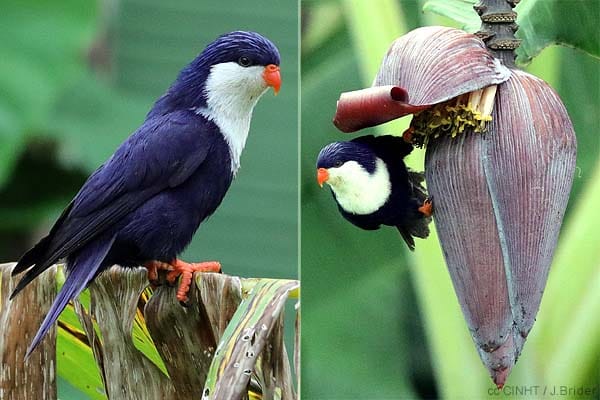
Blue Lorikeet on a banana flower – J brider
Gerald McCormack, Director, CINHT
The Blue Lorikeet (Vini peruviana) is a native bird of French Polynesia, formerly existing on about twenty islands in the Society Islands (including Tahiti) and the northern Tuamotu atolls. In recent years it has been lost from Tahiti and all the main Society Islands, surviving only on three remote atolls to the northwest (especially Bellinghausen/Motu One) and on three or four atolls of the Tuamotus.
Scientists have concluded that the Blue Lorikeet has been lost after the islands had been colonised by the Ship Rat (Rattus rattus). The lorikeet nests in holes in trees, and the Ship Rat destroys its eggs and young. In contrast, the Blue Lorikeet, and its relative the Rimatara Lorikeet (Vini kuhlii), can flourish on islands known to have only the smaller Pacific Rat (Rattus exulans).
In ancient times the larger Southern Group islands all had a variety of landbirds, probably including the Grey Duck (Mokorā, Anas superciliosa), Pacific Reef-Heron (Kōtuku, Egretta sacra), Pacific Pigeon (Rupe, Ducula pacifica), Cook Islands Fruit-Dove (Kūkupa, Ptilinopus rarotongensis), a kingfisher (Ngōtare/Tanga‘eo), Spotless Crake (Mo‘o, Zapornia tabuensis), and the Rimatara Lorikeet (Kura). Some time before the Missionaries arrived in the 1820s all islands had lost the Rimatara Lorikeet, and 1899 Aitutaki had lost all its native landbirds, except the Grey Duck and the Reef-Heron.
It was therefore very surprising that in 1899 visiting scientists noted the Blue Lorikeet on Aitutaki. They described it as the pet of the natives. Today the Blue Lorikeet is more numerous on Aitutaki than on any island in French Polynesia, thanks to the abundance of flowers with nectar and the absence of Ship Rat. There are in excess of 1000 birds, possibly more than 2000. They are obviously not seriously interfered with by the abundant Pacific Rat.
When the Blue Lorikeet was introduced to Aitutaki is not known. A likely scenario is that it was brought as a cage-bird from French Polynesia on the Mission ship, which was regularly sailing between the Cook Islands and the Society Islands after 1820.
In September 2001 a number of people have been reporting a small blue and white bird with a short beak on Rarotonga. The adult Blue Lorikeet (Kurāmo‘o) of Aitutaki fitted the description but its presence here was unlikely. However, on Saturday and Sunday mornings the bird spent some time feeding on our banana flowers in Upper Tūpapa. It certainly was a Blue Lorikeet.
Should we introduce more Blue Lorikeets to Rarotonga? While there is plenty of suitable food, the widespread presence of the Ship Rat counts against the lorikeet flourishing on Rarotonga. The most humane conclusion is to leave the Blue Lorikeet to Aitutaki where they can breed successfully because there are no Ship Rats.
There is also a lone Eastern Rosella(Platycercus eximius) of Australia in the ‘Ārorangi and Nikao areas. This bird was one of four aviary-birds brought to Tītīkāveka around 1988. They escaped around 1990 and three were killed or died within a year or two. The lone survivor moved to the other side of the island where it was last reported in May 2002. I would be interested in any report that it is still alive. It is about 30cm in total length. It has a red head and breast, white cheeks, with yellow on the belly and blue on the wings.
First published CINEWS (March 2023)


