



Gerald McCormack, CINHT,
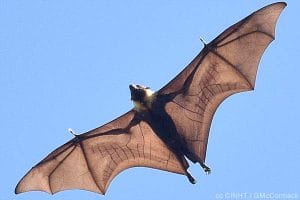
Pacific Fruit-bat, Adult in flight 1 – Tonga, Tongatapu – Gerald McCormack
The Moa Kirikiri lives on Mangaia and Rarotonga and is often called a flying-fox, although it is not closely related to the fox. It is really a bat, a fruit-eating bat.
Our Pacific Fruit-bat (Pteropus tonganus), which lives on many islands from the Cook Islands westward to New Caledonia and Vanuatu, is the most widespread species in the South Pacific. This situation is reflected in the name South Pacific Fruit-bat, although it is also known as the Tonga Fruit-bat, White-necked Fruit-bat and Insular Fruit-bat.
When the Missionaries arrived in the 1820s the South Pacific Fruit-bat was on Mangaia but not Rarotonga. It was first noticed on Rarotonga in the 1870s, and people claimed it had introduced itself from Mangaia.
The traditional Polynesian name for the fruit-bat on Samoa, Niue and Tonga is Peºa or Peka, while the Mangaia name, Moa Kirikiri (“gravel fowl”) is unique. Although fruit-bats obviously fly like moa (fowl), their relationship to kirikiri (gravel, pebbles or small stones) is obscure.
Fruit-bats live in trees in colonies or camps which may contain several hundred individuals. During the day they hang upside-down to sleep, with periodic wanderings to disrupt the sleep of others and advance their social position.
Around sunset they fly separately from the camp in search of edible fruit, flowers and leaves, often travelling several kilometres during the night. They chew the food to remove the digestibles and spit out the remaining fibre.
Although they feed mainly on the native plants in the inland mountains, a few visit the lowlands to eat on a variety of domestic plants. During the winter, especially June and July, the shortage of inland food drives many down to the lower parts of the valleys and the inner lowland to feed on the introduced Cecropia (Rau Mäniota, Cecropia pachystachya ) and Kapok (Mamaºu, Ceiba pentandra ). It is during this time, when they are also fat, that they are hunted.
Around the turn of the century fruit-bats were so common that they interfered with domestic fruit production and the Government paid a bounty for each one killed. Today, they are relatively rare on both Rarotonga and Mangaia and a “use regulation” (raºui) may be required to maintain them as a subsistence food resource.
Within the camp, each mature male defends a territory, marked with scent from his shoulder glands, and attracts a small harem of females. Although little is known about the reproductive cycle on Rarotonga, most evidence indicates that the main birthing season starts in early August.
Females have their first pup at 24 months and produce one a year for about twelve years. The pup, born after a six month pregnancy, spends its first month almost continuously at the breast, even when the mother flies to feed at night. From the second month it is fed milk during the day but weaned at night, and by the fifth month it can fly and feed itself.


