



Gerald McCormack, CINHT
Laughing Gulls

Adults (right & top), Juvenile (bottom) – Cook Islands, Aitutaki – Gerald McCormack
Seagulls are such common seabirds in New Zealand, Australia and America, that it always comes as a surprise for visitors to find no seagulls in the Cook Islands, assuming they ignore the two plastic ones at the Deli in Foodland. Although seagulls seem like the most adaptable scavengers we can imagine, they have not managed to establish themselves on the islands of tropical Polynesia. The nearest island to have resident seagulls is New Caledonia.
It was therefore surprising when people reported a dull brown seagull at Avatiu and at Muri in April 1992. It stayed a few weeks and then disappeared. Since then a similar type of seagull has been reported during the early months of 1995, 1997 and 1998. These birds were all first-year Laughing Gulls (Leucophaeus atricilla). This means that on each occasion it was a different bird that was seen, and only on one occasion did two birds visit together.
The really surprising thing about these solitary visitors is that they have come all the way from the eastern United States or the Caribbean, where they left their nests in July or August. After the breeding season the adults and young spread out mainly going to the southern part of the breeding area in the Caribbean, and into South America. Many also fly to the Pacific coast of North America, and they often spread down the South American coast, sometimes reaching Chile. For many years it has been known that a few birds have overshot the American coast and made their way to Hawaii. It now seems that every year or two a young bird somehow finds its way to the Cook Islands.
While the young birds reported have been almost uniformly dull brown, a visit to the Sandspit or “Honeymoon Island” on Aitutaki in April [1998] revealed two Laughing Gulls in their more dramatic plumage. The more mature one had grey and black wings, a white body with a dramatic black hood over the head and a black band on the tail. After much e-mail correspondence with American ornithologists it has been concluded that these birds were second-year Laughing Gulls, and that they have another year to go before they are ready to breed. It is not known if after April they flew back to America to be there when the adults were breeding during the middle of the year, or if they have remained in Aitutaki to fly back to America next April or May when they will be mature.
Crested Terns
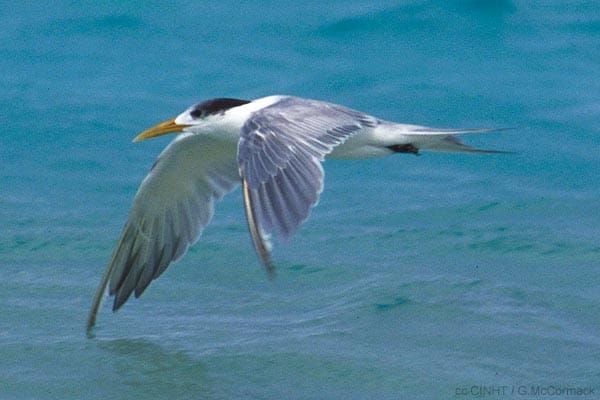
Adult in flight, first known national record – Cook Islands, Aitutaki – Gerald McCormack 1998-04
The April [1998] visit to Aitutaki revealed another very rare seabird, the Crested Tern(Thalasseus bergii). This tern breeds in Fiji and Tonga in the west, the Societies and Tuamotu in the east, but not in the Cook Islands or Samoa. This is an unusual pattern and it is difficult to see how the Cook Islands and Samoa differ from the islands both east and west on which the tern breeds. It is certainly the most conspicuous seabird on the shoreline of atolls and high islands throughout French Polynesia.
The Crested Tern is a pale grey and white seabird about the size of the Brown Noddy (Ngōio, Anous stolidus). It is distinguished from other terns by the large yellow beak and the black crest on the head. It was enjoyable to see two on Aitutaki and, who knows, maybe this species will eventually settle down and breed there. Hopefully the students of Araura College will continue to watch out for this new seabird.
Giant-Petrels
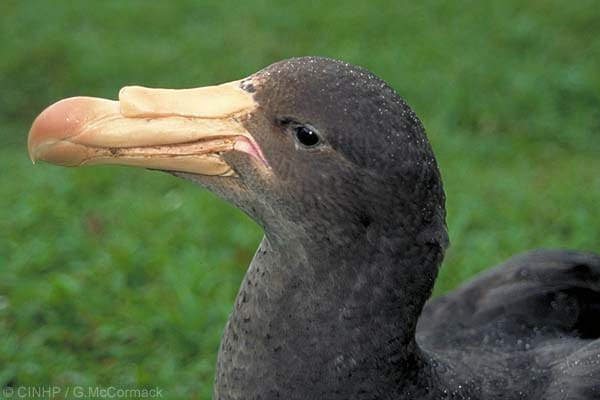
Sub-adult colour-phase (Rarotonga 1997) – Cook Islands, Rarotonga – Gerald McCormack
While commenting on rare seabirds, I should mention the enormous brown bird that Junior Papa managed to keep alive on halfbeaks (miromiro, Euleptorhamphus viridis) for a few months. Quite a number of people reported a seabird, resembling a dark brown goose, flying around Muri and Titikaveka last September [1997].
This enormous seabird, with a two-metre wingspan, was a young Northern Giant-petrel (Macronectes halli). They breed on remote islands near Antarctica but otherwise live on the wing throughout the cold Southern Ocean. The young birds sometimes wander northward and this is the second juvenile positively identified in the Cook Islands, the other being on Mauke (1970). A similar bird on Aitutaki (1985) may have been this species, but it may also have been the very similar Southern Giant-Petrel (Macronectes giganteus). Unfortunately, it was a one-way journey for all three young giant-petrels. There is no definite Polynesian name for these gigantic but uncommon visitors, although the Ruro of Mangaia may have been this species.
First published CINEWS (08 August 1998)


