



Gerald McCormack, CINHT,
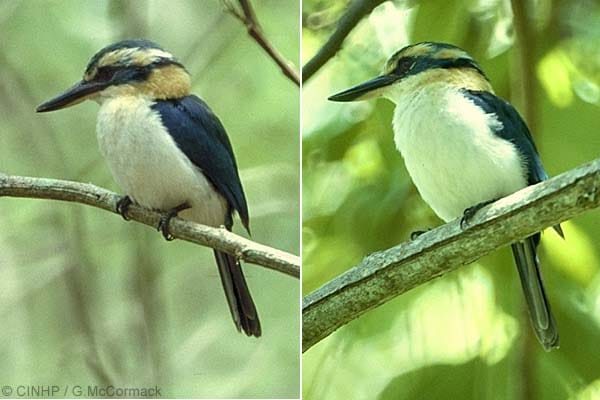
Mangaia Kingfisher, Two adults – Cook Islands, Mangaia – Gerald McCormack
The landbirds which breed on Mangaia, the resident landbirds, can be divided into those introduced by people (the introduced landbirds) and those which arrived naturally (the native landbirds).
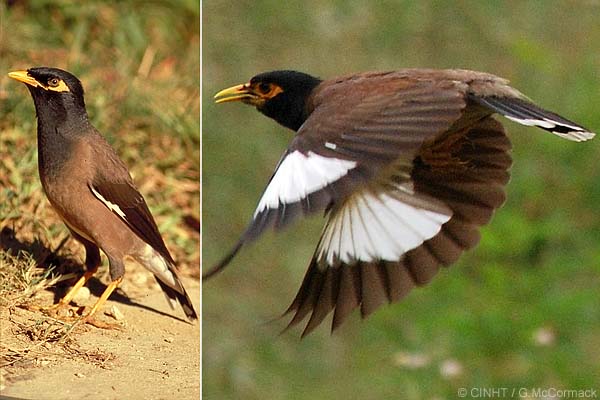
Adult; In flight – Cook Islands, Rarotonga – Gerald McCormack
In the introduced group, two species have naturalised and now live in some areas without direct assistance from people: the Red Junglefowl (Moa, Gallus gallus), which was originally introduced by the early Polynesian settlers, is common and widespread; and the Common Mynah (Manu Kavamani, Acridotheres tristis), introduced during the late 1950s to control the Coconut Stick insect, is very common and widespread.
Mangaia has now only five native resident landbirds – three are relatively widespread in the
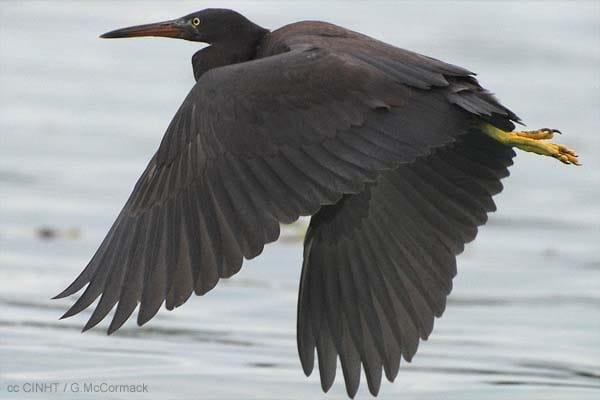
Dark grey Pacific Reef Heron in flight.
Pacific, while two are restricted to a few islands only. The three widespread landbirds are: the abundant Grey Duck (Mokora, Anas superciliosa), which hide in the fernlands during the day and feed at night in the extensive swamplands; the Pacific Reef-heron (Kōtuku, Egretta sacra), which is common on the reef-flat; and the small, flightless Spotless Crake, (Mo’omo’o, Zapornia tabuensis), which lives in the swamplands, where it is now very rare – presumably the victim of cats and rats.
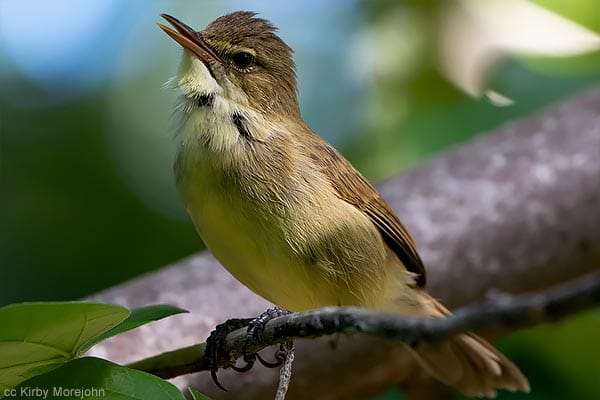
Cook Island Warbler, Male singing – Cook Islands, Mangaia – Kirby Morejohn 2022-06
The two restricted landbirds are the Cook Islands Reed-warbler (Kereārako, Acrocephalus kerearako) and the Mangaia Kingfisher, (Tanga’eo, Todiramphus ruficollaris). The Kereārako is found only on two islands in the world – Mangaia and Miti’āro. Fortunately this noisy native bird has adapted well to the ways people have changed the environment and is widespread on both islands. The Tanga’eo is found on Mangaia and nowhere else in the world. These beautiful blue kingfishers with an orange neck live in territories on much of the makatea and near the swamplands, where they live on skinks and insects. A survey in 1992 concluded that there were 250-450 on the island. The kingfisher nests most successfully in the small forests of Fish-poison Tree (‘Utu , Barringtonia asiatica); moderately successfully in the mixed makatea forests; but is generally unsuccessful elsewhere due to harassment by the Common Mynah.
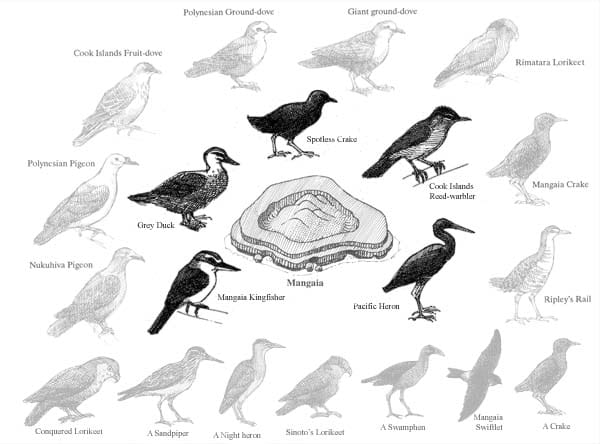
The 20 birds historically found on Mangaia, the faded birds indicate those that are extinct or extirpated – Illustration by Judith Künzle
How many native landbirds have been lost from Mangaia since the arrival of people on the island? Fossil bones found on the floors of the many limestone caves have enabled scientists to obtain a detailed knowledge of the birdlife of Mangaia in ancient times. The fossils indicate that there were at least 20 resident landbirds before the first Polynesian settlers arrived about 1,600 years ago. Since that time, 15 have been lost.
The particular environmental changes which destroyed each of the 15 landbirds lost from Mangaia are not known. But in general terms, the changes involved the introduction of new animals, changes in vegetation and, in some cases, hunting of birds for food or feathers. Major factors in the pre-Missionary era included hunting for food and feathers, the replacement of the inland forests with fern, and the introduction of the Pacific Rat (Rattus exulans), Polynesian Dog and Polynesian Pig. In the post-Missionary era the main factors included further vegetational change for horticulture along with the introduction of guns, domestic cats, new breeds of dogs, European Pigs, and the Ship Rat (Rattus rattus).
The 15 landbirds known to have been lost from Mangaia are: the Nuku Hiva Pigeon(Ducula galeata) now only on Nukuhiva in Marquesas – endangered, the Polynesian Pigeon (Ducula aurorae) now only on Makatea Island – endangered, the Cook Islands Fruit-dove (Ptilinopus rarotongensis) now only on Rarotonga and Ātiu; the Polynesian Ground-dove(Gallicolumba erythroptera) now it may survive on up to 20 islands in the Tuamotu Group – endangered, the Giant Ground-dove (Gallicolumba nui)extinct, the Rimatara Lorikeet (Vini kuhlii )now only on Rimatara in Australs – at risk, the Mangaia Crake (Porzana rua) extinct, the Ripley’s Rail (Gallirallus ripleyi) extinct. Conquered Lorikeet (Vini vidivici) – extinct, Sinotos Lorikeet (Vini sinotoi), Mangaia Swiftlet (Porzana rua) and 4 undefined species including a Sandpiper, a Night heron, a Swamphen and a Crake.


