



Gerald McCormack, CINHT
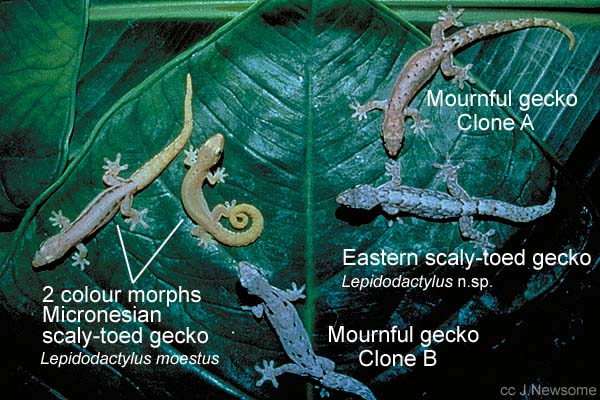
Mournful Gecko and Parent species – J. Newsome
The Mournful Gecko (Lepidodactylus lugubris), about 80mm from nose to tail-tip, is the most common household lizard in the Cook Islands and throughout the Pacific. Like other gecko lizards, it hides during the day and hunts insects at night, especially on walls near lights. It has wide toes with minute hairs underneath, which enable it to climb seemingly smooth vertical surfaces and to walk upside-down on ceilings.
Although Mournful Geckos usually congregate together, they give noisy “CHIK-CHIK-CHIK-CHIK-CHIK-CHIK” calls to warn each other to keep a suitable distance, and they follow up with a vigorous physical attack when the warning is ignored.
Within houses, the Mournful Gecko is pale grey or cream coloured with a few pairs of dark spots spaced out along the midline of the back. They also thrive in unpeopled areas where they look very different, being well camouflaged with irregular speckles and patches of rich brown and grey. However even here, a close inspection will reveal the tell-tale paired spots, especially on the back near the hindlegs.
In 1972 two scientists looked at about 700 Mournful Geckos from several countries and noticed that only 4 had male features. The other animals were not hermaphrodites with female and male reproductive organs – they were simply female. When they also discovered that none of the recently pregnant females had any sperm in their reproductive tubes, they proposed that the Mournful Gecko could reproduce in the absence of sperm.
Two years later another scientist isolated a Mournful Gecko and collected the eggs. One egg hatched a daughter which, in isolation, eventually also laid an egg which developed to the embryo stage. The conclusion was unavoidable: the Mournful Gecko could reproduce in the absence of sperm – a process known as parthenogenesis or, more popularly, as “virgin birth”.
Recent chemical and genetic analysis has shown that the supposed Mournful males of the early study were actually the males of an undescribed species, which looked very similar. All Mournful Geckos are females. Sometimes a Mournful Gecko is seen clinging on the back of another in what looks like mating. Despite appearances, this is mere simulation, a pseudo-copulation. Mournful females typically produce regular batches of two eggs without the simulated mating as a triggering behaviour.
Humans, along with other mammals and birds, are species with distinct male and female individuals. Their reproduction is sexual, involving copulation to enable the sperm cells of the male to fertilize the egg cells inside the female. This process re-arranges the genetic information on the chromosomes, making all the young different from their parents and different from each other (except for the rare identical offspring). This method of reproduction creates variety and enables a species to take better advantage of small changes in the environment.
“Virgin birth” is very rare among higher animals: unknown among mammals and birds, and occurring among less than 30 of the more than 3,000 species of lizards. “Virgin birth” species are unisexual and reproduce asexually: there are no males, there is no mating, there is no sperm, there is no re-arranging of chromosomes. The young are identical to the mother and identical to each other. Such a group of identical animals are known as a “clone”.
Not only is “virgin birth” rare among higher animals, but species that reproduce without males usually have very restricted distributions compared to closely related species with males and females. The two exceptions to this lack of distributional success of unisexual species are a blind cave snake and the Mournful Gecko. The Mournful Gecko, hitchhiking on the canoes of the ancient seafarers, has successfully colonized most islands in the tropical Indian Ocean and in the tropical Pacific. In contrast, most of its 18 bisexual relatives are restricted to individual islands.
The recent chemical and genetic analysis has also shown that all Mournful Geckos do not belong to a single clone with a single ancestral mother. There are several clones each having a separate ancestral mother and each taking advantage of a slightly different aspect of the environment. Each clone arose through a reproductive accident among closely related bisexual species, probably in the central Pacific.
Genetics for experts:

Mournful Gecko – 3 clone variants – Gerald McCormack 2020
One set of chromosomes is known as monoploid (1n), and this is the number in the egg or sperm of a male/female species. During fertilization these single sets combine to make cells with two sets of chromosomes, a condition known as diploid (2n). The basic clones of the Mournful Gecko are also diploid. In this case the monoploid set consists of 22 chromosomes (1n=22), and the diploid number of chromosomes is 44 (2n=44). There are also triploid clones (3n=66) of Mournful Geckos which started when a unisexual diploid female (2n=44) was fertilized by the sperm (1n=22) of a male of a closely related bisexual species, probably in the Northern Philippines.
The most common clone of Mournful Geckos in the Cook Islands and throughout the Pacific is the Diploid A Clone (2nA), which displays the “A Pattern” of paired spots (described above).
The Diploid B Clone (2nB) has the “B Pattern” – irregular spots along the outer edge of the back, especially around the neck. In the South Pacific this clone is recorded as common in Fiji and rare in Tahiti.
The Triploid B Clone (3nB) has a more variable “B Pattern”. This clone is very common in the Cook Islands and in French Polynesia.
There is also a Triploid A Clone (3nA), which is presently known from one specimen from Samoa. And there is a C Clone, with the “C Pattern”, known from two animals – one from the Cook Islands and one from Hawaii. There is still much to discover about the evolution and genetics of the Mournful Ladies.
First published CINEWS (1997)


