



Gerald McCormack, CINHT
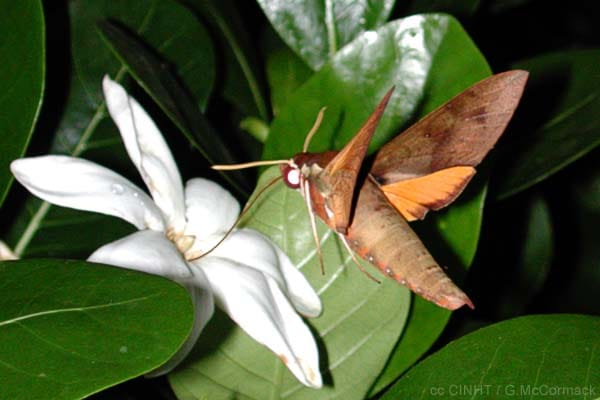
Gnathothlibus erotus Hover-feeding on Tahitian Gardenia – Cook Islands, Rarotonga – Gerald McCormack
Sometimes in the evening bird-like creatures hover over flowers while probing them with a long slender beak. Are they hummingbirds?
Although they look like the hummingbirds of books and films these creatures are actually large moths, known as hawk-moths or sphinx-moths. They have strong slender wings enabling them to fly very fast and to hover. They are nocturnal feeders, usually starting around dusk. Their caterpillars are called hornworms, because they have a long horn on the rear end.
In the Cook Islands there are five species of hawkmoth. Our most commonly seen hawkmoth is the large brown Gnathothlibus erotus – wow, what a name. Unfortunately this large moth (to 5cm long) does not have an English name. It is our only hawkmoth with a white stripe from the eyebrow along the sides of the thorax, so we might call it the White-brow Hawkmoth.
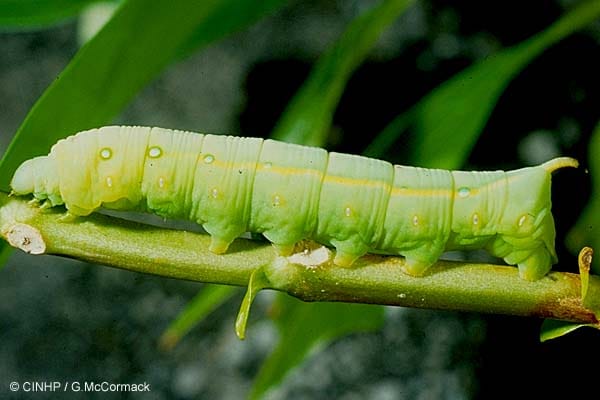
Gnathothlibus erotus Caterpillar or Hornworm – Cook Islands, Manihiki – Gerald McCormack
The White-brow Hawkmoth is found from India eastward across the South Pacific to Pitcairn Island. It is often attracted to lights at night, and is sometimes treated as an omen, or messenger from the spirit world. Its Māori names include ‘Iriano, ‘Irianu, Mū, Kiona, Kikiona, and Manu Tāmate Mōrī. The White-brow Hawkmoth rests with its wings roof-like. It is brown with yellow hindwings, and white legs. Its hornworm is usually green with a yellow stripe along the sides linking a series of white spots with dark edges. The hornworm is usually found feeding on Indian Mulberry, known on different islands as Nono, Nano, Noni, Nenu, or Nonu.
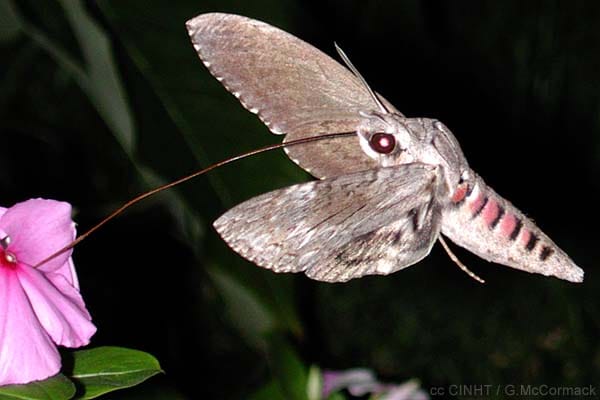
Sweet-potato Hawkmoth, Adult feeding – Cook Islands, Rarotonga – Gerald McCormack
Our other large hawkmoth is mainly a pest on Sweet Potato (Kūmera) and is known in the tropical Pacific as the Sweet-potato Hawkmoth (Agrius convolvuli). This moth is common from French Polynesia westward through Asia to western Europe, and in Eurasia it is called the Convolvulus Hawkmoth. It is also in New Zealand, where one tradition has it arriving on the waka Aotea – along with the Kūmara, Karaka, Kiore and Pūkeko. The Sweet-potato Hawkmoth is light grey with darker marks and spots. It is about 5cm long, and its tongue is exceptionally long – about twice as long as its body.
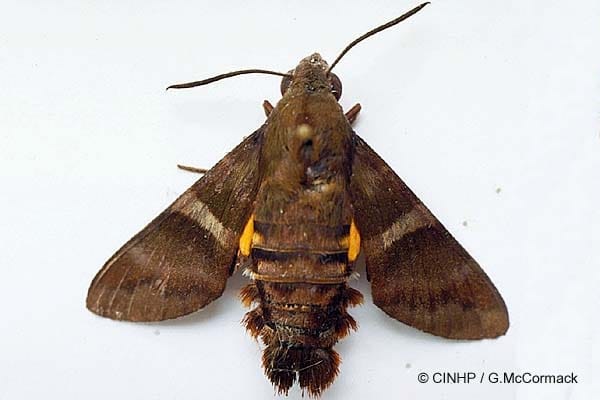
Hummingbird Moth, Adult – Cook Islands, Rarotonga – Gerald McCormack
Our third hawkmoth is the Hummingbird Hawkmoth (Macroglossum hirundo). This is our smallest hawkmoth, about 3cm long. It is native from Indonesia and tropical Australia eastward to at least the Cook Islands. The Hummingbird Hawkmoth is brown, with yellow and black hindwings. It looks more like a hummingbird than its two relatives, because the rear end has tail-like bristles. Its caterpillar is brown or green. It is a common pest on Indian Mulberry (Nono).
The final two Hawkmoths are the Hippotion velox (no common name) and the Vine Hawkmoth (Hippotion celerio).
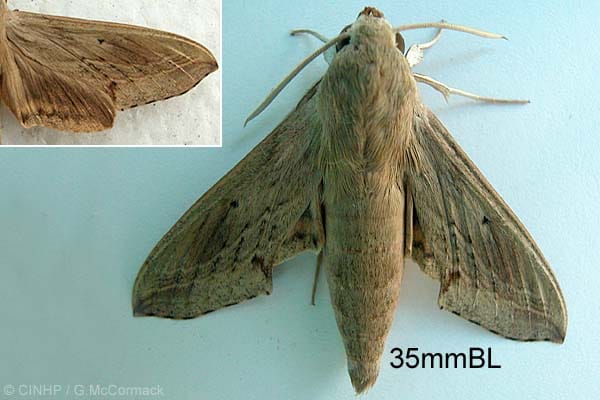
Hippotion Velox, Specimen and wing detail (Pukapuka) – Cook Islands, Pukapuka – Gerald McCormack
The Hippotion Velox is uniformly grey-brown with a central black spot, 2 faint wavy stripes on its forewing and half grey-brown and half orange-brown with a scalloped grey stripe on the hindwing. This species appears paler colour in Tokelau and darker colour in Tonga and Fiji. The specimen found in the Cook Islands was found on the northern group island of Pukapuka and is of the paler variety.
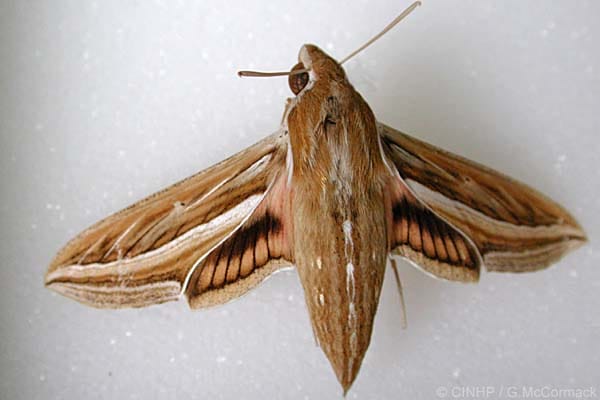
Vine Hawkmoth, Specimen (MoA collection, Totokoitu) – Cook Islands – Gerald McCormack
The Vine Hawkmoth(Hippotion celerio), a moth with a wingspan of about 8 cm, is easily
recognized by its brown and white striped forewings and red hindwings. Growing to around 4 cm in body length, this species has a distinctive caterpillar that can reach up to 9 cm long, appearing in shades of brown, green, or dark grey, with a large eyespot on the first abdominal segment and two smaller yellow spots on the second. Globally, it ranges from Africa to India and occasionally appears as a vagrant in regions including Australia, Samoa, and the Cook Islands.
First published CINEWS (15 June 2002)


