



Gerald McCormack, Director, CINHT

Pacific Heron, 3 morphs – Cook Islands, Rarotonga – Gerald McCormack
The Pacific Reef Heron (Kōtuku, Egretta sacra) is the fowl-sized, hunch-backed bird stalking in the shallow waters of the lagoon and in inland swamplands and streams. It grabs or stabs small fish and invertebrates with its large sharp beak by suddenly extending its long neck, at times assisted by a forward dash. Sometimes they extend their wings and run back and forth to herd small fish before lunging in for the kill.
They hunt alone and defend their feeding territories against other herons, except during the breeding season. Although usually silent, they can give a loud “kraaa” during territorial encounters. They have a graceful floating flight on large slow-flapping wings, with the head withdrawn on the S-shaped neck, and their legs extended to the rear.
Within the Cook Islands, herons are common throughout the Southern Group, uncommon on Suwarrow, and rare to very rare on the other northern atolls. They are most common on Miti‘āro because, in addition to the reef-flat food, they are able to feed on small freshwater fish, especially young Tilapia (Tīrāpia, Oreochromis mossambicus), in the many pools on the extensive marshlands. The Tilapia, which were introduced sometime since 1960, have also become the main food of the famous freshwater eel of Miti‘āro, the Pacific Short-finned Eel or ‘Ītiki (Anguilla obscura).
The Pacific Reef Heron is a coastal heron with a large geographic distribution from Bangladesh through Southeast Asia and Australia, Micronesia and across the South Pacific to the Marquesas islands, Tuamotus and Pitcairn. In latitude they range north to Japan and south to New Zealand, where they are common in Northland, Coromandel and the Marlborough Sounds; rare elsewhere, as far south as Stewart Island.
Grey and white morphs
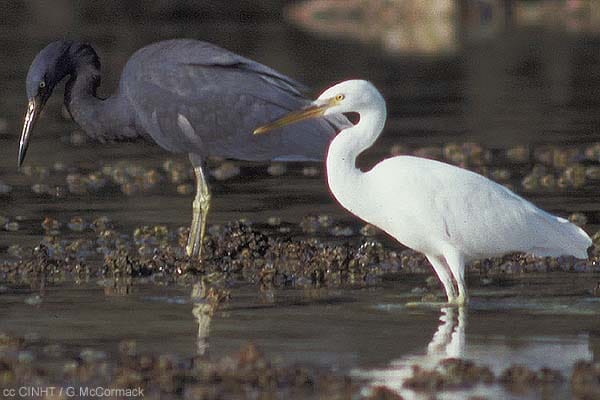
Grey and White Morphs, Ma’uke – Gerald McCormack
Reef Herons are typically uniformly dark grey or white. A round-Rarotonga count in April 1994 recorded 66 grey birds and no white birds, most on the north and east coasts. Although herons on Rarotonga are typically dark grey, white birds are sometimes seen and on one occasion I saw five together. On Aitutaki grey birds and white birds are both common.
The term “colour morph” is used here to refer to a permanent colour variation, such as sexual dimorphism where the male has a different colour than the female. In the case of the grey and white colour variants of the heron it is not related to gender, season or age.
There has been considerable scientific speculation about the environmental or physiological pressures that might control the numbers of grey and white birds in a population. In French Polynesia on the volcanic islands of the Societies and Marquesas more than 90% are dark grey (as on Rarotonga), while on the coral atolls of the Tuamotus about 60% are white.
The data from French Polynesia and Cook Islands are consistent with the predator camouflage theory with grey birds better camouflaged for hunting on the darker sands of volcanic islands, and white birds having an advantage on the white coral-sands of atolls. Not all data supports the theory of hunter camouflage; other environmental and physiological factors are probably also involved.
Rare mottled herons
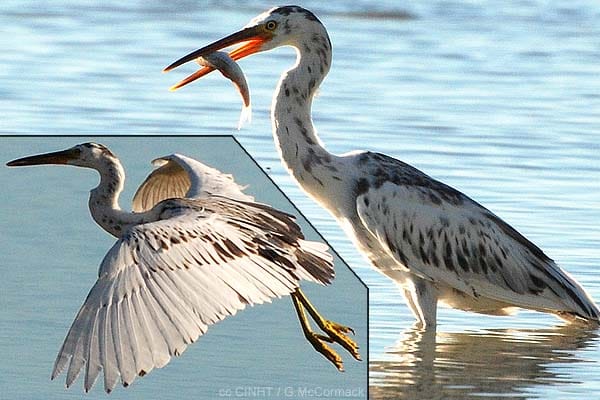
Mottled morph, Aitutaki – Gerald McCormack
Mottled herons are very rare. Typically, mottled birds are mainly white with scattered patches of dark grey, from a few scattered feathers to large patches, usually on the back, inner wings and tail. While most ornithologists think that mottled herons are a permanent colour morph, a few also think that sometimes they are a transition phase of immature white birds.
The image shows the mottled heron similar to that reported by Robbie Brown near Tamarind House in mid-June. I compared it with the dozen other mottled herons I have photographed over the last thirty years and discussed the situation with several ornithologists, including Dick Watling of Fiji. The conclusion is that the bird is an adult and its mottling is permanent rather than transitional. This is a permanent mottled morph, rather than a transitional mottled phase.
Most of the mottled birds I have photographed have a similar grey and white pattern on the wings, with more extensive variable grey on the body. On the wings many feathers are bicoloured, mainly white with some sections of grey. When the wing is extended it is white with grey on the tips of most primary flight feathers, and two other rows of intermittent grey-tipped feathers. When folded, the wing is extensively peppered with fine streaks of grey. I also have one photograph of an immature bird with this colour pattern which supports the idea that this is a permanent colour morph rather than an age-dependent transitional colour phase.
I have photographed three mottled herons that lack the peppering of bicoloured grey feathers but instead have a few uniformly grey feathers. They look similar to some immature Little Blue Herons of the United States as they transition from white juveniles to blue adults. If these local white herons with a few uniform grey feathers are transitional immatures, they are atypical and very rare. Alternatively, their very few uniformly grey feathers might have been caused by a skin mutations affecting feather colour.
Polynesian names
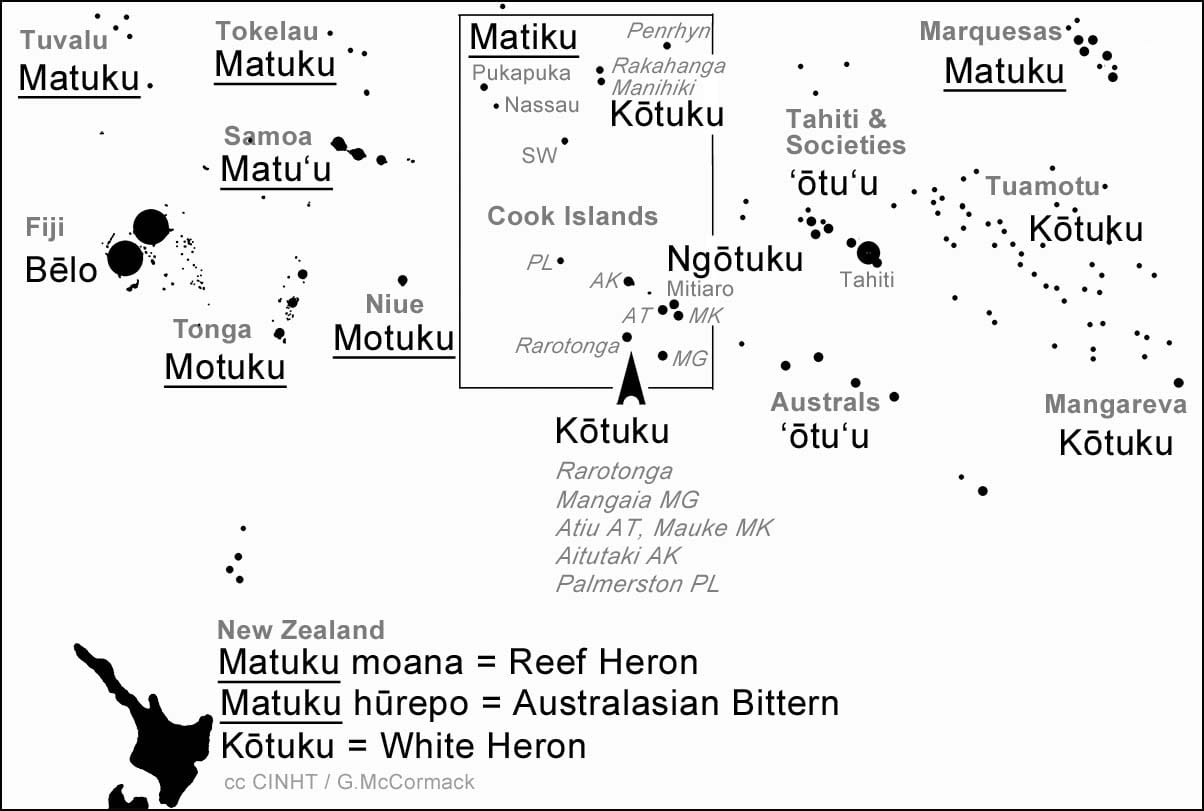
Polynesian names of the Pacific Heron throughout the Pacific
The Pacific Reef-Heron, a.k.a. the Eastern Reef Heron and the Pacific Reef Egret, is widespread in Polynesia and it has an interesting pattern of Polynesian names. In Western Polynesia it is known by cognates of Matuku: Motuku (Tonga, Niue), Matuku (Tuvalu, Tokelau), Matu‘u (Samoa) and Matiku (Pukapuka). In Eastern Polynesia it is known by cognates of Kōtuku: Kōtuku (Tuamotu, Mangareva, Southern Cooks, Manihiki-Rakahanga) and ‘otu‘u (Societies, Australs), with the minor variant of Ngotuku on Miti‘āro. The exceptions in Eastern Polynesia are in the Marquesas with Matuku, and in New Zealand with Matuku moana for the Pacific Reef Heron and Matuku hūrepo for the Australasian Bittern.
At first glance the use of the Western Polynesian name Matuku in the Marquesas appears to support the old Emory/Sinoto Model that the first Eastern Polynesian settlers voyaged from Samoa directly to the Marquesas, and later moved south and southwest to settle the intervening islands. However, it is also consistent with the more recent Continuous Settlement Model, which has a gradual eastward settlement of Eastern Polynesia from Samoa. In the latter case, the Polynesians called the heron Matuku and carried this name throughout Eastern Polynesia to the Marquesas and down to New Zealand. At a later date the people of the Societies and Tuamotu replaced the initial ma- with kō-, to give Kōtuku. This new name was carried into the Southern Cook Islands and north to Manihiki and Rakahanga, and southwest to New Zealand where it was applied to a second species of heron, the White Heron (Egretta alba).
In New Zealand the White Heron maintains a small population of about 120 birds which breed on the West Coast of the South Island, but disperse throughout the country during the non-breeding season. This beautiful bird caught the imagination of the Māori and in oratory it is the most exquisite compliment to be likened to their Kōtuku. The White Heron, although rare in New Zealand, is widespread in Australia and Asia.
First published CINEWS (25 July 2015)


