



The most venomous fishes in the Cook Islands are several Lionfishes and Scorpionfishes, and a Stonefish, which all belong to the Scorpionfishes family. All members of this family have poison glands associated with hollow fin-spines, especially the dorsal spines, to inject poisonous proteins into animals that attack them. Although the puncture wounds from the spines are small and inconspicuous, a sharp throbbing pain develops almost immediately, and within minutes it spreads up the limb and intensifies.
Lionfishes have a weak system of injecting their venom. Scorpionfishes have a more efficient system of injecting the poison. The most serious of all stinging fishes, the Stonefish, has very large poison glands and an extremely efficient system of injecting the venom. The degree of pain is a measure of the seriousness of the sting – Lionfishes and small Scorpionfishes cause the victim to cringe with pain, large Scorpionfishes cause the victim to almost lose control with pain, while the Stonefish causes the victim to thrash about uncontrollably and scream in agony. Only in the most unusual circumstances are stings from Lionfishes and Scorpionfishes life threatening, but a serious sting from a Stonefish, without suitable treatment, can progress over a period of a few hours to extreme breathing difficulty, convulsions, and even death.
Lionfishes
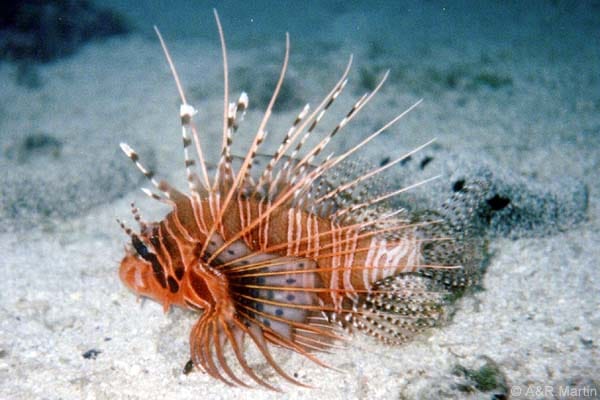
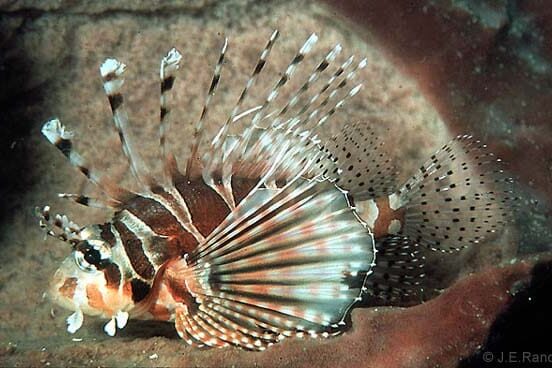
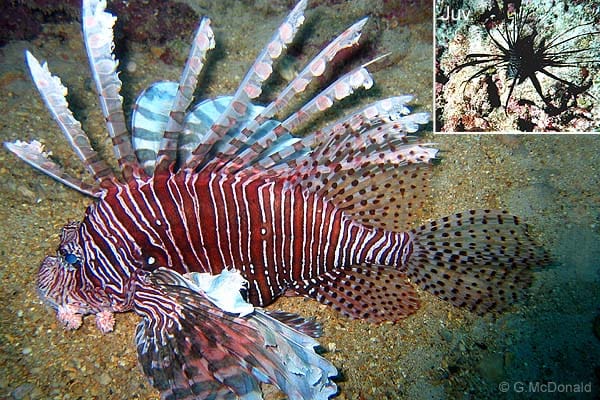
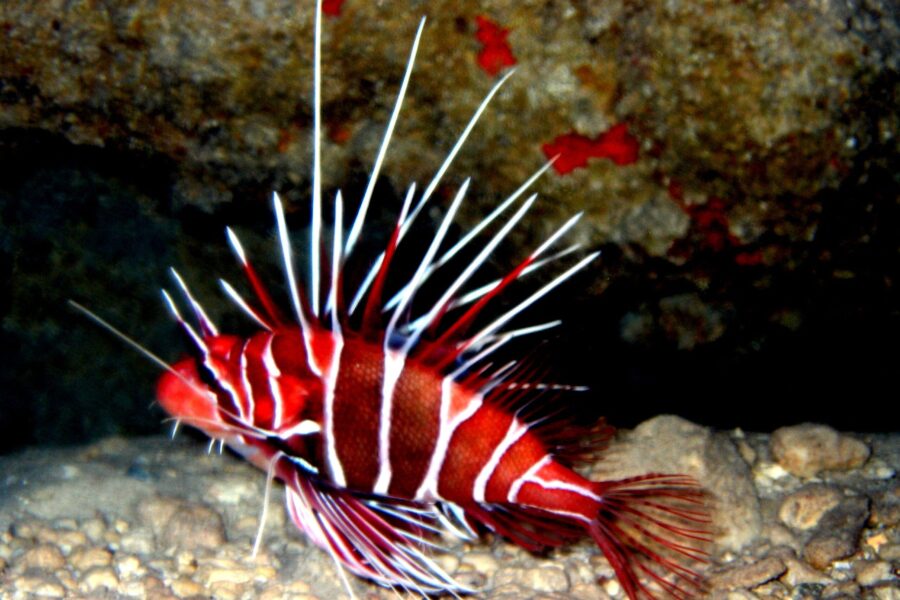
Lionfishes have alternate bright red and white bands, and long spectacular fins. They are among the most beautiful of reef fishes. They usually hide in crevices and under ledges during the day and emerge to hunt at night. In the open they are conspicuous as they move slowly and gracefully to gently corner their prey before the final lunge. People can be stung by a lionfish by poking it while it is hiding under a ledge or in a hole, or while it is slowly swimming.
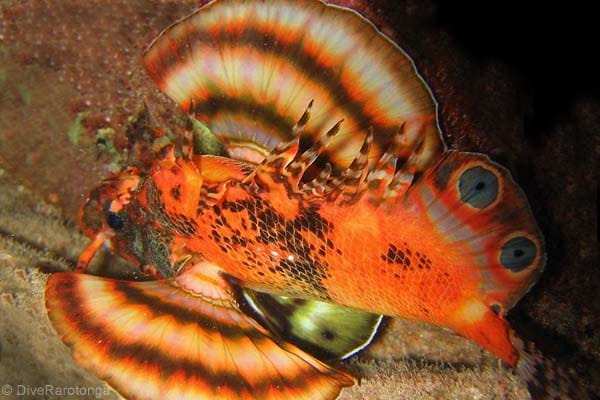 Twinspot Lionfish
Ambush hunters
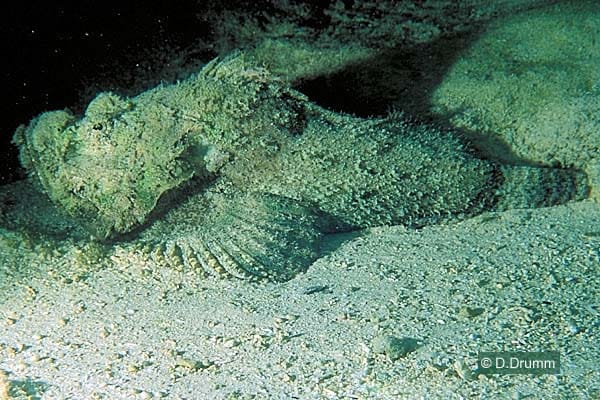
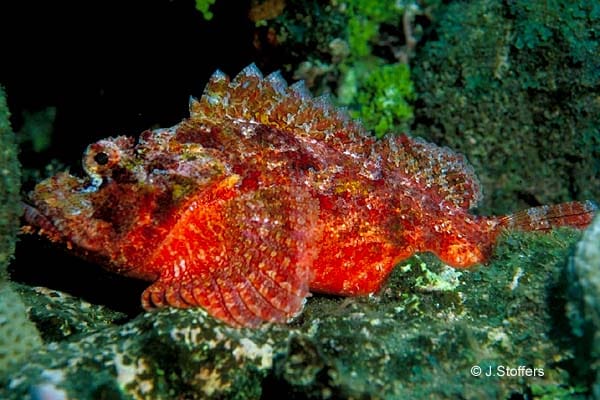
Scorpionfishes and the Stonefish are thoroughly camouflaged and make a living as ambush hunters. They lie motionless on the bottom, sometimes partly buried in the sand, waiting for unsuspecting prey to devour with a rapid forward lunge. It is while they are lying quietly in ambush that people sometimes accidentally attack them. If the foot comes shuffling from the side they will usually have time to escape, but if the foot comes rapidly down from above they may only have time to raise their dorsal spines in self-defence. The spines can easily penetrate a bare foot, or a foot hidden behind a thin rubber sole. The poison is injected in accordance with the type and size of fish, and the pressure applied by the attacker. The almost instantaneous pain should cause the attacker to withdraw so the fish can escape.
Scorpionfish? Stonefish?
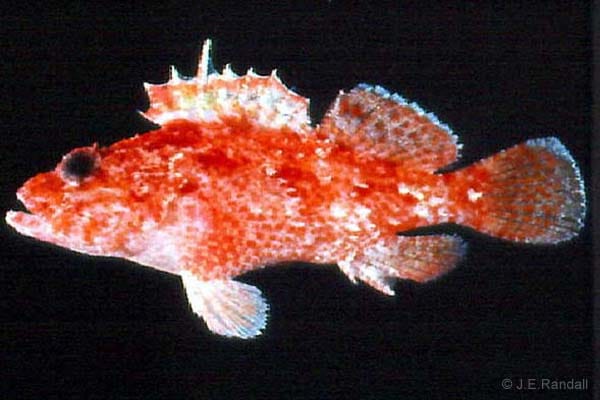
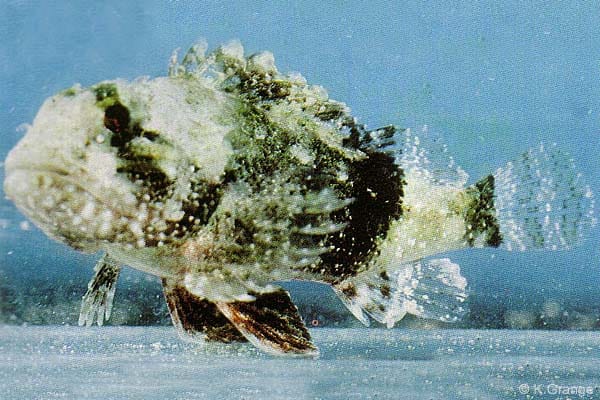
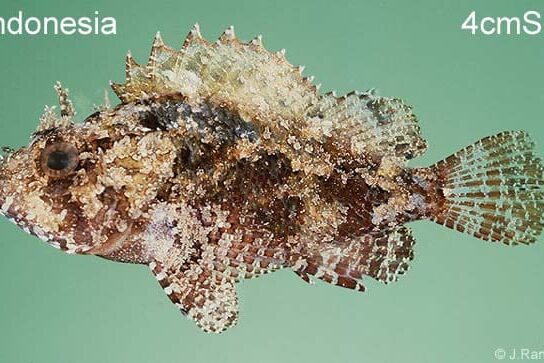
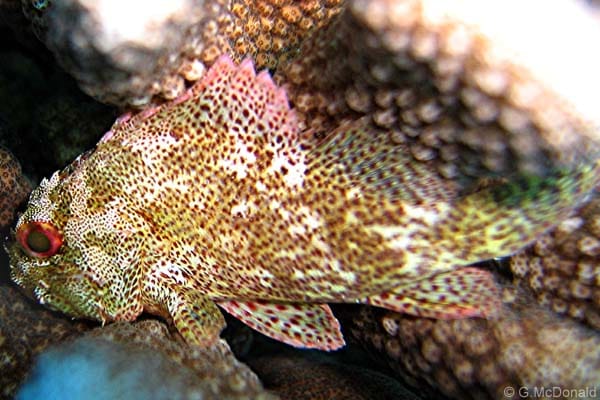
Locally the largest and most serious scorpionfish is the Devil Scorpionfish (Scorpaenopsis diabolus) which grows to about 25cm (mouth to tail-base). The Flasher Scorpionfish (Scorpaenopsis macrochir), to about 13cm, has not been locally recorded but is likely to be here as it is in countries both east and west of the Cook Islands. The only locally recorded stonefish is the Humpback Stonefish (Synanceia verrucosa), which can reach 35cm in length. In the Cook Islands a scorpionfish rather than the Humpback Stonefish is the stinger of most people.
The easiest way to distinguish between a scorpionfish and a stonefish is that the scorpionfish’s closed mouth points upward at an angle of less than 45°, and the soft-rayed hind section of the dorsal fin is about twice as high as the hard-spined forward section. A stonefish has the closed mouth very near vertical (90°), and the hind section of the dorsal fin is only slightly higher than the forward section.
In the Cook Islands Lionfishes are typically known as Tātarai‘au, while Scorpionfishes and the Stonefish are usually lumped together as No‘u. A name distinction between Scorpionfishes and the Stonefish would be useful – maybe No‘u for the more common Scorpionfishes, and No‘u Nui for the rarer and more dangerous Humpback Stonefish.
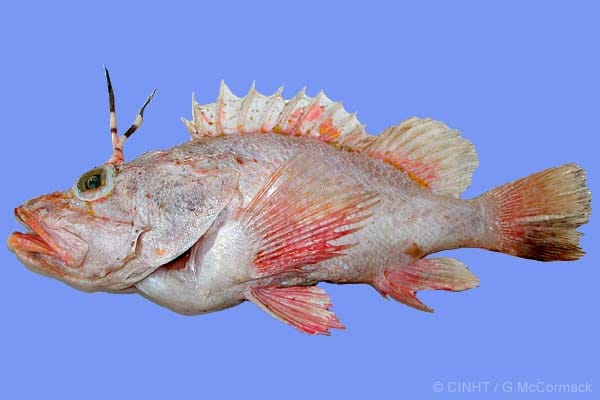
 Decoy scorpionfish (Iracundus signifer)
Fish-sting remedies
NOTE: THIS IS NOT MEDICAL ADVISE – always seek advice from a trained medical professional
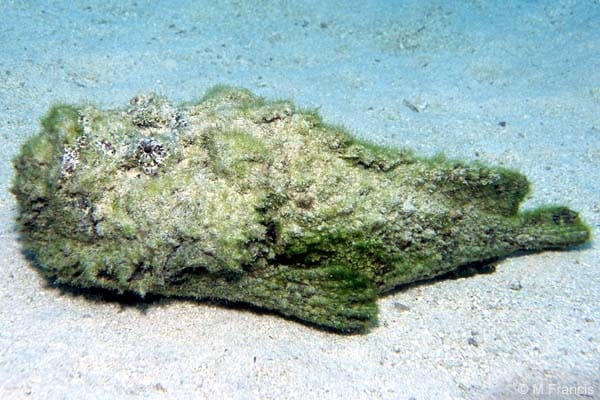
Humpback Stonefish – Rarotonga, M Francis
First of all – prevention is better than cure. Do not put your hands into holes and crevices or under ledges. Whenever walking in shallow water look carefully, and a slow low shuffle gives lurking fishes a better chance of noting your approach and of escaping. Lightweight soles will give little protection if you push down on a set of rai
sed spines, but are adequate for a slow shuffler. Moderately firm and thick-soled footwear will offer good protection in most cases.
The small size of the puncture wounds is misleading, but the level of pain will give a good indication of the seriousness of the sting. Your first action, having released the fish, is to call for help and to start moving as quickly as possible towards the shore. It is embarrassing to be thrashing about in pain on the beach, but far safer than the same performance under water!
The Natural Heritage Project collects information on traditional and home remedies, and you might like to contribute to this interesting area of knowledge. The juices from numerous different types of plants have been recorded as useful, but the effectiveness of each is difficult to assess. Now that science has established that the poison is a protein, and how proteins can be destroyed, we can see that some home remedies are consistent with this knowledge.
One remedy is to rub slices of “green ripe” pawpaw (papaya) on the puncture wounds. This sounds promising, if the juice enters the open wounds, because green pawpaw has a high concentration of a strong protein-digesting enzyme (papain), which should destroy the protein poison. Another starter would be the hot stone with water and chicken manure on top, and a half coconut shell with a single hole to direct the steam onto the wound – whether the chicken manure is essential or not, I‘m not sure. The fact that this method directs strong heat onto the wound is consistent with the knowledge that proteins are destroyed by heat. Another informant assured me that the insertion of a hot nail into each puncture wound was very successful – but note that this method could produce other medical problems. The application of burning kerosene is another way of applying heat, but accurately focusing the heat of the flame could be difficult, and the method likely to lead to other medical problems. For the more outdoorsy folk, there is the killing of the fish that stung you, removal of its gall bladder intact, and squirting its contents into the puncture wounds – the chemical basis of this cure is unknown, but I know a reliable informant who found this cure to work very rapidly.
If none of the above methods appeal, then you may have no alternative than to try the method described below, which appears in most recently published marine medical books.
Non-scalding hot water
Treatment should start IMMEDIATELY. (1) Clean the wound thoroughly with freshwater with soap or antiseptic; (2) encourage bleeding with gentle massage; and (3) soak in nonscalding hot water for 60-90 minutes to destroy the protein poison and reduce the pain. Antiseptic solution in the bathing water is a good idea to reduce the likelihood of infection.
It is most important to not burn your injured limb with the hot water, remembering that the limb is in such great pain that it cannot tell you it is now being burnt. The test for nonscalding hot water is to immerse a non-injured hand into the water and if it you can tolerate it for a few minutes then it is OK for your injured limb. Such water has a temperature of 45°C (115°F). Hopefully you will be near a house that can provide a steady supply of nonscalding hot water, but in an emergency the radiator water of an engine is hot – but please be very careful in removing the radiator cap as the pressurised hot water may squirt you, and it may be dangerously scalding! It is important to not panic but remain calm and thoughtful while providing assistance to a fish-sting victim.
After soaking treat the wound with antiseptic solution, cover and keep the limb elevated as much as possible to reduce swelling. Even if the treatment seems successful you should also seek medical advice. For very serious stings a doctor may infiltrate the wound area to reduce the pain with a local anaesthetic, such as Procaine®, Novocaine® or Lidocaine®. If local measures are inadequate, intramuscular or intravenous Meperidine® or Demerol® is known to be useful. Over the next few days, watch carefully for any signs of secondary infection – if in doubt, consult a doctor.
Original File created December 1999


