



Gerald McCormack, Director, CINHT
Long before the first Papa‘ā (Caucasians) visited the Cook Islands Polynesian fisherman were using drop-stone hand-lining at 100-150 fathoms (200-300 metres) to catch Vena, Mangā, ‘Ā’ā Mangā and Mangā Ru‘i. The fishing technique was a unique tradition of the Northern and Southern Cook Islands, Rimatara and Rurutu, and it was not introduced to the Society Islands, Tuamotu and Tubuai until after European contact[1]. While the scientific identification of Vena and Mangā had been known for a long time, this article discusses the discovery of ‘Ā’ā Mangā in 1998, and Mangā Ru‘i in April 1999.
The four fishes belong to the Snake-Mackerel Family, which are deepwater predators, with strong conical teeth along the jaws and a few razor-sharp fangs on the roof of the mouth. These fishes generally live at depths of 200-500 metres, sometimes migrating upwards at night. While we usually call them snake-mackerels, they are also known as gemfishes and escolars.
Oilfish
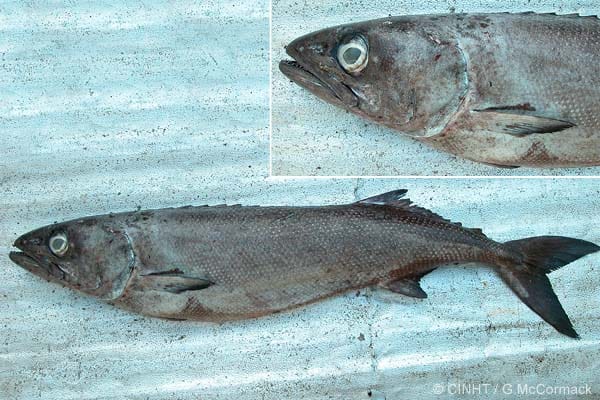
Oilfish, Pukapuka – Gerald McCormack
The largest of the family is the Vena or ‘Uravena, the Oilfish (Ruvettus pretiosus). This monster of the deep often reaches 150cm (maximum 300cm!), has a rough scaly skin, an interesting ventral keel, and a flesh much prized by the traditional connoisseur, but well known to cause diarrhoea for the inexperienced – hence its other name, “scour-fish”. Rupe Rima caught a large Vena early this year (CI News 11/1/99).
Single-lined Snake-Mackerel
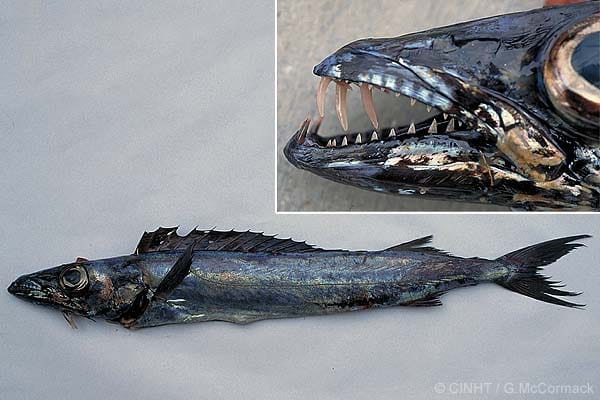
Roudi Escolar, Adult – Cook Islands, Aitutaki – Gerald McCormack
The most well known gemfish, and the main target of the Cook Islands deepwater fishery, is the Single-lined Snake-Mackerel, Single-lined Gemfish or Roudi Escolar (Promethichthys prometheus). This is the Mangā of the Southern Group, the Kapoa of the Northern Group. This species, typically to 60cm in length (maximum 90cm), is often seen for sale in the tree at Avatiu Bridge, usually provided by Tereapii Temata and his friends. And, not surprisingly, it was Apii who enabled the ‘Ā’ ā Mangā mystery to be solved.
Black Snoek
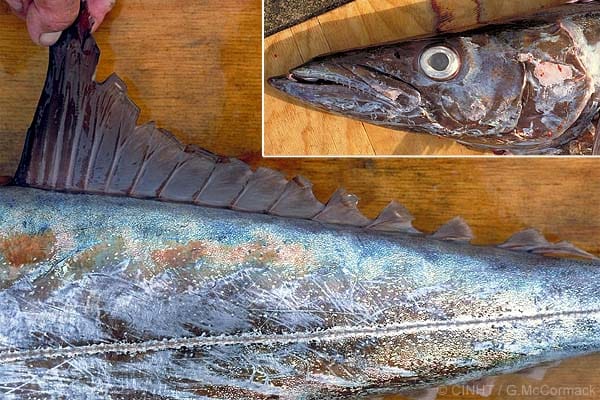
Black Snoek, Rarotonga – Gerald McCormack
The ‘Ā’ā Mangā caught by Apii Temata in May 1998 was identified by John Paxton, a gemfish expert at the Australian National Museum, as a Black Snoek (Thyrsitoides marleyi). The literature gives 150cm as the maximum standard length, so Apii’s fish at 170cm and 28kg was a whopper, in addition to being the first confirmed record of this species in the Cook Islands. Since then other ‘Ā’ā Mangā, caught by Julian Dashwood, Sonny Tatuava and Apii, have all been Black Snoek. The large fish with Rouru Quarter, in a 1980s photograph in the Fishing Club, is also a Black Snoek. To date, all the large ‘Ā’ā Mangā investigated have been Black Snoek. The species is recognised by the 18 spines in the first dorsal fin, the upper line on the side terminates before the start of the second dorsal fin, and the lower line starts between the third and fourth dorsal spines.
Domine
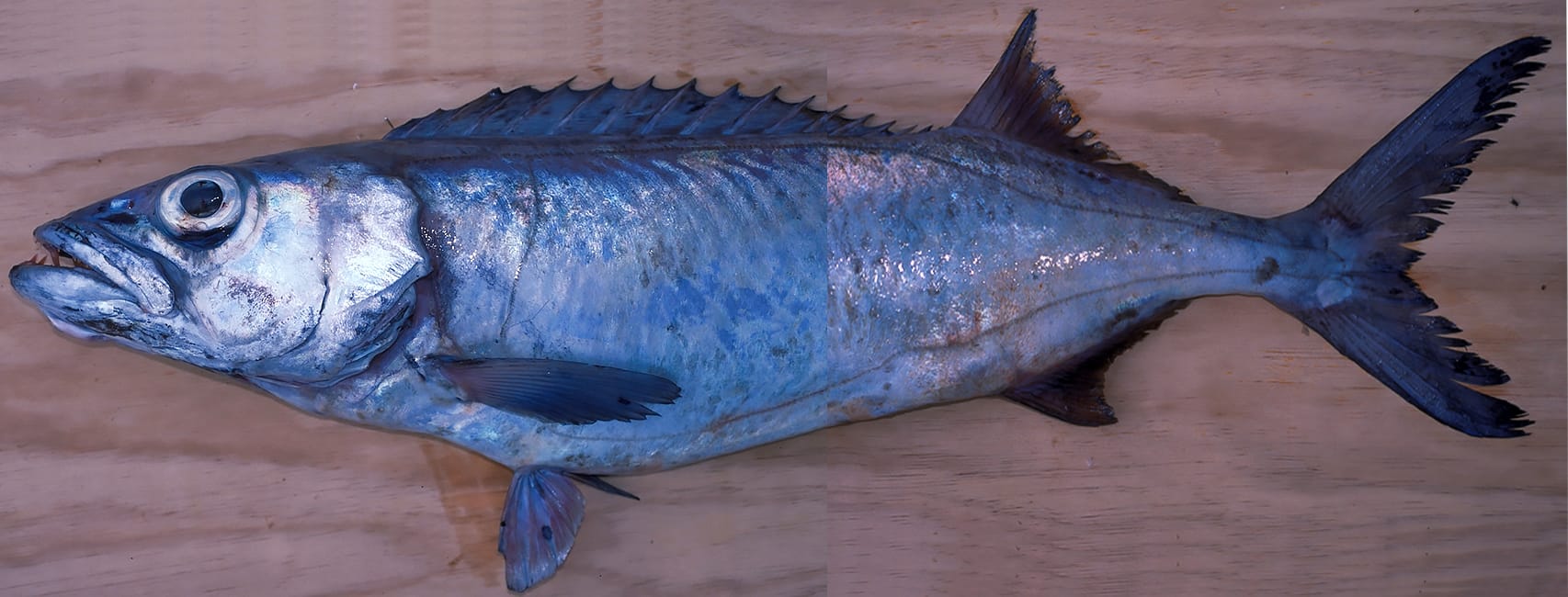
Domine, Rarotonga – Gerald McCormack
Sonny Tatuava caught a Mangā Ru‘i in April 1999. A literature search by the author showed Sonny’s fish to be a Domine (Epinnula magistralis), a species first recorded in the Caribbean and given the Spanish name of Dómine, which has been adopted as the English name also. It has been caught in southern Japan, northeast Australia, and Hawaii – and now in the Cook Islands. The Domine is deep-bodied and grows to 100cm, with Sonny’s at 75cm and 20cm deep. The local name Mangā Ru‘i is based on that the fact that, while it has a Mangā-like mouth, the body is similar to a Ru‘i, the Black Jack (Caranx lugubris). With this identification we now have three separate species of gemfishes linked to the three traditional names for mangā, and the Oilfish linked to Vena. Unfortunately not all is solved – the question is: Is the real Snake Mackerel or Serpent Snake-Mackerel living in the Cook Islands?
Serpent Snake-Mackerel
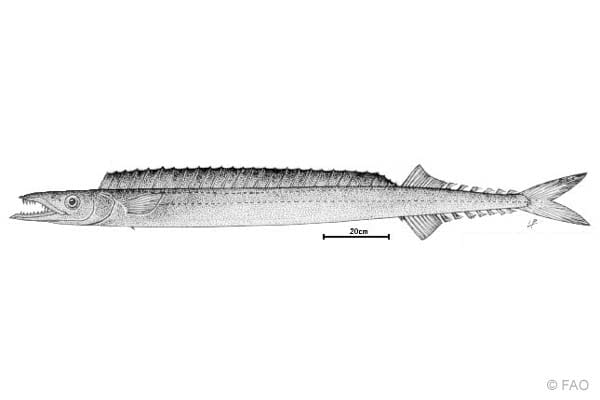
Illustration of A Serpent Snake-Mackerel
It has been previously suggested that the Serpent Snake-Mackerel (Gempylus serpens) was present in the Cook Islands. A careful search has failed to provide any positive proof. Hopefully before the end of the year, if it is in our waters, one will be caught for identification. What is it like? It is a very elongate fish, typically to 70cm (maximum 100cm), about 15 times longer than deep. The first dorsal fin has 28-32 spines; the second dorsal fin is small and opposite the anal fin, and both are followed by 6 finlets. There are two lines on the sides. Happy fishing.
Other interesting fish from 1999
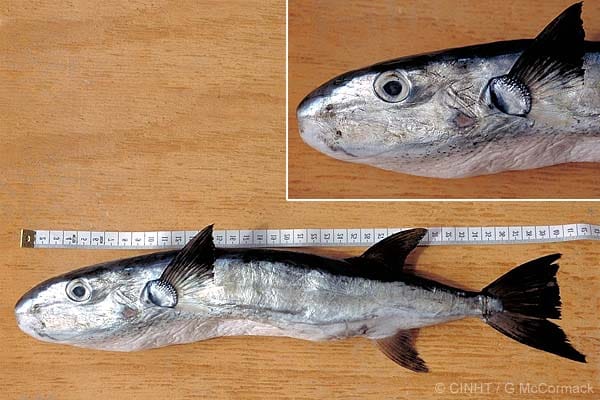
Oceanic Pufferfish, Rarotonga – Gerald McCormack
In 1999 Paruru Pera caught two interesting species. The first was identified as a Oceanic Pufferfish, a new record for the Cook Islands. This unusual fish has the scientific name Lagocephalus lagocephalus, meaning “rabbit-head, rabbit-head” – who said scientists have no humour? The head of this unusual fish certainly did have a rabbit-like head – after removing the ears – a gently sloping forehead ending in thick fleshy lips hiding two large incisor teeth on the upper jaw. Being a pufferfish it was probably poisonous, as many in the family have a very potent poison, tetrodotoxin (TTX), in the skin, viscera and reproductive organs. In Japan special chefs prepare the flesh of the fugu, a pufferfish, for customers who enjoy the flavour, and the risk. While the survival rate of customers using registered chefs is excellent, several die each year taking the risk with unregistered chefs. And then there were the newly weds in Tasmania who could catch only a pufferfish for breakfast. He died while going for assistance, and his wife was found dead in the camp. Pufferfish should be treated with respect.
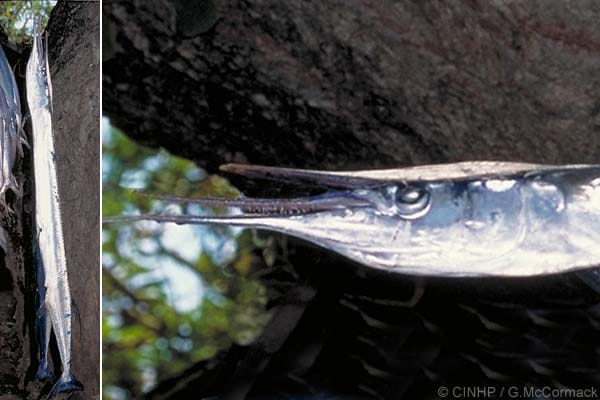
Flat Needlefish, Rarotonga – Gerald McCormack
Pauru also caught a couple of Flat Needlefish (Ablennes hians) which finally enabled the traditional names Pāpā and ‘Aku to be correctly assigned. The ribbon-like Flat Needlefish, to 120cm in length, is the Pāpā, while one or two nearly cylindrical needlefishes are covered by the name ‘Aku or ‘Aku‘aku.
First published in the CINEWS (1999)
References
1. Nordhoff, C. B. (1928). Fishing for the Oilfish: native methods of deepsea fishing for Ruvettus pretiosus at Atiu, and elsewhere in the South Seas. Natural History 28: 40-45.


