



Gerald McCormack, CINHT,
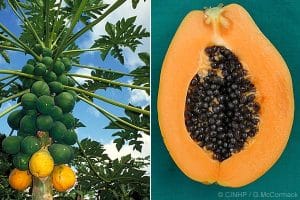
Solo variety (hermaphrodite) and fruit – Cook Islands, Rarotonga – Gerald McCormack
The pawpaw (Carica papaya) is a popular and delicious breakfast fruit. It is sliced and the hundred loose black seeds are easily scraped out to leave the firm orange-yellow or pink flesh, which is eaten raw with or without a squirt of fresh lime juice. These now popular fruits are various lines of the Solo Variety, developed in the early 1960s by the late Professor Ngakasone at the University of Hawai’i.
The development of the Solo Pawpaw transformed a widespread, locally consumed fruit into an exportable fruit. During the 1960s Hawai’i started to export the small Kapoho Solo to mainland America, and with the opening of the Rarotonga International Airport in 1973 the Cook Islands started exporting to New Zealand. For one reason or another New Zealanders were not keen on the small (0.5kg) Kapoho and Rarotonga concentrated on the larger, orange-yellow Waimanalo Solo, which averaged a kilogram.
There are several other lines of the Solo Pawpaw which have different sizes, keeping qualities and colours, including the pink-fleshed Sunrise Solo. Experiments with hybridising the different lines is ongoing.
In addition to the beautiful colour, satisfying texture and pleasing taste, the pawpaw has great nutritional qualities.
The ripe fruit is very nutritious being very high in Vitamin C and A.
| Energy | Calcium | Phosphorus | Vitamin A | Vitamin C | |
| MJ / Kcal | mg | mg | micro-g | mg | |
| Pawpaw | 0.2 / 40 | 20 | 12 | 120 | 50 |
| Fresh Orange Juice | 0.2 / 40 | 20 | 90 | 40 | |
| Mango | 0.3 / 70 | 10 | 180 | 50 | |
| Apple | 0.3 / 63 | 4 | 10 | 10 | |
| Rec. Daily Need* | 500 | 750 | 30 |
* The Recommeded Daily Need is a general figure for teenagers and adults.
*The table shows the amounts of nutrients per 100g edible portion.
The immature fruit is also an important food. It can be peeled, de-seeded and diced to be boiled in water and eaten as a vegetable. It can be halved, de-seeded, filled with stuffing and baked in the oven. It can be used to make pickles and chutney.
Other Uses
The white sap (latex) of the plant contains up to 2% papain, a protein-digesting enzyme. Vertical cuts are made in the larger immature fruits in the early morning and the latex ooze is later scraped into non-metallic containers and dried to form a greenish-grey powder, called raw papain. The enzyme, in the raw state or after further purification, has many uses in industry: in brewing beer, in processing certain cheeses, in preparation of meat extract products, and in the processing of wool and silk. It is commonly used to tenderize meat, and, medicinally, it is taken with meals by people with protein digestive problems.
Within the home, meat can be tenderized by wrapping it for several hours in pawpaw leaves or by layering it with slices of immature fruit for a while before cooking. It has also been discovered that picked-flowers remain fresher when wrapped in pawpaw leaves, and this also applies to the edible seaweed common on Aitutaki (rimu, Caulerpa racemosa).
The latex, especially in the form of sliced or grated green fruit, is applied externally for a number of skin ailments. It is used to treat sores (tona), boils/carbuncles (‘ē’ē and taupō), cuts (motu), ringworm (mūnā), athlete’s foot, and stings from Firecoral (Kāoa ngaikaika), jellyfish (Kōpurerua), Portuguese Man-o’-War (Tūtae-to’orā, tu-pakipaki-tai, Physalia utriculus) and stonefish (No’u, Synanceia verrucosa).
The seeds can be swallowed whole to treat intestinal worms (toketoke), and are effective against whipworm (Trichuris), roundworm (Ascaris) and pinworm/threadworm (oxyurids) but not hookworm (Ancylostoma). Although the fresh latex is a strong vermicide (worm-killer) it is also a strong laxative, and a mere teaspoonful can kill an adult.
Parts of the plant, especially the fresh green fruit, are widely used as a contraceptive and to induce abortions. In 1994 researchers at Sussex University concluded that papain was an effective contraceptive and would also cause an abortion. The scientists reported that eating unripe fruit for two or three days causes enough papain to be absorbed that it affects the level of the hormone progesterone such that it cannot maintain the foetus, which is then aborted.
The spread of the pawpaw and the development of its Polynesian names
The pawpaw has never been discovered in the wild, and it has been concluded that it may have arisen in Mexico and Costa Rica as a hybrid of the Mountain Pawpaw (C. peltata). Certainly, the native people of Central America and tropical South America had spread and cultivated the plant in pre-historic times, and in 1535 Oviedo wrote that the Spaniards had found the plant around Panama and spread it into the Caribbean, giving it the name papaya throughout Hispaniola. The name variously papaya, papayo and papaio was based on Carib name, which have been variously recorded as ababai, papaio and pappai. In the 1500s the Spanish took the plant to Malacca and it spread rapidly throughout Southeast Asia, India and East Africa, typically taking the name papaya or papaio. At that time the fruit was said to be mellon-like and as large as a man’s fist, and it was widely used as a subsistence food. In the 1700s when the great Swedish scientist, Linnaeus, was giving names to everything, he gave this plant the name Carica papaya – literally “fig-leaf papaya”.
When most communities, including the American English have adopted the name Papaya, how did the British English, Australia and New Zealand (and the Cook Islands) come by the name Papaw, Pawpaw or Papa? Although the origin of these names is unknown, they may have been independently derived from a Carib name, such as pappai. These names have been in use at least since 1624 when a Captain Smith wrote “The most delicate Pine-apples, Plantans, and Papaws.” –
In some instances Pawpaw refers to the rounder more orange cultivars and Papaya to the smaller longer more pinky fleshed cultivars. To add to the confusion in north America Pawpaw refers to a small fruit tree Asimina triloba which is not related to the tropical plant found in the Cook Islands.
The earliest note on the pawpaw in the Cook Islands is in the diary of Rev Charles Pitman, missionary in Ngatangiia: “Also the Ninita or Papaw apple before the introduction of the Gospel by natives drifted in a boat from the Paumotu’s Islands.” (Journal of Charles Pitman, Vol. III(237), 7/11/1835). It is not possible to determine when this event happened, other than pre-1823. It also shows that the first Rarotonga name was ninita and that this was obtained directly from the Tuamotu people.
In 1879 the Reverend William Wyatt Gill [Gill, 1879 #405] referred to it as the “Papaw Apple-tree”, and noted that the native name was ninita. Botanist Cheeseman [Cheeseman, 1903 #56] wrote that Papaw trees had been introduced around 1840 by the Missionaries, a conclusion now known to be mistaken by the availability of the Pitman Journal. Cheeseman noted that it had naturalised on the lowland and into the hills, and he recorded the Mäori name as ninita.
Where did the Tuamotu people get the pawpaw and the name ninita, which they gave to the people of Rarotonga?
The Spanish frigate Aguila visited Mehetia in 1772 and provided the inhabitants with several plants, including the Papaya. In those days there were regular voyages of canoes between the southern end of Tahiti, Mehetia and parts of the Tuamotu group. It is thought that the Papaya arrived on Tahiti around 1774, and the name ninita was its first Polynesian name, being the only name recorded in Davies’ Tahitian vocabulary of 1851.
It seems that there is a connection between stiffness, tetanus and papaya in Eastern Polynesia. Davies (1851) records ninita for the pawpaw and iita for tetanus or for stiffened in body or mind. Jaussen (1969) records ninita for pawpaw, iita for papaya and for stiffness, and moves tetanus to mai iriti. Lamaitre (1973) drops ninita altogether, has ‘ī’ītāī for pawpaw but not for stiffness, and maintains tetanus as ma’i ‘iriti. In Tonga in the early 1800 Mariner records gita as a common disease among Tongans and Fijians, the disease of tetanus. And gita is a cognate of kita of Rarotonga (in Savage, but dropped by Buse), and iita of Tahitian meaning stiffness. It is possible that the Mehetia people used ninita for stiffness and for the new rigid plant, the papaya, and the Tahitians took this on as ninita, but gradually drifted back to the cognate iita.
In the Cook Islands kita was to be steadfast or immovable in the 1962 Savage dictionary, while it has been dropped from the Buse 1995 dictionary – unless we accept a link between “to be steadfast” and kïtä a transliteration of the word “guitar”! On Rarotonga since at least 1866 the word uti for convulsions and cramps has been used for tetanus.
In the Cook Islands the name ninītā is still used in the Northern Group, although Rarotonga has contracted the name to nītā. The Ngāpūtoru group are unusual in associating the Pawpaw with the widespread name for the Missionary-introduced Mango, vī, which in turn was the pre-historic name of the Polynesian-introduced Otaheite Apple. In Ngāpūtoru the Pawpaw is known as vī puaka, meaning Pig Mango or Mango-for-the-pig. Aitutaki uses the name vīnita, an unusual combination.
Why did Hawaiians call the Pawpaw hē’ī, which is Hawaiian for fe’ī the Tahitian name for the Mountain Banana. Hawaii did not have the Mountain Banana in pre-historic times. It seems that both the Mountain Banana and the Pawpaw were taken to Hawaii around 1810 and that only one name survived the voyage, resulting in both plants being known in Hawai’i as hē’ī. The Marquesas formerly lacked the Otaheite Apple, and they gave its Tahitian name of vī to the Pawpaw when it arrived around 1820 – then, when the Apple finally arrived a few years later they also called that vī. To distinguish the two vī, the Pawpaw is vī papai.
While the names lesi (Tonga) and ‘esi (Samoa) seem to be linguistically related to hē’ī (Hawai’i), there is apparently no historic connection. In 1808 the ship General Wellesley introduced the Pawpaw to Fiji from Asia, and it took the Fijian name for the ship, weleti. When the plant went from Fiji to Tonga and Samoa it took the ship’s name as: lesi and ‘esi. (This section is based mainly on Langdon (1989) [Langdon, 1989 #627].)
A biology – some other notes
The papaya is a fast-growing, short-lived, small tree, to about 6 metres, with few or no branches and a terminal cluster of large leaves on very long, hollow stalks. The leaves, to 50cm across, are deeply dissected into 5-9 lobes, and various sub-lobes. The flowers are unisexual, and the plants have either male or female flowers. The male flowers, each a thin 25mm tube with five 15mm petals, form in clusters on a long, drooping branching structures. The male flowers provide pollen to the flowers on the female tree but sometimes their normally rudimentary ovary develops into a small fruit, and sometimes damage to the roots can make the plant change from male to female. The female flowers, one or two at the base of each leaf-stalk, have five 5cm petals surrounding a 3cm ovary.
Both male and female flowers produce nectar and both have a strong sweet scent especially obvious at dusk when moths are active. The long-tongued moths visit both male and female flowers to obtain pollen and in the process they accidentally transfer the pollen from the male flowers to the stigma lobes of the female flowers. In plantations it is usually found that one male tree is sufficient to provide pollen for about ten female trees. After pollination the pollen tubes grow down into the ovary and each one fuses with an ovule which then develops into a seed. Today, some of the modern varieties have bisexual flowers, functional male and female parts.
After pollination the ovary develops into an oval, pear-shaped or round fruit about 20cm diameter, and up to twice as long. It has a hollow cavity lined by a skin which supports hundred of small, black seeds and a thick orange or yellow or pinkish flesh, which is sweet and juicy. The seeds are attached to a membrane and are easily scraped out with a spoon leaving a delicious flesh to be eaten fresh for breakfast or a dessert.


