



Gerald McCormack, CINHT
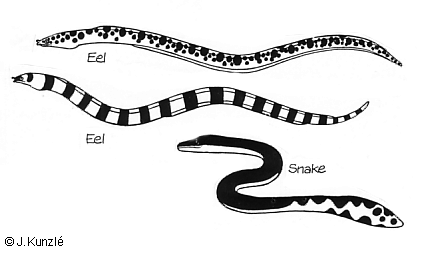
Illustration depicting spotted and banded snake eel and a sea snake – J. Kunzlé
Inshore sea-snakes are common on and around the reefs of Fiji, Samoa, Tonga and Niue, but have never been recorded in the Cook Islands. The snake-like creatures in our lagoons are scaleless fish in the Snake-eel Family.
Snake-eels differ externally from sea-snakes in having a dorsal fin along most of the body, a more-or-less pointed tail, and protruding nostrils on the upper lip. Although they are not poisonous, they do have lots of small sharp teeth.
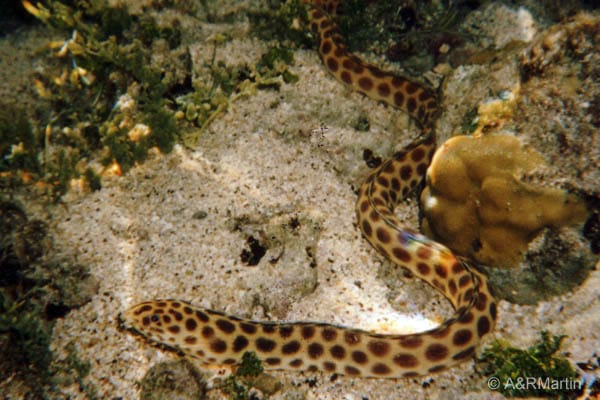
Spotted Snake-eel, (Myrichthys maculosus) – A&R Martin
The most common snake-eels are the Spotted Snake-eel (Myrichthys maculosus) and the Banded Snake-eel or Barred Snake-eel (Myrichthys colubrinus). The Spotted Snake-eel is up to 80cm, cream in colour with black spots. The Banded Snake-eel is a similar length with dark bands completely encircling its white body. And a less common third species has its bands reduced to dark saddles.
Although we have no inshore sea-snakes, we share with the rest of the tropical Pacific, the oceanic Yellow-bellied Sea-snake (Pelamis platurus). Like the inshore sea-snakes, the Yellow-bellied Sea-snake has external scales, a vertical paddle-like tail, no dorsal fin, and non-protruding nostrils. They swim to the surface to fill their lungs with air and can remain submerged for about two hours.
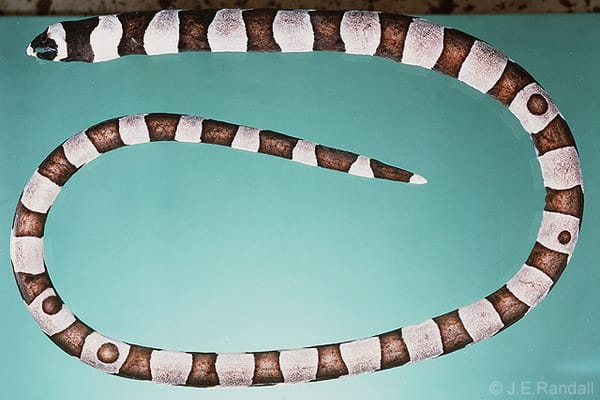
Banded Snake-eel (Myrichthys colubrinus) – J Randall
The Yellow-bellied Sea-snake grows to about a metre in length. Although its colour is variable, it typically has a black upperside separated by a sharp line of demarcation from a yellowish belly. The paddle-like tail is usually mottled black and yellow.
Unlike the inshore sea-snakes which live around the reefs, the Yellow-bellied Sea-snake lives its entire life in the surface waters of the open ocean. They even give birth to free-swimming young as they float along, grabbing small fish here and there.
Despite their preference for the open ocean, Yellow-bellied Sea-snakes are sometimes stranded on islands. For example, in July 1981 Sharon Mackey found one stranded on a beach in Aitutaki, which she killed by freezing. And since then, three more have been found stranded but alive on beaches in Aitutaki – 1985, 1990 and 1992. There have been no recorded strandings on any other island in the Cook Islands during the same time period.
Sea-snakes are very poisonous, each having enough venom to kill three people. Fortunately, Yellow-bellied Sea-snakes are non-aggressive, and if provoked they can only bite small objects, such as your finger; and even then, they withhold most of their poison. Nevertheless, if you are unlucky enough to notice two small painless puncture wounds get medical help immediately.
First published CINEWS(1993), modified/updated (25 February 2026)
Illustration: Judith Kunzlé
Image Credits: A&R Martin, J Randall


