



Gerald McCormack, CINHT
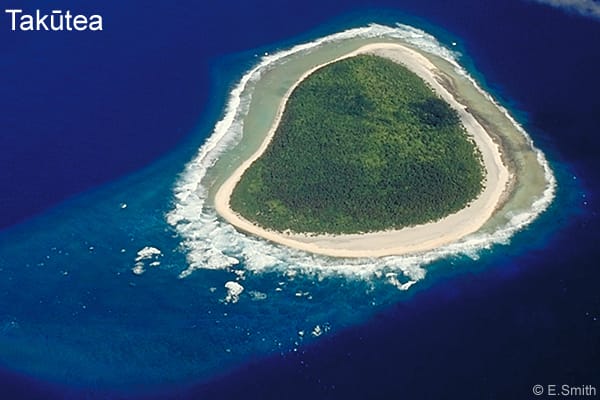
Takutea Island – Geo Photoz
Takūtea is a small, low, unpeopled island 22km northwest of Ātiu. It has a land area above median high water of about 120 hectares (90 hectares of vegetation and 30 hectares of beach) with a maximum elevation of about 6 metres. It is owned by the people of Ātiu who have traditionally visited to harvest wildlife and coconuts (for copra). Although not known to have been permanently settled there is the remains of a small archaeological structure on the eastern tip of the island.
When Mariri, one of the first settlers of Ātiu, visited the small neighbouring island he caught a Kū Tea, literally “squirrelfish, white”. To honour this rare event, because squirrelfish are typically red, he named the island Taku Kū Tea, “My White Squirrelfish”. The name later condensed to Takūtea.
Geology
Geologically the island is a limestone cap on the remains of an extinct volcano. Drilling information from other islands enables us to infer a few things about the upper structure of Takūtea. During the peak of the last Ice Age, 20,000 years ago, the island was a rugged limestone plateau 120 metres above sea level. After the peak, the sea level rose and surpassing the plateau about 9,000 years ago enabling the corals to develop an encircling slab of reefal limestone about 10 metres thick. At the same time storms deposited sand and rubble in the centre to maintain a slightly elevated area, much as it is today. Geologically this type of island is called a sand-cay (pronounced “sand-key”) – a deposit of sand and rubble. In the recent past, under the surface of a growing beach, sand and rubble was cemented together to form successive slabs of gently sloping beachrock. These sloping slabs of beachrock, locally called papa, have been exposed by the retreating beaches and are particularly prominent on the northern side of the island.
The limestone platform and the overlying sand and rubble are permeable to water. Because rainwater is less dense than seawater it displaces the subterranean seawater to form a shallow lens of freshwater. This freshwater lens, which bulges slightly above sea level, was traditionally accessed through a well known as Vaipiro, literally “old water”.
To the southeast there is a submarine reef 6-20 metres below the surface and extending 3km from the island. When this is taken into consideration the island is boomerang shaped and it has been suggested that it is the remains of a former atoll.
Survey History
Because of its significance as an uninhabited wildlife reserve for seabird colonies Takutea has been visited regularly over the years with the purpose to survey bird populations, coconut crab numbers and vegetation distribution. The first focused visit with this intention by Natural Heritage Trust was in May/June 1989 and again in September 1990. Takutea was also visited in 2001 by a team from Hambolt University (Carter et al), in May 2014 by Eco Oceania for Te Ipukarea society and on behalf of the trust and again in August/September 2019 by Joseph Brider from Natural Heritage Trust and his team.
Vegetation
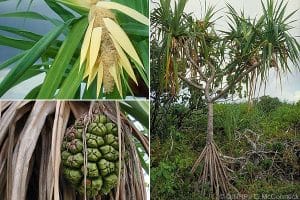
Pandanas – Plant, Fruit and Flower – Gerald McCormack
In 1905 about 80 hectares (60% of the island) was cleared and planted in Coconut Palm (Nū, Cocos nucifera) for a copra industry and the island was periodically visited by working parties over the next 70 years. Since then the plantation has not been maintained and the area has reverted to native forest and scrublands. The rest of the island is pristine coastal forest and scrublands. The main native forest, covering about half the island, consists mainly of Pisonia (Pukatea, Pisonia grandis ), Guettarda (‘Ano, Guettarda speciosa), and Coconut Palm (Nū), with a few Lantern Tree (Puka, Hernandia nymphaeifolia). The scrublands are mainly Scaevola (Nga‘u, Scaevola paulayi) with scattered Tree Heliotrope (Tau‘unu, Heliotropium arboreum) and Pandanus (‘Ara-tai, Pandanus tectorius complex ), and areas of Timonius (Kōpara, Timonius uniflorus) and Polynesian Chaff-flower (Kōpū Varu, Achyranthes aspera). Seaward of the dwellings there is a forest of Polynesian Mahogany (Tamanu, Calophyllum inophyllum).
The rarest Cook Islands plant on Takūtea is the Romanzoff Shrub (Kadua romanzoffiensis), which grows in a small area on the northern part of the island. This rare plant is otherwise known in the Cook Islands from a few plants on Palmerston and Pukapuka, where it is known as Polouyi. It has a native distribution on a few islands from Tuvalu and Tokelau to the Line Islands and Oeno (Pitcairn Group).
A Protected Area
Takūtea was the first Protected Area in the Cook Islands. In 1902 the Land Court awarded the island to Ngamaru Rongoiti Ariki, who then gave it to His Majesty King Edward. In March 1903 the King accepted the island for the general benefit of the people of the Cook Islands, and from that time it has been known as a Wildlife Sanctuary. In 1938 the island was freed of all trusts and reservations, which enabled the title to be investigated according to Native customs and usages. As a result, in 1950 the Land Court gave a Freehold Order vesting the land in the three Ariki and four Mata’iapo of Ātiu: “As trustees for all the Native Land Owners of Atiu and their descendents. Trustees have no power to lease save with the consent of the owners.”

Juvenile and adult coconut crab – Gerald McCormack
Since 1903, as previously, the island was periodically visited by groups from Ātiu to harvest copra and traditional foods, such as fish, seabirds, and Coconut Crab (Unga Kaveu, Birgus latro). The infrequency of such visits was an important check on the level of harvesting. Since the mid-1980s the increased availability of ships and larger boats has increased the frequency of visits and raised the level of wildlife harvesting. In 1985 the Society Explorer, an expedition-tourism ship, visited Ātiu and Takūtea and several thousand dollars were earnt. In April 1986 eighty Ātiu men started to clear land to survey for the construction of an airport to enable tourists to fly to Takūtea to enjoy its wildlife. However, after the initial enthusiasm the project was abandoned when it was realised that the airport and planes would disturb some of the seabird colonies. Around this time, recognising the unique abundance of wildlife and the island’s ecotourism potential, the Trustees banned the harvesting of seabirds and banned the pulling of tail-feathers from Red-tailed Tropicbirds.
In 1989 and again in 1990 the students of Ātiu College worked with the author to develop methods to survey some of the seabird colonies on Takūtea – results are reported below.
The role of the Trust in managing the wildlife resources of the island are contentious. For example, in 1993 the Trustees declined approval for a local shipper to take a group of Ātiu people to Takūtea to harvest wildlife. The legal opinion of a large Rarotonga law firm was that the Trustees held the island in Trust for the use of the beneficiaries (the landowners of Ātiu and their descendents), and by denying them access they were depriving the beneficiaries the benefits of their own property. Subsequently there were several harvesting trips to Takūtea from Ātiu, and in 2004 the Trust approved a boat-based ecotourism venture, envisioning regular overnight visits, without any special provisions or infrastructure to protect any of the wildlife from interference.
Wildlife
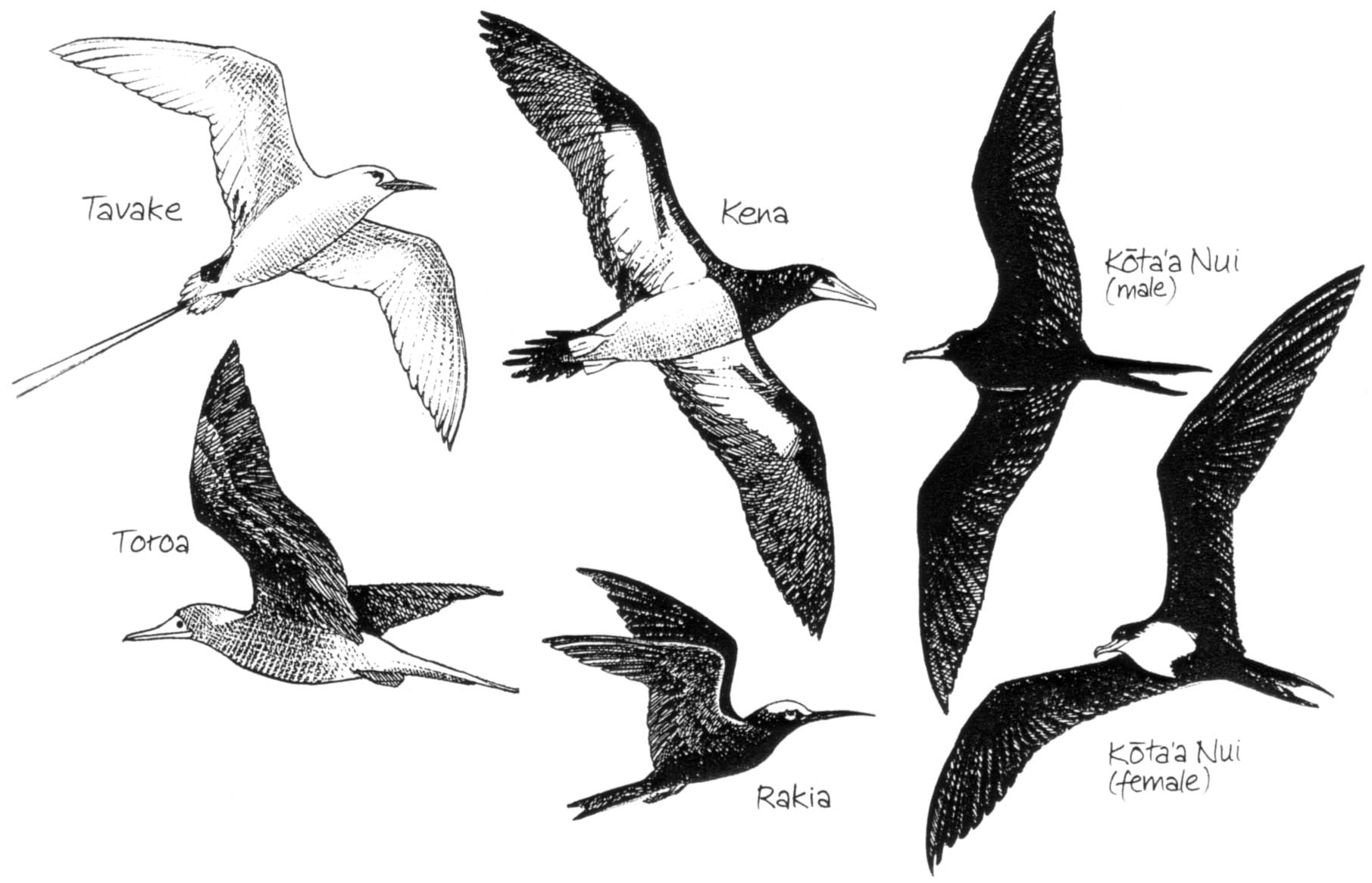
Illustration of birds found on Takutea – Judith Kūnzle
As an unpeopled island, rarely visited in the past, the island of Takūtea has a great abundance of wildlife, both marine and terrestrial. The most sought after wildlife have been reeffish, Double-spine Spiny-Lobster (Koura, Panulirus penicillatus), Maxima Giant-clam (Paua, Tridacna maxima), Red-tailed Tropicbird tail-feathers, Red-tailed Tropicbird young (kaparere), and Coconut Crab (Unga Kaveu).
Takūtea has the largest Tavake (Red-tailed Tropicbird) in the Cook Islands, the other large colonies being on Suwarrow and Palmerston. They breed on the ground, mainly under coastal shrubs, and typically lay a single egg during April or May. The survey by Ātiu College students during 1989 estimated that about 2000 pairs nested during the breeding season, while a similar survey a year later showed a drop to less than 1000 nests. A further Survey of Seabirds on Takūtea in August 2001 (Carter et al. 2001) estimated 536-590 nests. The research from this survey outlined some discrepancies in measurements of the perimeter length from the 1989-90 survey to the 2001 survey; this coupled with potential difference in timing could have accounted for the lower estimated numbers; though the authors still considered an overall decline in numbers between the surveys in 1989/90 and 2001. Another Survey in May 2014 (Pierce et el) observed 1800 nests around the island perimeter.
The only colony of Great Frigatebird (Kōta’a Nui, Fregata minor) in the Southern Group is on Takūtea. The small colony of about 100 pairs nest on the top of a clump of Pukatea (Pisonia) trees. The same clump also supports the only Southern Group colony of Red-footed Booby (Toroa, Sula sula) – a colony of about 150-300 pairs (Pierce et el, 2014)
The only Southern Group colony of Brown Booby (Kena, Sula leucogaster) is found on the upper-shore on the western and northwest parts of the island. Although the colony consisted of a mere 20 nests, it was stable during 1989 and 1990. The 2001 study found 13 out of 20 nests were active breeding nests. The survey in August 2019 recorded only 6 active nests. This difference in numbers from 1989-90 survey could be attributed to the difference in timing of the surveys and the breeding season
A bird which is very common in the Northern Group but rare in the south is the White-capped Noddy or Black Noddy, (Rakia, Anous minutus). The only two colonies in the south are a small one on Motukitiu on Aitutaki and a small one on Takūtea. While the 1989 survey found the remains of 26 nests, only three were found in 1990. In subsequent surveys birds were observed flying over and around the island but no nests were observed.
First Published (2 March 2005) updated By Felicity Carr (July 2026)
References:
- Gerald McCormack, 1994, Takutea Wildlife Sanctuary, Cook Islands, South Pacific Regional Environment Programme
- Carter et al, 2002, Seabird research at Takutea, Cook Islands in August 2001, Unpublished report Humboldt State University, Department of Wildlife, Arcata, California; and California Institute of Environmental Studies, Davis, California. 16pp
- Pierce et al, 2014, Preliminary report on a suwarrow biosecurity planning workshop and a survey of Takutea, Cook Islands, May 2014, Eco Oceania Pty Ltd Report for Darwin Initiative, Te Ipukarea and Takutea trust.
- Joseph Brider, 2019, Moko’ero Reserve and Takūtea Wildlife Sanctuary Terrestrial Assessment Report Prepared for the National Environment Service, Ridge to Reef Project By Cook Islands Natural Heritage Trust,


